
Repair Chevrolet Repair Toyota Repair Honda Repair AvtoVAZ Repair Mercedes-Benz Repair BMW Repair Opel
Home  |  Contacts  |  Sitemap  |    
English Русский
Български
Беларускі
Український
Српски
Hrvatski
Română
Polski
Slovenský
Magyar
AudiManual.ru


  • AUDI 80
  • AUDI 100
  • AUDI A3
  • AUDI A4
  • AUDI A6
  • AUDI A8
  • AUDI Q
  • OTHER
  • ARTICLES
B8 (2007-2015) B7 (2004-2008) B6 (2000-2006) B6 (2000-2006, petrol) B5 (1994-2001) B5 (1994-2001, petrol)

Checking the condition of suspension and steering components (Audi A4 B7)

  • Home
  • Audi A4
  • B7 (2004-2008)
  • General information
  • Maintenance
  • Checking the condition of suspension and steering components
            0
Table of contents: Checking shock absorbers ↓ Checking other suspension and… ↓ Checking the steering play ↓
Note: Steering and suspension components should be checked regularly - wear can cause excessive and dangerous tire wear, poor ride and handling, and increased fuel consumption. For more information on steering and suspension components, see Chapter 10.


Checking shock absorbers


1. Park the car on a level surface, turn off the engine and apply the parking brake. Check the tire inflation pressure.

2. Press hard with your hand on one corner of the car and release your hand. Pay attention to the movement of the body. It should stop swinging and return to its original position after one or two oscillations.

3. If the car continues to rock or does not return to its original position, then a possible cause is a worn shock absorber.

4. Repeat the above procedure for each of the three remaining corners of the car.

5. Jack up the car and place it on supports.

6. Inspect the shock absorbers for signs of fluid leakage. A light film of fluid is not a cause for concern. If a leak is detected, make sure that the fluid is coming from the shock absorber and not from somewhere else.

7. Check the correct installation, secure fastening and integrity of the shock absorbers. Check the upper supports of the front suspension struts for damage and signs of wear. If any are found, replace the struts.

8. If you need to replace the shock absorbers, please refer to the instructions Chapter 10. Always replace both components on the same axle. If possible, try to replace all four components as a set.


Checking other suspension and steering components


9. Inspect the steering system components for damage and deformation. Pay attention to the condition of the dust boots. Make sure the power steering fluid lines are tight, especially at their connections.

10. Clean the steering knuckle from dirt in the area of the suspension ball joint. Ask an assistant to grab the lower edge of the wheel and rock it while you watch the movement of the ball joint connecting the steering knuckle to the suspension arm. Inspect the dust boots of the suspension ball joints for tears (see illustrations). If play or torn boots are detected, the ball joint and its boot should be replaced.
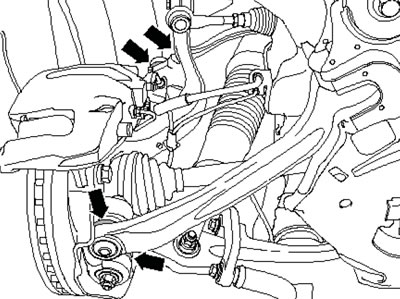
10.10a. Suspension ball joint dust boots
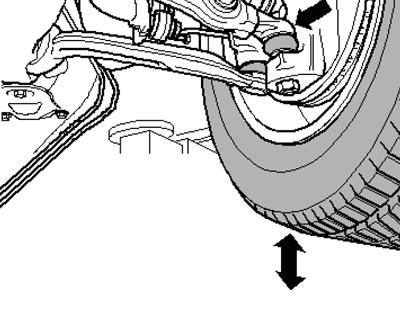
10.10a. Suspension ball joint dust boots


10.10b. Front suspension strut joint dust boots

10.10b. Front suspension strut joint dust boots


11. Grasp each front wheel at the front and rear edges and try to turn it with the front edge inward and the rear edge outward to check for play in the steering gear. If play is found, check for loose steering gear and tie rod end joints. Tighten any loose joints. Loose tie rods may be caused by worn joints (first check the reliability of tightening the nuts). Check the condition of the steering gear boots and ball joints of the tie rod ends (see illustration). If the end cap boots are torn, replace them together with the end caps. Make sure that the lock nut (1) is tightened to 40 Nm. For more information on steering and suspension, see Chapter 10.
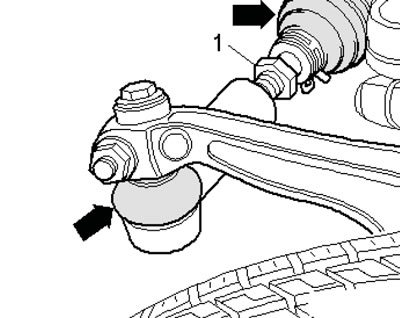
10.11. Steering tie rod joint dust boots

10.11. Steering tie rod joint dust boots


Checking the steering play


12. Set the steering wheel to the straight-ahead position.

13. Turn the steering wheel from side to side, watching the front wheels. The steering wheel with the engine running may have a play of no more than 2.5 mm (by the outer radius of the steering wheel). There should be no play in the steering column when attempting to move the steering wheel up/down or left/right.

14. If there is more play in the steering wheel, check the steering rods and steering gear.

(The original version is on the portal «audimanual.ru»)
The article was checked by auto expert Timur Bazhenov
This article is available at russian, bulgarian, belarusian, ukrainian, serbian, croatian, romanian, polish, slovak, hungarian

Share information:
Previous articles
Audi A4 B7: Maintenance
Next articles

Replacing brake fluid and bleeding the brake system
Checking the brake system
Checking the condition and adjusting the components for cleaning…
Changing engine oil and oil filter
Checking the condition of the CV joint boots of the drive shafts
Checking the condition of the tires and their inflation pressure
Checking the condition of the exhaust system
Replacing spark plugs


Similar articles on other Audi car models:
Checking the technical condition of the oil pump Audi 80 B2 (1979-1986)
Checking the suspension and condition of the exhaust system Audi 100 C4 (1990-1994, petrol)
Checking the condition of suspension and steering components Audi A3 Type 8L (1996-2003)
Checking steering components, suspension and axle shafts Audi A6 C4 (1994-1997)
Checking the front suspension and steering Audi A8 D2 (1994-2002)
Checking the condition of suspension and steering components Audi Q7 Typ 4L (2005-2015, diesel)
Poly V-belt — checking condition (petrol engines) Audi A2 (1999-2005)
Link to this page in different formats


Visitor comments

No comments yet


How much will 22 + 40 =


A4(B8, 2007-2015) 
  • General information
  • Operating instructions
  • Power unit
  • Petrol engines 1.8 l
  • Petrol engines 1.8/2.0 l
  • Petrol engines 3.0 l
  • Petrol engines 3.2 l
  • Fuel system (petrol)
  • Diesel engines 2.0 l (CA*)
  • Diesel engines 2.0 l (CJCB)
  • Diesel engines 2.7/3.0 l
  • Diesel engines 3.0 l
  • Fuel system (diesel)
  • Transmission
  • Manual gearbox 0B1
  • Manual gearbox 0B2
  • Manual gearbox 0B3
  • Manual gearbox 0B4
  • Automatic transmission 0B5
  • Automatic transmission 0B6
  • Automatic transmission 0AW
  • All-wheel drive system
  • Chassis
  • Front suspension
  • Rear suspension
  • Brake system
  • Steering system
  • Body
  • Exterior
  • Interior
  • Seats
  • Doors, locks and windows
  • Security system
  • Heating and air conditioning
  • Electrical equipment
  • Audio system
  • Power devices
  • Equipment and devices
  • Lighting and lamps
  • Electrical circuits
 
A4(B7, 2004-2008) 
  • General information
  • Introduction to manual
  • Troubleshooting
  • Operating instructions
  • Maintenance
  • Power unit
  • Petrol engines 2.0 (ALT)
  • Petrol engines 2.0 (TFSI)
  • Petrol engines 1.8 (MPI)
  • Diesel engines
  • Cooling system
  • Air conditioner
  • Fuel and exhaust system
  • Ignition system
  • Starting and charging
  • Transmission
  • Clutch
  • Manual gearbox
  • Automatic gearbox
  • Drive shafts
  • Chassis
  • Brake system
  • Front suspension
  • Rear suspension
  • Steering
  • Body
  • Exterior
  • Interior
  • Electrical equipment
  • Equipment and devices
  • Lighting and signaling
  • Windscreen wipers and washers
  • Electrical diagrams
  • Electrical diagrams (since 2007)
 
A4(B6, 2000-2006) 
  • General information
  • Vehicle Description
  • User manual
  • Maintenance
  • Power unit
  • Gasoline engine
  • Diesel engine
  • Lubrication system
  • Cooling system
  • Supply system
  • Injection system
  • Exhaust system
  • Ignition and control
  • Transmission
  • Gear box
  • Clutch and drive shafts
  • Chassis
  • Brake system
  • Car suspension
  • Steering
  • Body
  • Heating and ventilation
  • Exterior (external elements)
  • Interior (internal elements)
  • Electrical equipment
  • Power devices
  • Lighting and appliances
  • Electrical circuits
 
A4(B6, 2000-2006, petrol) 
  • General information
  • Introduction to the guide
  • Car care
  • Power unit
  • Engine repair
  • Lubrication system
  • Cooling system
  • Injection and control system
  • Ignition system
  • Power and exhaust system
  • Transmission
  • Clutch and drive shafts
  • Car gearbox
  • Chassis
  • Suspension and wheels
  • Steering
  • Brake system
  • Body
  • Interior
  • Exterior
  • Electrical equipment
  • Equipment and devices
  • Lighting and signaling
  • Power devices
  • Electrical circuits
 
A4(B5, 1994-2001) 
  • General information
  • Introduction to the guide
  • Car care
  • Maintenance (gasoline)
  • Maintenance (diesel)
  • Power unit
  • Gasoline engines
  • Diesel engines
  • Engine overhaul
  • Cooling system
  • Fuel injection (gasoline)
  • Fuel system (diesel)
  • Exhaust system
  • Ignition system
  • Transmission
  • Clutch
  • Mechanical gearbox
  • Automatic gearbox
  • Drive shafts
  • Chassis
  • Brake system
  • Car suspension
  • Steering
  • Body
  • Exterior
  • Interior
  • Doors, locks and windows
  • Heating and ventilation
  • Electrical equipment
  • Power devices
  • Equipment and devices
  • Electrical circuits
 
A4(B5, 1994-2001, petrol) 
  • General information
  • Vehicle description
  • Maintenance
  • Power unit
  • Engine repair
  • Turbocharging
  • Exhaust system
  • Cooling system
  • Ignition system
  • Fuel system
  • Motronic injection system
  • MPI and MPFI injection system
  • Transmission
  • Clutch
  • Gearbox and shafts
  • Chassis
  • Steering
  • Car suspension
  • Brake system
  • Wheels and tires
  • Body
  • Heating and ventilation
  • Body parts
  • Electrical equipment
  • Fuses and relays
  • Power devices
  • Lighting and lamps
  • Tools and devices
  • Electrical circuits
 
AudiManual.ru © 2017-2026 · Mobile version · Feedback · Sitemap: EN BG BY UA RS HR RO PL SK HU · Site search · News and articles
80 B2 · 80 B3 petrol · 80 B3 · 80 B4 · 100 C3 diesel · 100 C3 petrol · 100 C3 · 100 C4 petrol · 100 C4 · A3 Type 8L · A4 B5 petrol · A4 B5 · A4 B6 petrol · A4 B6 · A4 B7 · A4 B8 · A6 C4 · A6 C5 · A6 C5 Allroad · A8 D2 · Q5 Type 8R · Q7 Typ 4L · Audi A2 ·
This site uses cookies 🍪. Click the button to accept this fact.