



Table of contents: Front suspension and steering ↓ Suspension struts/shock absorbers ↓ Half shafts ↓ Instruments and electrical equipment ↓ Steering and suspension ↓ Transmission ↓ Brake system ↓
Every 12 months.
Front suspension and steering
1. Raise the front of the vehicle and support it on jack stands.
2. Inspect the dust boots and covers for cracks or signs of wear.
3. On models with a power steering system, inspect the system hoses, pipes, and connections for leaks.
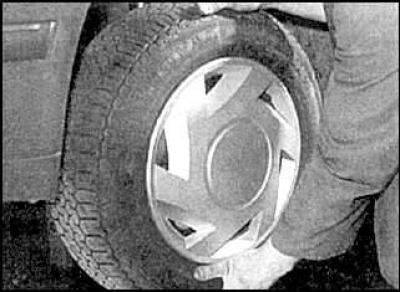
4. Grasp the wheel from above and below and try to shake it. If the free play is too great, have an assistant press the brake pedal and shake the wheel again. If the free play has decreased or disappeared, then the hub bearings need to be replaced. If the free play remains, then the suspension joints or mounts are worn out.
5. Grasp the sides of the wheel and try to shake it. Too much free play may be caused by worn hub bearings or ball joints of the steering rods.
6. Check the condition of the suspension element mounting bushings.
7. Lower the vehicle to the ground and turn the steering wheel 1/8 of a turn in either direction. If the steering wheel play is too great, check the steering joints and connections.
Suspension struts/shock absorbers
1. Inspect the shock absorbers for signs of fluid leakage. If there is a leak, the shock absorber must be replaced.
2. Check the effectiveness of the shock absorbers by rocking the car up and down.
Half shafts
1. Raise the front of the car and place it on supports. Turn the steering wheel to the side until it stops and slowly rotate the wheel. Check the condition of the CV joint boots by pushing apart the folds. Also check the condition and tightening of the clamps.
2. Check the condition of the joints themselves. To do this, hold the axle shaft and try to rotate the wheel. Then, hold the inner joint and try to rotate the axle shaft. Excessive free play indicates wear in the joints, wear of the axle shaft splines, or looseness of the axle shaft mounting nut.
3. Inspect the shock absorbers for signs of fluid leakage. If there is a leak, the shock absorber must be replaced.
Instruments and electrical equipment
1. Check the operation of all devices and electrical equipment.
2. Check the accuracy of the sensor readings. Turn on all electrical equipment elements one by one to check their operation.
Steering and suspension
Check the operation of the steering and suspension. Check that there is no vibration or noise when driving.
Transmission
Check the operation of the engine, clutch, gearbox and axle shafts. Check that they do not make unusual noise when driving.
Brake system
1. Check that the vehicle does not pull to one side when braking and that the wheels do not lock up too early.
2. Check that the steering wheel does not shake when braking.
3. Check the operation of the handbrake and brake booster. To do this, press the brake pedal several times and start the engine. The pedal should drop slightly. Let the engine run for a few minutes and turn it off. Press the brake pedal. You should hear the hiss of the vacuum booster. After several presses, it should stop, and the pedal should become significantly harder.