
Repair Chevrolet Repair Toyota Repair Honda Repair AvtoVAZ Repair Mercedes-Benz Repair BMW Repair Opel
Home  |  Contacts  |  Sitemap  |    
English Русский
Български
Беларускі
Український
Српски
Hrvatski
Română
Polski
Slovenský
Magyar
AudiManual.ru


  • AUDI 80
  • AUDI 100
  • AUDI A3
  • AUDI A4
  • AUDI A6
  • AUDI A8
  • AUDI Q
  • OTHER
  • ARTICLES
B8 (2007-2015) B7 (2004-2008) B6 (2000-2006) B6 (2000-2006, petrol) B5 (1994-2001) B5 (1994-2001, petrol)

Replacing brake fluid and bleeding the brake system (Audi A4 B7)

  • Home
  • Audi A4
  • B7 (2004-2008)
  • General information
  • Maintenance
  • Replacing brake fluid and bleeding the brake system
            0
Table of contents: General information ↓ Replacing brake fluid and bleeding… ↓

General information


Warning: Contact with brake fluid is hazardous to health. Do not suck it out with your mouth through a hose. Store brake fluid only in a container that is out of the reach of children.


1. Brake fluid has the property of absorbing moisture, as a result of which its boiling point decreases over time, which, under significant load on the brakes, can lead to the formation of steam bubbles in the brake lines and reduce the effectiveness of the brakes.

2. To replace the brake fluid, you will need the help of an assistant, but this procedure can be carried out without outside help using a special device - see the instructions supplied with such a device (the pressure created by the device must not exceed 2 bar). When bleeding the brake system, the vehicle must be in a horizontal position to properly monitor the brake fluid level in the reservoir.

Replacing brake fluid and bleeding the brake system and clutch


3. Turn off the ignition.

4. Mark the current brake fluid level on the tank wall with a felt-tip pen to prevent it from being exceeded when replacing the brake pads. Unscrew the plug (arrow on the illustration) brake fluid reservoir and pump out approximately 100 ml of brake fluid from the reservoir, leaving approximately 1 cm of liquid.
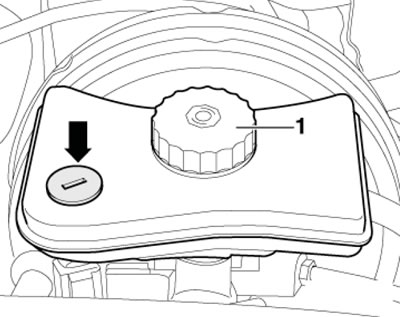
9.4. Brake fluid reservoir plug and cap

9.4. Brake fluid reservoir plug and cap


Note: Do not remove all the fluid from the reservoir, otherwise air will enter the hydraulic drive of the brake system.


5. Remove the brake fluid reservoir cap. If a bleeding device is used, connect it to the reservoir instead of the cap. Otherwise, fill the reservoir with fresh brake fluid to the "MAX" mark and maintain this level while performing the following procedures.

6. On models with manual transmission, remove the cap from the clutch hydraulic bleed nipple on the clutch slave cylinder (see illustration), connect a hose to the nipple and drain approximately 100 ml of brake fluid from the clutch hydraulic system. Tighten the nipple, close it with a cap and press the clutch pedal several times.
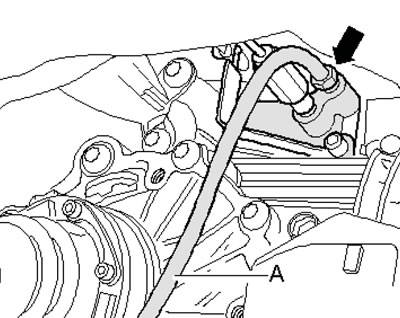
9.6. Hose on the clutch hydraulic drive bleed nipple

9.6. Hose on the clutch hydraulic drive bleed nipple


7. Thoroughly clean and remove the protective caps of the bleed nipples on all brake mechanisms (see Chapter 9). Attach one end of a clean, transparent hose to the brake bleeder nipple on the front left wheel (the nipple is located on the brake wheel cylinder), and insert the other end into a container for collecting brake fluid. Pour some brake fluid into the container and constantly ensure that the end of the hose is immersed in it. Also, the container should be raised at least 30 cm above the bleed nipple to ensure pressure and prevent air from entering it.


8. When using a bleeding device, when you unscrew the bleeding nipple, the brake fluid comes out by itself. Bleed approximately 200 ml of brake fluid, tighten the nipple and go to paragraph 11

9. Ask an assistant to press the brake pedal sharply 3-5 times at intervals of 2:3 sec and release the nipple half a turn with the pedal depressed. After the brake pedal hits the floor, tighten the nipple. Remove your foot from the pedal. Repeat this process to pump out the old brake fluid (until a new one appears, which can be recognized by its light color).

Note: If the liquid layer at the bottom of the tank is less than 10 mm, the system will have to be bled.


10. Tighten the bleed screw, close its protective cap and add new brake fluid to the reservoir.

11. In the same way, pump out the old brake fluid sequentially from the remaining calipers in the following order: front right, rear left, rear right.

Caution: The drained brake fluid must in any case be clean and free of air bubbles.


12. Adjust the brake fluid level according to the previously applied mark.

13. Press the brake pedal and check its free travel. Make sure that the brake pedal does not "sink" when you press it - the free travel of the pedal should be no more than 1/3 of its full travel.

14. Check the brakes on a road with light traffic. To do this, you should perform at least one strong braking, checking the ABS at the same time. A sign of proper ABS operation is pulsation of the brake pedal when braking.

Note: The effect of ABS is best demonstrated on unpaved roads.
The article was checked by auto expert Timur Bazhenov
This article is available at russian, bulgarian, belarusian, ukrainian, serbian, croatian, romanian, polish, slovak, hungarian

Share information:
Previous articles
Audi A4 B7: Maintenance
Next articles

Checking the brake system
Checking the condition and adjusting the components for cleaning…
Changing engine oil and oil filter
Checking the condition and replacing hoses and tubes in the…
Checking the condition of suspension and steering components
Checking the condition of the CV joint boots of the drive shafts
Checking the condition of the tires and their inflation pressure
Checking the condition of the exhaust system


Similar articles on other Audi car models:
Bleeding the brake hydraulic system Audi 80 B2 (1979-1986)
Replacing brake fluid Audi 100 C4 (1990-1994, petrol)
Replacing brake fluid Audi A3 Type 8L (1996-2003)
Replacing brake fluid Audi A6 C4 (1994-1997)
Checking the brake fluid level Audi A8 D2 (1994-2002)
Replacing brake fluid, bleeding the brake system Audi Q7 Typ 4L (2005-2015, diesel)
Cooling system — checking and refilling fluid Audi A2 (1999-2005)
Link to this page in different formats


Visitor comments

No comments yet


How much will 45 + 24 =


A4(B8, 2007-2015) 
  • General information
  • Operating instructions
  • Power unit
  • Petrol engines 1.8 l
  • Petrol engines 1.8/2.0 l
  • Petrol engines 3.0 l
  • Petrol engines 3.2 l
  • Fuel system (petrol)
  • Diesel engines 2.0 l (CA*)
  • Diesel engines 2.0 l (CJCB)
  • Diesel engines 2.7/3.0 l
  • Diesel engines 3.0 l
  • Fuel system (diesel)
  • Transmission
  • Manual gearbox 0B1
  • Manual gearbox 0B2
  • Manual gearbox 0B3
  • Manual gearbox 0B4
  • Automatic transmission 0B5
  • Automatic transmission 0B6
  • Automatic transmission 0AW
  • All-wheel drive system
  • Chassis
  • Front suspension
  • Rear suspension
  • Brake system
  • Steering system
  • Body
  • Exterior
  • Interior
  • Seats
  • Doors, locks and windows
  • Security system
  • Heating and air conditioning
  • Electrical equipment
  • Audio system
  • Power devices
  • Equipment and devices
  • Lighting and lamps
  • Electrical circuits
 
A4(B7, 2004-2008) 
  • General information
  • Introduction to manual
  • Troubleshooting
  • Operating instructions
  • Maintenance
  • Power unit
  • Petrol engines 2.0 (ALT)
  • Petrol engines 2.0 (TFSI)
  • Petrol engines 1.8 (MPI)
  • Diesel engines
  • Cooling system
  • Air conditioner
  • Fuel and exhaust system
  • Ignition system
  • Starting and charging
  • Transmission
  • Clutch
  • Manual gearbox
  • Automatic gearbox
  • Drive shafts
  • Chassis
  • Brake system
  • Front suspension
  • Rear suspension
  • Steering
  • Body
  • Exterior
  • Interior
  • Electrical equipment
  • Equipment and devices
  • Lighting and signaling
  • Windscreen wipers and washers
  • Electrical diagrams
  • Electrical diagrams (since 2007)
 
A4(B6, 2000-2006) 
  • General information
  • Vehicle Description
  • User manual
  • Maintenance
  • Power unit
  • Gasoline engine
  • Diesel engine
  • Lubrication system
  • Cooling system
  • Supply system
  • Injection system
  • Exhaust system
  • Ignition and control
  • Transmission
  • Gear box
  • Clutch and drive shafts
  • Chassis
  • Brake system
  • Car suspension
  • Steering
  • Body
  • Heating and ventilation
  • Exterior (external elements)
  • Interior (internal elements)
  • Electrical equipment
  • Power devices
  • Lighting and appliances
  • Electrical circuits
 
A4(B6, 2000-2006, petrol) 
  • General information
  • Introduction to the guide
  • Car care
  • Power unit
  • Engine repair
  • Lubrication system
  • Cooling system
  • Injection and control system
  • Ignition system
  • Power and exhaust system
  • Transmission
  • Clutch and drive shafts
  • Car gearbox
  • Chassis
  • Suspension and wheels
  • Steering
  • Brake system
  • Body
  • Interior
  • Exterior
  • Electrical equipment
  • Equipment and devices
  • Lighting and signaling
  • Power devices
  • Electrical circuits
 
A4(B5, 1994-2001) 
  • General information
  • Introduction to the guide
  • Car care
  • Maintenance (gasoline)
  • Maintenance (diesel)
  • Power unit
  • Gasoline engines
  • Diesel engines
  • Engine overhaul
  • Cooling system
  • Fuel injection (gasoline)
  • Fuel system (diesel)
  • Exhaust system
  • Ignition system
  • Transmission
  • Clutch
  • Mechanical gearbox
  • Automatic gearbox
  • Drive shafts
  • Chassis
  • Brake system
  • Car suspension
  • Steering
  • Body
  • Exterior
  • Interior
  • Doors, locks and windows
  • Heating and ventilation
  • Electrical equipment
  • Power devices
  • Equipment and devices
  • Electrical circuits
 
A4(B5, 1994-2001, petrol) 
  • General information
  • Vehicle description
  • Maintenance
  • Power unit
  • Engine repair
  • Turbocharging
  • Exhaust system
  • Cooling system
  • Ignition system
  • Fuel system
  • Motronic injection system
  • MPI and MPFI injection system
  • Transmission
  • Clutch
  • Gearbox and shafts
  • Chassis
  • Steering
  • Car suspension
  • Brake system
  • Wheels and tires
  • Body
  • Heating and ventilation
  • Body parts
  • Electrical equipment
  • Fuses and relays
  • Power devices
  • Lighting and lamps
  • Tools and devices
  • Electrical circuits
 
AudiManual.ru © 2017-2026 · Mobile version · Feedback · Sitemap: EN BG BY UA RS HR RO PL SK HU · Site search · News and articles
80 B2 · 80 B3 petrol · 80 B3 · 80 B4 · 100 C3 diesel · 100 C3 petrol · 100 C3 · 100 C4 petrol · 100 C4 · A3 Type 8L · A4 B5 petrol · A4 B5 · A4 B6 petrol · A4 B6 · A4 B7 · A4 B8 · A6 C4 · A6 C5 · A6 C5 Allroad · A8 D2 · Q5 Type 8R · Q7 Typ 4L · Audi A2 ·
This site uses cookies 🍪. Click the button to accept this fact.