
Repair Chevrolet Repair Toyota Repair Honda Repair AvtoVAZ Repair Mercedes-Benz Repair BMW Repair Opel
Home  |  Contacts  |  Sitemap  |    
English Русский
Български
Беларускі
Український
Српски
Hrvatski
Română
Polski
Slovenský
Magyar
AudiManual.ru


  • AUDI 80
  • AUDI 100
  • AUDI A3
  • AUDI A4
  • AUDI A6
  • AUDI A8
  • AUDI Q
  • OTHER
  • ARTICLES
B8 (2007-2015) B7 (2004-2008) B6 (2000-2006) B6 (2000-2006, petrol) B5 (1994-2001) B5 (1994-2001, petrol)

Checking the engine with a vacuum gauge (Audi A4 B6)

  • Home
  • Audi A4
  • B6 (2000-2006)
  • Power unit
  • Gasoline engine
  • Checking the engine with a vacuum gauge
            0
Using a vacuum gauge, you can get information about the condition of the engine and determine if the cylinder head gasket is blown, the fuel system is damaged, the rings are damaged, the fuel system is incorrectly adjusted, the valves are damaged, etc. Unfortunately, the readings of the vacuum gauge can be misinterpreted, so these measurements must be used in combination with other methods of checking the engine. For a correct determination, both the absolute value of the vacuum gauge readings and the rate of their change are important.

Basic positions and fluctuations of the vacuum gauge needle when diagnosing engine faults
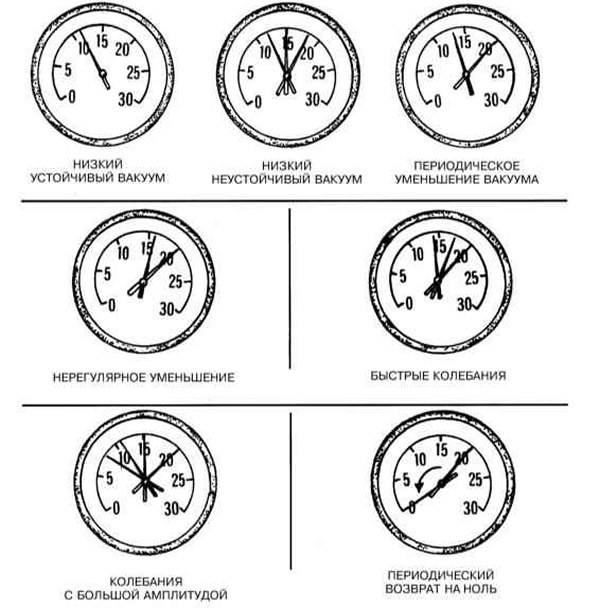


Basic positions and fluctuations of the vacuum gauge needle when diagnosing engine faults


Connect a vacuum gauge to the intake manifold. Start and warm up the engine to normal operating temperature.

Read the vacuum gauge. If the engine is in normal condition, the vacuum gauge readings should be 430-560 mm Hg, and the vacuum gauge needle should be in place.

Low constant readings vacuum gauge indicate that the gasket between the intake manifold and the throttle body is damaged, the vacuum hose is damaged, the ignition timing is incorrectly set, or the valve timing is incorrectly set.


If the vacuum gauge readings below normal by 80 – 200 mm Hg and fluctuate, then the intake manifold gasket near the inlet may be damaged or the injector may be faulty.

If the readings constantly fall by 50 - 100 mm Hg relative to the stable value, then the valves may be damaged. In this case, it is necessary to measure the compression in the engine cylinders.

If the readings are falling, but not regularly, then perhaps the valve is jammed or there is an ignition failure.

If the readings fluctuate rapidly with an amplitude of about 100 mm Hg., at constant idle speed, and smoke coming from the exhaust pipe, the valve guides may be damaged. If the readings fluctuate rapidly as idle speed increases, then the intake manifold gasket or cylinder head gasket may be damaged, the valve springs may be weak, the valves may be burnt, or there may be an ignition failure.

Small fluctuations of about 25 mm Hg. are usually associated with failures in the ignition system.

If the readings fluctuate greatly, the cylinder head gasket or cylinder may be damaged.

If the arrow moves slowly within a wide range of values, then the crankcase ventilation system may be clogged, the intake manifold gasket or the gasket between the throttle body and the manifold may be damaged.

Check how quickly the vacuum gauge readings recover after the throttle valve is opened sharply and fully and returned to its original position. If the engine is in normal condition, the readings will drop to almost zero, then increase by about 130 mm Hg above normal and again decrease to the previous values at constant idle speed. If the readings recover slowly and pass through the maximum after closing the throttle valve, then the piston rings may be damaged. If there is a long delay, then the exhaust system may be clogged.
The article was checked by auto expert Elisey Ermolaev
This article is available at russian, bulgarian, belarusian, ukrainian, serbian, croatian, romanian, polish, slovak, hungarian

Share information:
Previous articles
Audi A4 B6: Gasoline engine
Next articles

Checking the compression in the engine cylinders, detecting leaks
Removal and installation the upper engine cover / lower engine…
Engine specifications
General information about the 4-cylinder engine
Removal and installation the timing belt (4-cylinder)
Removal and installation the cylinder head (4-cylinder)
Removal and installation the accessory drive belt (4-cylinder)


Similar articles on other Audi car models:
Engine Oil — Checking Level Audi 80 B4 (1991-1996)
Idle speed and maximum engine speed — checking and adjustment Audi 100 C3 (1982-1990, diesel)
Checking the engine with a vacuum gauge Audi A3 Type 8L (1996-2003)
Checking the crankcase pressure on a 2.5-I-TDI engine Audi A6 C5 (1997-2004)
Starting the engine Audi A8 D2 (1994-2002)
Checking fuel consumption in the return lines of the injectors… Audi Q5 Type 8R (2008-2017)
Engine — Checking Oil Level Audi A2 (1999-2005)
Link to this page in different formats


Visitor comments

No comments yet


How much will 25 + 26 =


A4(B8, 2007-2015) 
  • General information
  • Operating instructions
  • Power unit
  • Petrol engines 1.8 l
  • Petrol engines 1.8/2.0 l
  • Petrol engines 3.0 l
  • Petrol engines 3.2 l
  • Fuel system (petrol)
  • Diesel engines 2.0 l (CA*)
  • Diesel engines 2.0 l (CJCB)
  • Diesel engines 2.7/3.0 l
  • Diesel engines 3.0 l
  • Fuel system (diesel)
  • Transmission
  • Manual gearbox 0B1
  • Manual gearbox 0B2
  • Manual gearbox 0B3
  • Manual gearbox 0B4
  • Automatic transmission 0B5
  • Automatic transmission 0B6
  • Automatic transmission 0AW
  • All-wheel drive system
  • Chassis
  • Front suspension
  • Rear suspension
  • Brake system
  • Steering system
  • Body
  • Exterior
  • Interior
  • Seats
  • Doors, locks and windows
  • Security system
  • Heating and air conditioning
  • Electrical equipment
  • Audio system
  • Power devices
  • Equipment and devices
  • Lighting and lamps
  • Electrical circuits
 
A4(B7, 2004-2008) 
  • General information
  • Introduction to manual
  • Troubleshooting
  • Operating instructions
  • Maintenance
  • Power unit
  • Petrol engines 2.0 (ALT)
  • Petrol engines 2.0 (TFSI)
  • Petrol engines 1.8 (MPI)
  • Diesel engines
  • Cooling system
  • Air conditioner
  • Fuel and exhaust system
  • Ignition system
  • Starting and charging
  • Transmission
  • Clutch
  • Manual gearbox
  • Automatic gearbox
  • Drive shafts
  • Chassis
  • Brake system
  • Front suspension
  • Rear suspension
  • Steering
  • Body
  • Exterior
  • Interior
  • Electrical equipment
  • Equipment and devices
  • Lighting and signaling
  • Windscreen wipers and washers
  • Electrical diagrams
  • Electrical diagrams (since 2007)
 
A4(B6, 2000-2006) 
  • General information
  • Vehicle Description
  • User manual
  • Maintenance
  • Power unit
  • Gasoline engine
  • Diesel engine
  • Lubrication system
  • Cooling system
  • Supply system
  • Injection system
  • Exhaust system
  • Ignition and control
  • Transmission
  • Gear box
  • Clutch and drive shafts
  • Chassis
  • Brake system
  • Car suspension
  • Steering
  • Body
  • Heating and ventilation
  • Exterior (external elements)
  • Interior (internal elements)
  • Electrical equipment
  • Power devices
  • Lighting and appliances
  • Electrical circuits
 
A4(B6, 2000-2006, petrol) 
  • General information
  • Introduction to the guide
  • Car care
  • Power unit
  • Engine repair
  • Lubrication system
  • Cooling system
  • Injection and control system
  • Ignition system
  • Power and exhaust system
  • Transmission
  • Clutch and drive shafts
  • Car gearbox
  • Chassis
  • Suspension and wheels
  • Steering
  • Brake system
  • Body
  • Interior
  • Exterior
  • Electrical equipment
  • Equipment and devices
  • Lighting and signaling
  • Power devices
  • Electrical circuits
 
A4(B5, 1994-2001) 
  • General information
  • Introduction to the guide
  • Car care
  • Maintenance (gasoline)
  • Maintenance (diesel)
  • Power unit
  • Gasoline engines
  • Diesel engines
  • Engine overhaul
  • Cooling system
  • Fuel injection (gasoline)
  • Fuel system (diesel)
  • Exhaust system
  • Ignition system
  • Transmission
  • Clutch
  • Mechanical gearbox
  • Automatic gearbox
  • Drive shafts
  • Chassis
  • Brake system
  • Car suspension
  • Steering
  • Body
  • Exterior
  • Interior
  • Doors, locks and windows
  • Heating and ventilation
  • Electrical equipment
  • Power devices
  • Equipment and devices
  • Electrical circuits
 
A4(B5, 1994-2001, petrol) 
  • General information
  • Vehicle description
  • Maintenance
  • Power unit
  • Engine repair
  • Turbocharging
  • Exhaust system
  • Cooling system
  • Ignition system
  • Fuel system
  • Motronic injection system
  • MPI and MPFI injection system
  • Transmission
  • Clutch
  • Gearbox and shafts
  • Chassis
  • Steering
  • Car suspension
  • Brake system
  • Wheels and tires
  • Body
  • Heating and ventilation
  • Body parts
  • Electrical equipment
  • Fuses and relays
  • Power devices
  • Lighting and lamps
  • Tools and devices
  • Electrical circuits
 
AudiManual.ru © 2017-2026 · Mobile version · Feedback · Sitemap: EN BG BY UA RS HR RO PL SK HU · Site search · News and articles
80 B2 · 80 B3 petrol · 80 B3 · 80 B4 · 100 C3 diesel · 100 C3 petrol · 100 C3 · 100 C4 petrol · 100 C4 · A3 Type 8L · A4 B5 petrol · A4 B5 · A4 B6 petrol · A4 B6 · A4 B7 · A4 B8 · A6 C4 · A6 C5 · A6 C5 Allroad · A8 D2 · Q5 Type 8R · Q7 Typ 4L · Audi A2 ·
This site uses cookies 🍪. Click the button to accept this fact.