
Repair Chevrolet Repair Toyota Repair Honda Repair AvtoVAZ Repair Mercedes-Benz Repair BMW Repair Opel
Home  |  Contacts  |  Sitemap  |    
English Русский
Български
Беларускі
Український
Српски
Hrvatski
Română
Polski
Slovenský
Magyar
AudiManual.ru


  • AUDI 80
  • AUDI 100
  • AUDI A3
  • AUDI A4
  • AUDI A6
  • AUDI A8
  • AUDI Q
  • OTHER
  • ARTICLES
B8 (2007-2015) B7 (2004-2008) B6 (2000-2006) B6 (2000-2006, petrol) B5 (1994-2001) B5 (1994-2001, petrol)

General information about steering and safety precautions (Audi A4 B6)

  • Home
  • Audi A4
  • B6 (2000-2006)
  • Chassis
  • Steering
  • General information about steering and safety precautions
            0
Table of contents: Hydraulic steering system… ↓ Steering column ↓ Before carrying out work with… ↓ General safety precautions ↓

Hydraulic steering system components. 4-cylinder engine and 6-cylinder diesel engine
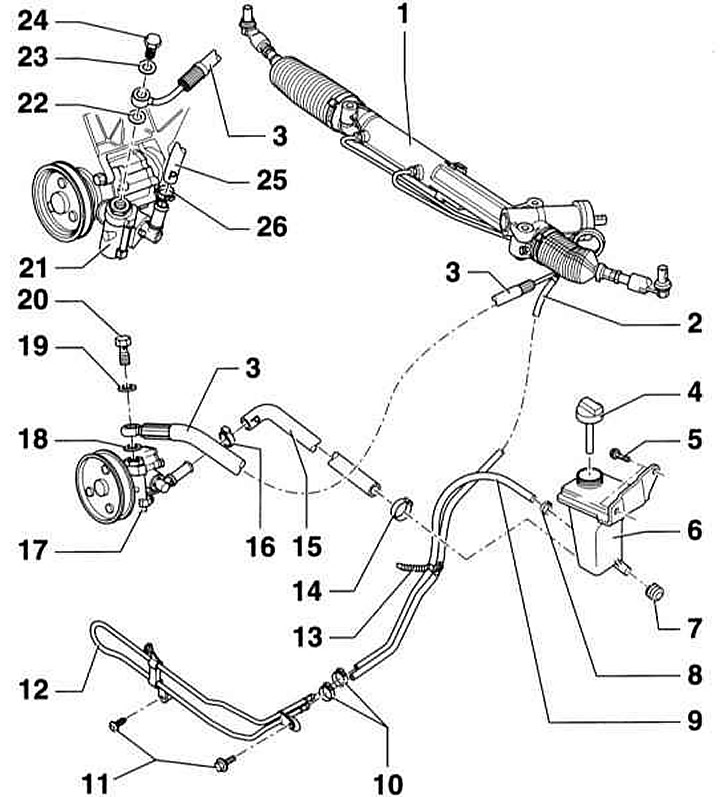


Hydraulic steering system components. 4-cylinder engine and 6-cylinder diesel engine

  • 1 - Power steering
  • 2 — High pressure hydraulic line
  • 3 - Drain hose
  • 4 - Cover with oil level indicator
  • 5 - Bolt, 5 Nm
  • 6 - Oil reservoir
  • 7 - Rubber support
  • 8 — Clamp
  • 9 — Return hose
  • 10 - Clamp, be sure to replace
  • 11 - Bolt, 10 Nm
  • 12 — Cooling pipe
  • 13 — Elastic clamp
  • 14 — Clamp*
  • 15 — Suction hose
  • 16 — Clamp*
  • 17 — Vane pump for 6-cylinder diesel engine
  • 18 — Sealing ring*
  • 19 — Sealing ring*
  • 20 - Hollow screw, 47 Nm
  • 21 — Vane pump for 4-cylinder engine
  • 22 — Sealing ring*
  • 23 — Sealing ring*
  • 24 - Hollow screw, 47 Nm
  • 25 - Suction hose
  • 26 — Clamp

*) Be sure to replace

Steering column
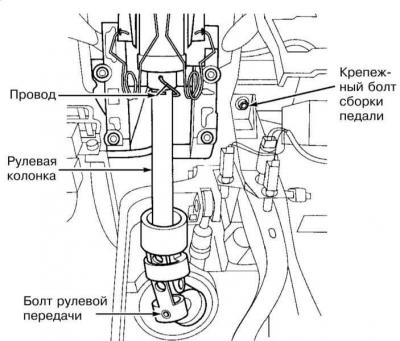


Steering column


The steering consists of a steering wheel, a steering column, a rack-and-pinion steering gear, and steering rods. The steering column transmits the steering wheel movements to the steering gear. The rack-and-pinion steering gear moves to the right or left in accordance with the steering wheel rotation. The steering rods transmit the steering forces to the front wheels via the joints and the steering knuckle.


The rack and pinion steering gear is backlash-free and maintenance-free. Maintenance only requires checking the protective boots and dust boots of the steering rod ends.

The car's steering has a hydraulic booster, which reduces the force applied to the steering wheel. The hydraulic booster contains a hydraulic pump and a reservoir of working fluid. The hydraulic pump sucks fluid from the reservoir and delivers it under high pressure to the control valve in the steering mechanism. The control valve has a mechanical connection with the steering spindle and directs the fluid, depending on the turn of the steering wheel, to the corresponding cavity of the working cylinder in the steering mechanism housing. Here the fluid acts on the piston and, thus, maintains the control process. At the same time, the piston squeezes the fluid from the opposite cavity of the working cylinder through the return pipeline into the fluid reservoir.

Welding and straightening work on steering components is not permitted. Self-locking bolts and nuts, as well as bolts and nuts that are corroded, must be replaced with new ones.

Caution: The tightening torques for threaded connections must be maintained.


The driver's airbag is located in the steering wheel. The airbag is a collapsible air bag that fills with air during a frontal collision of the vehicle, thus protecting the driver's upper body and head. In the event of a frontal collision of sufficient force, the control unit sends a signal to the airbag fuse. The explosion produces gas that inflates the airbag for a few milliseconds. This time is enough to dampen the forward movement of the driver's upper body. Then, within a few seconds, the airbag collapses again, as the gases escape from the airbag through the existing openings.


The airbag consists of a collision sensor, a fuse, an airbag control unit, and the airbag itself. The signal to inflate the airbag is generated by the control unit.

The vehicle is equipped with a driver and front passenger airbag, as well as side airbags, head airbags and seat belt tensioners. The locations of the airbags are usually marked with inscriptions "SRS Airbag".

It is not allowed to place a child seat on the front passenger seat that is oriented against the movement of the car, except for a special child seat in combination with an automatic child seat recognition device.

Caution: For safety reasons, do not carry out any work on parts belonging to the airbag and seat belt tensioner system.


Before carrying out work with security systems


1. Disconnect the negative (-) battery cable with the ignition off. The cabin air filter box must be removed first.

Caution: Before disconnecting the cable, find out the radio's security code, if any, refer to Section Replacing the battery.


2. Insulate the negative (-) battery terminal to prevent accidental contact.

3. Set the wheels straight and the steering wheel to the center position.

4. Before removing (touching) the airbag unit, remove the electrostatic charge. To do this, briefly touch the door lock or the body.

5. When connecting the battery, there should be no people in the vehicle.

General safety precautions


Never install airbag components from another vehicle or another steering wheel. When replacing, install only new parts.

Even after a minor accident that did not result in the airbag deploying, have the airbag system and belt tensioner checked at a service station.


If the airbag in the steering wheel is deployed, be sure to replace the steering wheel; if the side airbag is deployed, replace the cover in the door trim; if the front passenger airbag is deployed, replace the instrument panel.

The airbag control unit must be replaced after it has been triggered three times.

The airbag may only be checked at a service station. Under no circumstances should a test lamp, voltmeter or ohmmeter be used to check the airbag.

Airbag elements that have fallen from a height of more than 0.5 m must be replaced.

Protect airbag components from heat or fire. Do not expose airbag components to temperatures above +100°C.

Protect the airbag from contact with water, grease or oil. If water, grease or oil comes into contact with the airbag, wipe it off immediately.

After removing the airbag, store it with the soft side facing up. When storing it the other way around, there is a risk of it being ejected upwards if the gas generator is accidentally ignited. This creates a risk of injury.

If there is a break in work, the airbag must not be left unattended.

It is not allowed to disassemble the airbag unit. If there is a malfunction, it will be replaced as a whole. Since the airbag contains an explosive substance, it must be stored securely under supervision.

Before scrapping the vehicle, the airbag components must be disposed of.

When carrying out any work on a vehicle using electric welding, it is necessary to first disconnect the airbag control unit connector with the battery disconnected.
The article was checked by auto expert Elisey Ermolaev
This article is available at russian, bulgarian, belarusian, ukrainian, serbian, croatian, romanian, polish, slovak, hungarian

Share information:
Previous articles
Audi A4 B6: Steering
Next articles

Removal and installation the airbag unit
Removal and installation the steering wheel
Removal and installation the steering rod end
Removal and installation the steering gear protective cover


Similar articles on other Audi car models:
Vehicle traffic safety Audi 80 B3 (1986-1991, petrol)
Safety precautions when working with the ignition system Audi 100 C4 (1990-1994, petrol)
Generator — General Information and Safety Precautions Audi A3 Type 8L (1996-2003)
Description of electrical equipment and safety precautions Audi A6 C4 (1994-1997)
Steering column adjustment Audi A8 D2 (1994-2002)
General information and safety precautions: power supply system Audi Q7 Typ 4L (2005-2015, diesel)
Safety precautions when working with the fuel supply system Audi A2 (1999-2005)
Link to this page in different formats


Visitor comments

No comments yet


How much will 17 + 31 =


A4(B8, 2007-2015) 
  • General information
  • Operating instructions
  • Power unit
  • Petrol engines 1.8 l
  • Petrol engines 1.8/2.0 l
  • Petrol engines 3.0 l
  • Petrol engines 3.2 l
  • Fuel system (petrol)
  • Diesel engines 2.0 l (CA*)
  • Diesel engines 2.0 l (CJCB)
  • Diesel engines 2.7/3.0 l
  • Diesel engines 3.0 l
  • Fuel system (diesel)
  • Transmission
  • Manual gearbox 0B1
  • Manual gearbox 0B2
  • Manual gearbox 0B3
  • Manual gearbox 0B4
  • Automatic transmission 0B5
  • Automatic transmission 0B6
  • Automatic transmission 0AW
  • All-wheel drive system
  • Chassis
  • Front suspension
  • Rear suspension
  • Brake system
  • Steering system
  • Body
  • Exterior
  • Interior
  • Seats
  • Doors, locks and windows
  • Security system
  • Heating and air conditioning
  • Electrical equipment
  • Audio system
  • Power devices
  • Equipment and devices
  • Lighting and lamps
  • Electrical circuits
 
A4(B7, 2004-2008) 
  • General information
  • Introduction to manual
  • Troubleshooting
  • Operating instructions
  • Maintenance
  • Power unit
  • Petrol engines 2.0 (ALT)
  • Petrol engines 2.0 (TFSI)
  • Petrol engines 1.8 (MPI)
  • Diesel engines
  • Cooling system
  • Air conditioner
  • Fuel and exhaust system
  • Ignition system
  • Starting and charging
  • Transmission
  • Clutch
  • Manual gearbox
  • Automatic gearbox
  • Drive shafts
  • Chassis
  • Brake system
  • Front suspension
  • Rear suspension
  • Steering
  • Body
  • Exterior
  • Interior
  • Electrical equipment
  • Equipment and devices
  • Lighting and signaling
  • Windscreen wipers and washers
  • Electrical diagrams
  • Electrical diagrams (since 2007)
 
A4(B6, 2000-2006) 
  • General information
  • Vehicle Description
  • User manual
  • Maintenance
  • Power unit
  • Gasoline engine
  • Diesel engine
  • Lubrication system
  • Cooling system
  • Supply system
  • Injection system
  • Exhaust system
  • Ignition and control
  • Transmission
  • Gear box
  • Clutch and drive shafts
  • Chassis
  • Brake system
  • Car suspension
  • Steering
  • Body
  • Heating and ventilation
  • Exterior (external elements)
  • Interior (internal elements)
  • Electrical equipment
  • Power devices
  • Lighting and appliances
  • Electrical circuits
 
A4(B6, 2000-2006, petrol) 
  • General information
  • Introduction to the guide
  • Car care
  • Power unit
  • Engine repair
  • Lubrication system
  • Cooling system
  • Injection and control system
  • Ignition system
  • Power and exhaust system
  • Transmission
  • Clutch and drive shafts
  • Car gearbox
  • Chassis
  • Suspension and wheels
  • Steering
  • Brake system
  • Body
  • Interior
  • Exterior
  • Electrical equipment
  • Equipment and devices
  • Lighting and signaling
  • Power devices
  • Electrical circuits
 
A4(B5, 1994-2001) 
  • General information
  • Introduction to the guide
  • Car care
  • Maintenance (gasoline)
  • Maintenance (diesel)
  • Power unit
  • Gasoline engines
  • Diesel engines
  • Engine overhaul
  • Cooling system
  • Fuel injection (gasoline)
  • Fuel system (diesel)
  • Exhaust system
  • Ignition system
  • Transmission
  • Clutch
  • Mechanical gearbox
  • Automatic gearbox
  • Drive shafts
  • Chassis
  • Brake system
  • Car suspension
  • Steering
  • Body
  • Exterior
  • Interior
  • Doors, locks and windows
  • Heating and ventilation
  • Electrical equipment
  • Power devices
  • Equipment and devices
  • Electrical circuits
 
A4(B5, 1994-2001, petrol) 
  • General information
  • Vehicle description
  • Maintenance
  • Power unit
  • Engine repair
  • Turbocharging
  • Exhaust system
  • Cooling system
  • Ignition system
  • Fuel system
  • Motronic injection system
  • MPI and MPFI injection system
  • Transmission
  • Clutch
  • Gearbox and shafts
  • Chassis
  • Steering
  • Car suspension
  • Brake system
  • Wheels and tires
  • Body
  • Heating and ventilation
  • Body parts
  • Electrical equipment
  • Fuses and relays
  • Power devices
  • Lighting and lamps
  • Tools and devices
  • Electrical circuits
 
AudiManual.ru © 2017-2026 · Mobile version · Feedback · Sitemap: EN BG BY UA RS HR RO PL SK HU · Site search · News and articles
80 B2 · 80 B3 petrol · 80 B3 · 80 B4 · 100 C3 diesel · 100 C3 petrol · 100 C3 · 100 C4 petrol · 100 C4 · A3 Type 8L · A4 B5 petrol · A4 B5 · A4 B6 petrol · A4 B6 · A4 B7 · A4 B8 · A6 C4 · A6 C5 · A6 C5 Allroad · A8 D2 · Q5 Type 8R · Q7 Typ 4L · Audi A2 ·
This site uses cookies 🍪. Click the button to accept this fact.