



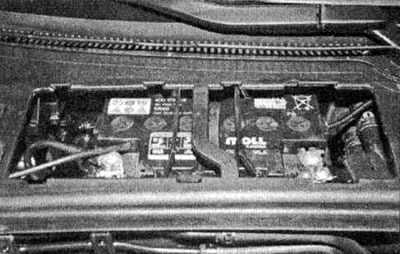
Battery in the battery compartment of the Audi A4
Between the plates is a separator. This separator separates the plates from each other, and the electrolyte passes through the microscopic pores that are in the separator. The electrolyte is an electrically conductive liquid that is approximately 37 percent concentrated sulfuric acid and 63 percent distilled water.
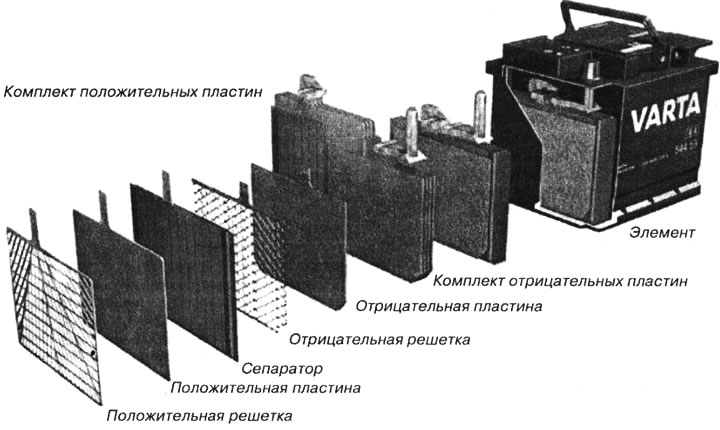
Energy Storage: The Inside of a 12-Volt Battery
Chemical processes occur inside the battery, which causes energy to accumulate in the battery. When current flows, this chemical energy is converted into electrical energy. The most important task of the battery is to provide the starter with enough energy to start the engine. This is not that simple. Depending on the engine and the type of starter, up to 2000 watts of power are needed at the moment of starting, when static friction must be overcome. To turn the engine, the starter only needs a fifth of this power. The current consumption of the starter increases at low temperatures, since the lubricants thicken at this time.
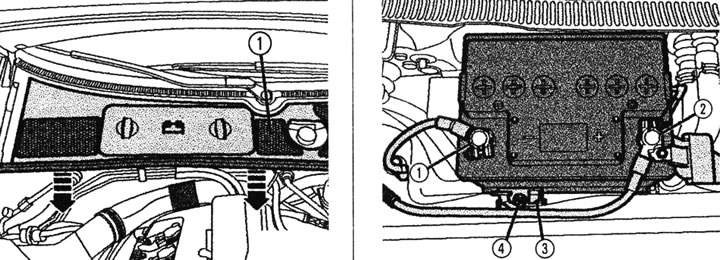
In the Audi A4, the battery is located in the battery compartment between the engine compartment and the windshield (in the back right part, under the cover). To access the battery, pull the rubber seal (arrows) forward and remove the cover 1 forward (fig. on the left). The picture on the right shows an open battery: 1 - flexible jumper on the negative pole for connection to the case, 2 - positive wire, 3 - battery mounting bracket, 4 - Allen screw. At the edge of the battery above the positive terminal 2, the elbow of the central gas outlet is visible.
Concepts and norms
Designation: The designation is on the battery case, it characterizes the battery properties. Example: 12V340A 70Ah (nominal voltage 12V, low temperature test current 340A, nominal capacity 70Ah).
Nominal voltage: All Audi A4 models have a nominal battery voltage of 12 volts. The actual voltage depends on the battery's state of charge and may be higher or lower than the nominal voltage.
Nominal capacity: This parameter characterizes the battery's ability to accumulate energy, the capacity is measured in ampere-hours (A-h). The battery capacity shows how much energy a fully charged battery can give at a temperature of 27°C in 20 hours, and the voltage should not fall below 10.5 volts (voltage at end of discharge). The parking light of an Audi A4, for example, consumes 20 watts (all four lamps). With an on-board voltage of 12 volts, the battery, in accordance with the formula l = W / V, delivers a current of 1.67 A. Thus, a battery with a capacity of 40 A-h can theoretically power a car with the parking light on for 24 hours. In practice, things are somewhat different: after 15 hours, the battery is discharged and the light goes out.
Low Temperature Test Current: A specified discharge current in amperes (A) that can be obtained from a 12-volt battery at a temperature of -18°C, where the voltage must not fall below 9 volts for 30 seconds and below 6 volts for 150 seconds.
Self-discharge: Chemical processes inside the battery cause discharge even if no consumer is connected to the battery. A charged starting battery loses approximately 0.5 percent of its charge daily. High temperatures, damage, and contamination accelerate the self-discharge of the battery.