



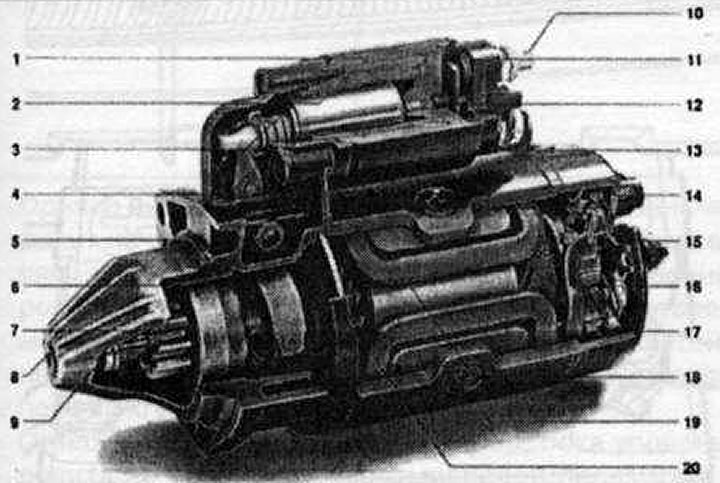
Starter with forced engagement and self-disengagement of the gear: 1 - holding winding, 2 - pull-in winding, 3 - return spring, 4 - starting lever, 5 - buffer spring, 6 - roller freewheel clutch, 7 - gear, 8 - armature shaft, 9 - thrust ring, 10 - electrical connection, 11 - contact, 12 - contact jumper, 13 - traction relay, 14 - collector bearing, 15 - collector, 16 - brush holder, 17 - pole piece, 18 - armature, 19 - pole housing, 20 - excitation winding
Starter with forced engagement and self-disengagement of the gear
When the ignition key is turned in the start direction, voltage is supplied to the holding 1 and pulling 2 windings of the starter traction relay 13, which is located at the top of the starter.
Pushing the pinion: The relay anchor pulls the starting lever 4. The starting lever pushes the carrier with the pinion 7 to the toothed ring of the engine flywheel via the guide rings and the buffer spring, causing these parts to start rotating. The anchor 18 of the starter motor does not yet rotate, the main current for the excitation winding and the anchor winding has not yet been switched on. Only when the pinion engages so much that the end of the stroke is reached, and the contact jumper in the traction relay begins to adhere to the relay contacts, the starter motor is switched on.
Movement of the pinion on the helical thread: The stator anchor, having started to rotate, due to the action of the steep thread, introduces the pinion, which is held against the toothed ring, even further into the toothed ring until the pinion hits the thrust ring 9 of the anchor shaft 8. The pull-in winding is short-circuited, the holding winding holds the relay anchor in the pulled-in position until the end of the starting process. The engine begins to turn.
If the engine starts, the rotation speed of the starter pinion begins to exceed the idle speed of the starter motor. The roller freewheel clutch 6 disconnects the connection with the force closure between the pinion and the anchor shaft. The anchor is protected from gaining speed, the pinion remains in engagement. When the ignition switch and starter are turned off, the starting lever, the leash and the pinion under the action of the return spring 3 move to the initial position. The pinion remains in this position until the next start.
This article was copied from an online resource AudiManual.ru