



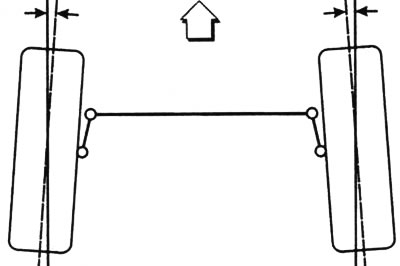
Wheel alignment: the front wheels seem to roll towards each other
Collapse. Camber is the tilt of the wheels relative to the vertical. Camber reduces the transmission of shocks to the steering components, and it also reduces the effort required to turn the wheel and the friction of the wheels on the road. The front wheels are installed with positive camber, that is, the upper parts of the wheels are slightly further apart than the lower ones,
Transverse inclination of the kingpin. The transverse inclination of the kingpin is the inclination of the kingpin axis relative to the vertical. If you mentally extend the kingpin axis line to the ground and measure the distance to the wheel axis line (to the midpoint of the tire's bearing area), then we get the rolling shoulder. In order to reduce parasitic forces in the steering, the rolling shoulder should be as small as possible. In addition, the transverse inclination of the kingpin in combination with the longitudinal inclination leads to the fact that when the wheels are turned, the car rises slightly. When the steering wheel is released, the wheels return to the middle position (restoring moment).
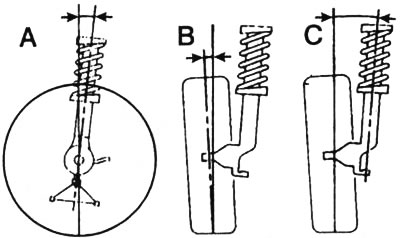
Wheel alignment angles: A: longitudinal inclination of the kingpin, B: camber, C: transverse inclination of the kingpin
Longitudinal inclination of the kingpin. The longitudinal inclination of the kingpin is the distance (in the direction of movement) between the imaginary centerline of the kingpin extended to the ground and the midpoint of the tire's bearing area. Due to the longitudinal inclination of the kingpin, the wheels are pulled rather than pushed, so they tend to take and maintain a straight position.
(The original publication in its entirety is posted on the website AUDImanual.ru)