



Table of contents: Starting a cold engine ↓ Warming up the engine ↓ Idling ↓ Estimated operating mode ↓ Full operating load ↓ Engine speed limitation ↓ Emergency program ↓
Starting a cold engine
The electronic control unit of the fuel injection system receives information about the engine temperature from the coolant temperature sensor. The lower the temperature of the engine itself, the longer the injector remains in the open position to ensure the supply of maximum fuel for the preparation of a highly enriched air-fuel mixture.
Warming up the engine
The coolant temperature sensor transmits information about the gradual increase in coolant temperature to the electronic control unit in the form of electrical signals about the change in resistance value. Accordingly, there is a gradual reduction in the duration of the injector in the open state. In this state of the engine, signals from the lambda probe are ignored. This means that the air-fuel mixture during this period of engine operation is not optimal for the catalyst.
Idling
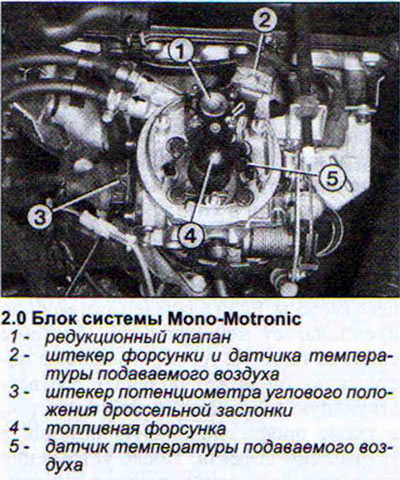
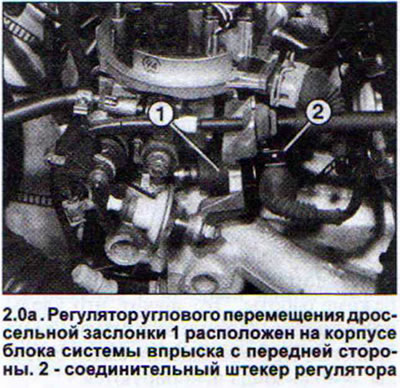
The idle speed sensor on the throttle position controller informs the injection control unit of the operating position of the throttle valve. The throttle position controller determines the idle speed and simultaneously equalizes the idle speed, which is necessary due to the inclusion of an increasing number of electrical consumers, the operation of the power steering, the engaged gear in cars with an automatic transmission or due to the operating air conditioner. Such an adjustment of the idle speed is possible by changing the ignition timing and, accordingly, the ignition moment (see illustration 2.0a).
Estimated operating mode
The electronic control unit receives information about the engine operation in the form of pulses about the engine speed from the Hall sensor, as well as about the throttle position from the potentiometer. Based on this data, the control unit recognizes the operating load on the engine and determines the required amount of fuel that the injector must inject to prepare the air-fuel mixture.
When determining the amount of fuel injected by the injector, the content of fuel and air in the mixture is taken into account at a value of (= 1. The constant combination of rich and lean air-fuel mixtures ensures optimal functioning of the catalyst.
The electronic control unit perceives pressing the accelerator pedal as a signal from the potentiometer about the need to increase speed and immediately "gives a command" to prepare an enriched air-fuel mixture.
Full operating load
At full operating load, or more precisely at an angular position of the throttle valve of 72.5°, the electronic control unit of the injection system ensures the preparation of an air-fuel mixture corresponding to the needs of the engine in this operating mode. This means that the specific fuel content in the mixture increases. When the mixture is enriched, the signals from the lambda probe are ignored.
Forced idle mode
When driving downhill with the accelerator pedal not pressed, the Mono-Motronic system saves fuel and cuts off its supply if the engine has warmed up to operating temperature. The system control unit recognizes this situation from the throttle potentiometer when the gas pedal is released, from information from the coolant temperature sensor and from the Hall sensor about the engine speed, which is within 1500-1900 rpm.
Engine speed limitation
When the maximum permissible engine speed is exceeded, the electronic control unit switches off the fuel supply to protect the engine. Limiting the engine speed by switching off the ignition is not possible, because unburned fuel would then get into the catalytic converter, which could damage it.
Emergency program
In the event of failure of one of the sensors, disruption of the necessary contact with the corresponding sensor, or a situation where the sensor begins to give meaningless information, the Mono-Motronic system continues to function. For this case, the memory of the electronic control unit contains data of the so-called emergency program, which cannot be changed. This program cannot take into account much of what is normally perceived by the system, but it does support the engine. The driver senses the activation of the emergency program by a drop in the effective engine power or by difficulty starting the engine.
The control unit recognizes and records some of the engine malfunctions in a memory device (storage device). If the registered error or malfunction does not recur during the next ten engine starts (sporadic function failure), then this fault is automatically removed from the compiled list. Permanent faults are read and printed using a special device connected to the diagnostic connector. As a rule, workshops do this during service work and during vehicle maintenance. Reading and printing fault codes by the car owner himself is impossible. If the car owner suspects a fault in the fuel injection system, then by contacting the workshop, he can receive a corresponding fault printout, as well as professional assistance in eliminating the defect. After the fault is eliminated, it is removed from the list.
[The text is based on materials from the website Audimanual.ru]