Table of contents: Gearbox operating modes ↓ Automatic transmission control lever… ↓
The car is equipped with a 4-speed automatic transmission with electronic control.
The automatic transmission has a torque converter lockup clutch, which prevents the torque converter from slipping, due to the design of the transmission, in 4th and, under certain conditions, in 3rd gear. This ensures the proper operation of the transmission in these gears and reduces fuel consumption.
Depending on the driving style, there is a need to select the gearbox operating mode.
Gearbox operating modes
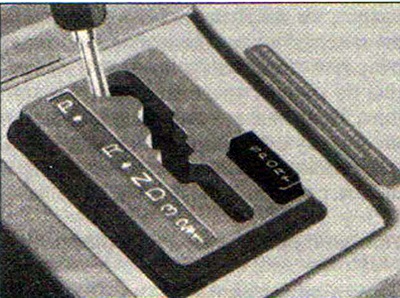
Using the "SPORT" button, you can switch from sports mode to economy mode and back.
The modes are switched by pressing a key.
When the sports mode is turned on, a green control arrow lights up in the key.
Switching modes can be done both before and during movement.
Note: The enabled mode remains even after the engine is turned off.
Economy driving mode
This is the normal switch position and corresponds to normal driving mode.
The program ensures movement with optimal fuel consumption, performing early transition to higher gears and late transition to lower gears.
Sport driving mode
To drive in sports mode, switch to this program. Late switching to higher gears allows you to fully realize the engine's power reserve. Switching to lower gears is performed at higher speeds than in economy mode.
Emergency program
If there is a malfunction in the control system, the automation switches to emergency mode.
The automatic transmission can operate according to one of two emergency programs.
When the first emergency program is executed, automatic switching to higher and lower gears occurs, but the jolts at the moment of switching become more noticeable.
When the second emergency program is running, automatic gear shifting is not performed.
Manual control of the gearbox is possible, however, when the control lever is set to the positions "D", "3", "2" in fact, only 3rd gear will be engaged.
The positions of the lever "1" and "R" will, as usual, correspond to the engagement of first gear or reverse gear.
When working on one of the emergency programs, the tempomat (cruise control) turns off.
When switching to the emergency program, you must immediately contact the workshop.
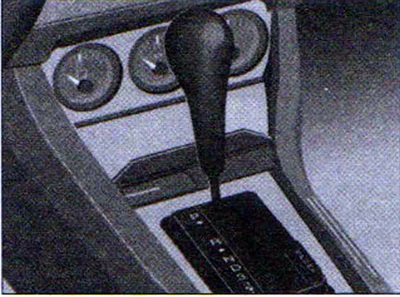
Automatic transmission control lever locks
When the ignition is on, the automatic transmission control lever is locked in the "P" or "N" position. To move the control lever to another position, you need to press the brake pedal. This control of the lever prevents erroneous engagement of the drive gear and spontaneous movement of the car.
The retarder installed on the automatic transmission prevents the transmission control lever from being blocked when it is necessary to shift sharply from one gear to another through N, for example from R to D. And only if the control lever remains in the N position for more than one second without pressing the brake pedal, the lever lock will be activated.
At speeds of approximately 5 km/h and above, the automatic transmission control lever, which is in the "N" position, is automatically unlocked.
Locking the ignition key in the lock
After turning off the ignition, the key can be removed from the lock only if the automatic transmission control lever is in the "P" position (parking lock). After the key is removed from the lock, the lever is locked in this position.
Automatic transmission control lever positions
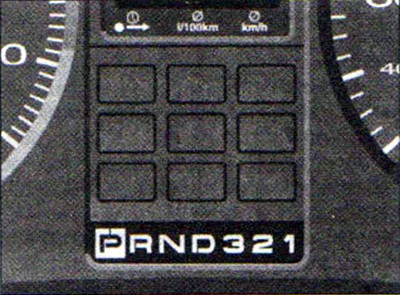
When the ignition is on, the actual position of the automatic transmission control lever is indicated by the indicator on the instrument panel. The illustration corresponds to the lever being set to position P.
P - Parking lock
The drive wheels are locked by means of rigid kinematic links. The parking lock position can only be used after the vehicle has come to a complete stop.
To move the control lever to position P, you must first press it down. When switching from position R to position P, you do not need to do this.
To move the automatic transmission control lever from position P after turning on the ignition, you need to depress the brake pedal and push the lever down.
Note: The automatic transmission control lever can be moved from the P position only after the key inserted into the ignition switch is turned to the "On" position
R — reverse
Reverse gear can only be engaged after the vehicle has stopped and the engine is idling. Before engaging the R position, the automatic transmission control lever must be pressed down. When the ignition is on and the automatic transmission control lever is set to the R position, the reversing lights come on.
N — neutral position (idle position).
To move the automatic transmission control lever from position N with the ignition on and the vehicle speed below 5 km/h or when the vehicle is stationary, you need to press the brake pedal.
O - the basic position when moving forward.
Automatic switching to higher and lower gears within four gear stages of the gearbox is carried out depending on the engine load, speed and driving mode.
When driving, under certain conditions, it is preferable to move the automatic transmission control lever to one of the positions indicated below.
3 - position for driving on roads in hilly areas.
This position is recommended for driving in conditions where, when the automatic transmission control lever is set to the main position D, frequent shifting from 4th to 3rd gear and back occurs.
1st, 2nd and 3rd gears are automatically engaged based on engine load, speed and driving mode. The ability to engage fourth gear is blocked. This slightly increases the engine braking effect when the accelerator pedal is released.
2 - position when driving in the mountains
This position of the automatic transmission control lever is suitable for overcoming long descents and ascents.
1st, 2nd and 3rd gears are automatically engaged based on engine load, speed and driving mode. The ability to engage 3rd and 4th gears is blocked. This avoids unnecessary upshifts and increases the engine braking effect.
1 - position when overcoming steep slopes.
This position is recommended for climbing and descending extremely steep slopes.
To move the automatic transmission lever to position 1, it must first be pressed down. Once engaged, the car will only move in first gear. The ability to engage 2nd, 3rd and 4th gears is blocked. This ensures the maximum possible engine braking effect.
When the lever is set to position 1, the cruise control cannot be used.
Note: Although it is possible to move the automatic transmission control lever to positions 3, 2, and 1 when manually downshifting, the automatic transmission will only perform the shift after it becomes impossible to exceed the maximum permissible engine speed.
Predictive downshift (kick-down)
The automatic anticipatory downshift allows for maximum acceleration. If you fully depress the accelerator pedal, the automatic transmission will shift to a lower gear corresponding to the engine speed and the speed at the moment of increasing fuel supply. Shifting to the next higher gear will occur only when the engine reaches the rotation speed corresponding to this gear.
Driving instructions for a car with automatic transmission
Starting the engine
The engine can only be started when the automatic transmission control lever is in position P or N.
Switching on the required operating range of the automatic transmission
To move the automatic transmission control lever to the desired operating position on a vehicle with the engine running, you must press the brake pedal. When moving the lever, do not press the accelerator pedal.
If the lever is accidentally shifted to neutral while driving, release the gas and wait for the revs to drop to idle speed before re-engaging the desired forward gear range.
Caution: If the automatic transmission control lever is in the forward gear range when the vehicle is parked, do not step on the gas under any circumstances (for example, by hand, acting in the engine compartment). In this case, the car will inevitably start moving, sometimes even if the parking brake is applied. Therefore, if it is necessary to perform certain work with the engine idling, always move the automatic transmission control lever to the parking position and apply the parking brake.
Moving off
Move the control lever to the desired operating range (D, R, 3, 2, 1). Wait until the automatic system switches on, creating a power connection between the gearbox and the drive wheels (at the moment of switching on, a slight jolt is felt). Only after this add gas.
Stop
When stopping briefly, for example at traffic lights, there is no need to switch to neutral. It is enough to hold the car with the brakes.
However, the engine should only run at idle speed
Parking
When stopping on a level surface, it is enough to engage the parking lock. If the road has a slope, you should first tighten the handbrake and then engage the parking lock. This reduces the load on the locking mechanism and makes it easier to disengage it later.
Forced engine start
Forced engine starting is not possible by towing or pushing. If the battery is discharged, the engine can only be started from an external, auxiliary battery
Towing
When towing a car with an automatic transmission using a cable, the transmission control lever must be in position N. The towing speed must not exceed 50 km/h. The maximum distance that a car with an automatic transmission can be towed using this method is 50 km.
If towing over a longer distance is necessary, the vehicle must be transported using the partial loading method with the front wheels raised. Transportation with the rear wheels raised is not permitted. When driving with the rear wheels raised, the leading front wheels rotate in the opposite direction. The planetary gears of the automatic transmission spin up to such a speed that the transmission immediately fails.
When towing AUDI 80 quattro models, certain requirements must be met.
The vehicle may be transported by partial loading with the front wheels raised. However, the speed must not exceed 50 km/h, and the distance over which the vehicle can be transported in this manner must not exceed 50 km.
If these parameters are not observed, the center differential will be damaged due to lack of lubrication.
When transporting a vehicle with the front wheels raised, the differential does not need to be locked to ensure it is balanced when turning.