



Table of contents: Position "P" ↓ Position "R" ↓ Position "D" ↓ Position "2" ↓ Position "1" ↓ Precautions when towing ↓
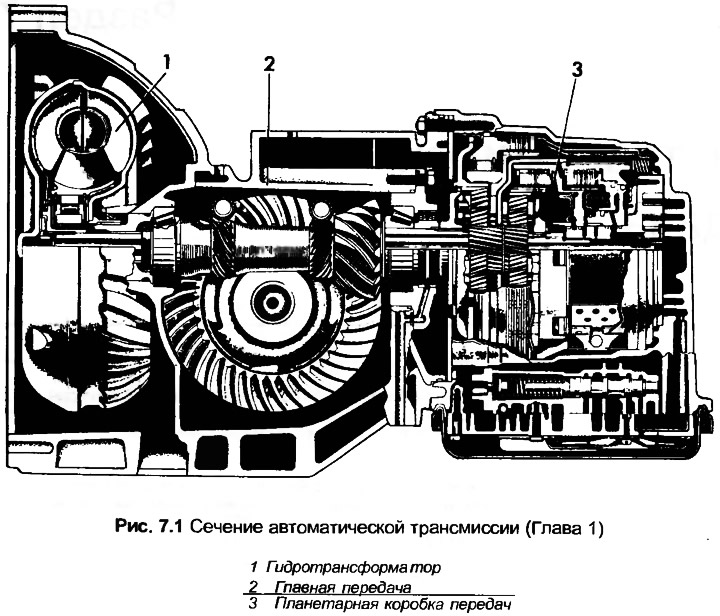
An automatic transmission consists of three main units: a torque converter, which is attached directly to the engine; final drive mechanism which includes the differential assembly; and a planetary gearbox with a hydraulically controlled multi-plate clutch and a band brake. The gearbox also houses a rear-mounted pump that is connected to the impeller of the torque converter, this pump supplies transmission fluid to the planetary gear, hydraulic control and torque converter. The fluid performs a triple function - lubricates moving parts, cools the automatic transmission system and provides a medium for transmitting torque. The lubrication of the final drive is separate from the transmission lubrication system, unlike a manual transmission, where the final drive is connected to the general lubrication system.
The torque converter is a non-separable unit. It is bolted to the crankshaft drive disk and replaces the clutch used on engines with a manual transmission.
The gearbox is of the planetary type, with epicyclic gear blocks, controlled by the brakes and clutches of a hydraulic control system. The correct gear is selected by a combination of three control signals: from a mechanical valve, controlled by a gear shift cable; from a mechanical valve controlled by the accelerator pedal and from a regulator controlling the hydraulic pressure. The gearshift cable and selector lever allow the driver to select a specific gear and make automatic control adjustments if desired. The accelerator control determines the correct gear for the desired degree of acceleration, and the regulator determines the correct gear based on engine speed.
Due to the need for special test equipment, the complexity of some parts, and the need for absolute cleanliness, the number of automatic transmission maintenance procedures is limited. The steps that can be performed are detailed in the following Chapters. Repairing the final drive differential is also not recommended.
The automatic transmission has three forward speeds and one reverse speed, selected by a lever with six positions as follows:
- R Parking
- R Reverse
- N Neutral
- D Main gear
- 2 Low gear
- 1 Low gear
Early 1990 Coupe models could be equipped with a four-speed automatic transmission.
Position "P"
In the Park position, the transmission is mechanically locked. This position should only be selected when the vehicle is absolutely stationary. The selector lever must be pressed to engage "P" and when moving off from the "P" position with the engine running, the brake pedal must also be pressed.
Position "R"
Reverse gear can only be engaged when the vehicle is absolutely stationary and the engine is idling. The selector lever must be pressed when engaging the "R" position, and the brake pedal must also be pressed when moving from the "P" position to "R".
Position "D"
This position is for normal driving, and once selected, the three forward gears will be automatically engaged throughout the entire speed range from zero to maximum.
Position "2"
With the lever in this position, the two lower gears are selected automatically, but the highest one will not be engaged. For this reason, position "2" should only be selected when the vehicle speed is below 115 km/h. Selecting position "2" uses the result of engine braking, and the actual speed change can only be made by pressing the accelerator pedal.
Position "1"
This position is rarely necessary, but only during steep ascents or descents. The transmission remains in the lowest gear, and therefore the "1" position should only be pulled out when the vehicle speed is below 65 km / h.
Precautions when towing
If the vehicle is towed, the ignition key must be positioned so that the steering wheel is not locked and the gear selector must be in the "N" (Neutral) position. Due to limited transmission lubrication when the engine is not running, the vehicle must not be towed for a distance greater than 50 km, or at a speed greater than 50 km/h, unless the front wheels of the vehicle are raised off the road.