Repair Chevrolet Repair Toyota Repair Honda Repair AvtoVAZ Repair Mercedes-Benz Repair BMW Repair Opel
Home  |  Contacts  |  Sitemap  |    
English Русский
Български
Беларускі
Український
Српски
Hrvatski
Română
Polski
Slovenský
Magyar
AudiManual.ru


  • AUDI 80
  • AUDI 100
  • AUDI A3
  • AUDI A4
  • AUDI A6
  • AUDI A8
  • AUDI Q
  • OTHER
  • ARTICLES
B4 (1991-1996) B3 (1986-1991) B3 (1986-1991, petrol) B2 (1979-1986)

Technical characteristics of the crank mechanism (Audi 80 B2)

  • Home
  • Audi 80
  • B2 (1979-1986)
  • Power unit
  • Engine EP, YP, YZ, DT, DS, DZ
  • Technical characteristics of the crank mechanism
            0
Table of contents: Crankshaft ↓ Pistons ↓ Piston pins ↓ Piston rings ↓ Connecting rods ↓

Crankshaft


The crankshaft is steel, forged. The shaft has five bearings. There are lubrication grooves in the upper liners of the main bearings. The axial fixation of the crankshaft is carried out by liners with thrust flanges of the bearing of the 3rd main journal.

Main journal diameter, mm:
  • nominal: 54.00-0022-0,042
  • 1st repair size: 53.75 -0022-0,042
  • 2nd repair size: 53.50 -0022-0,042
  • 3rd repair size: 53.25 -0022-0,042

Diameter of connecting rod journals
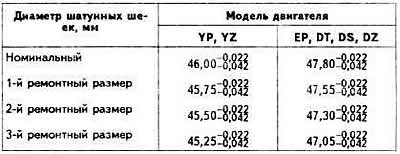
Diameter of connecting rod journals

Crankshaft axial clearance, mm:
  • nominal: 0.07-0.17;
  • maximum permissible: 0.25.

Clearance between liners and main journals of the crankshaft, mm:
  • nominal: 0.03-0.08;
  • maximum permissible (when worn out): 0,17.

Pistons


The pistons are made of aluminum alloy with steel inserts. The piston bottom has a combustion chamber. Each piston has two compression rings and one oil scraper ring. To install the piston in the cylinder, there is an arrow on the bottom, which should face the camshaft drive. The piston diameter is marked on the piston bottom and is measured at a distance of 15 mm from the edge of the piston skirt at an angle of 90° relative to the axis of the piston pin. The maximum permissible deviation of the piston diameter from the nominal size during operation should not exceed 0.04 mm.


Depth of recess in piston bottom, mm:
  • engine YP: 6.3;
  • yZ engine: 8.3.

yZ engine: 8.3.

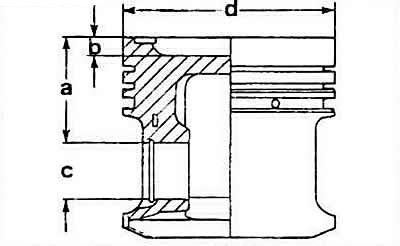
Piston sizes for EP, DT, DS, DZ engines
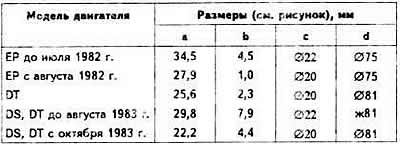
Piston sizes for EP, DT, DS, DZ engines

Note: Since the 1982 model year, the YP and YZ engines have had their piston pin length reduced from 63 to 55 mm and the piston surface in the piston pin bore area has been straightened. Only pistons of one configuration may be installed on engines when overhauled.


Piston pins


The piston pin is floating. It is held from axial movement by two retaining rings.

Outer diameter of piston pins of YP, YZ engines, mm: 21.996-22.000.

Characteristics of piston pins of engines EP, DT, DS, DZ
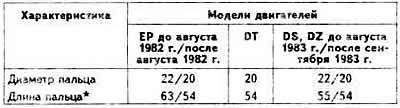
Characteristics of piston pins of engines EP, DT, DS, DZ

*Since July 1985, all engines are equipped with 57 mm long piston pins.


Piston pins are selected depending on the diameter of the hole for the pin in the piston. When assembling, the pin and connecting rod are assembled from parts of only one size group. This ensures the necessary tension between the pin and the piston boss and the gap between the pin and the bushing of the upper connecting rod head.

Piston rings


Each piston has three rings: two compression rings and one oil scraper ring. The oil scraper ring is composite. The rings should be installed on the piston with the "top" mark facing up (to the piston bottom). When installing pistons into cylinders, the ring locks must be offset by 120°.

Piston brand: Maihe or KS.

Characteristics of piston rings
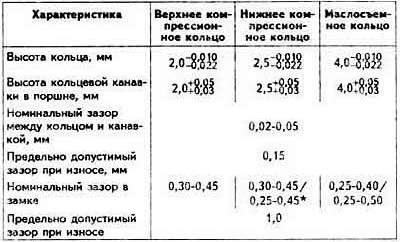
Characteristics of piston rings

*The numerator contains data for YP, YZ engines, the denominator contains data for EP, DT, DS, DZ engines.

Connecting rods


Connecting rods are steel, forged, with an I-section rod, thin-walled liners. A bushing is pressed into the upper head of the connecting rod. There are technological lugs on the lower head and the connecting rod cover, showing how to install them correctly. The lugs should be directed towards the camshaft drive.


Distance between the axes of the holes of the upper and lower heads of the connecting rod, mm:
  • engines YP, YZ: 136;
  • engines EP, OT, DS, DZ: 144.

Maximum permissible clearance during operation between the liners and the connecting rod journals of the crankshaft, mm: 0.12.

Maximum axial clearance of the connecting rod on the crankshaft journal, mm: 0.37.

Clearance between piston pin and upper connecting rod head, mm: 0.003-0.007.

Upper bushing hole diameter, connecting rod head (yP, YZ engines), mm: 22.017-22.023.

Hole diameter, mm (engines EP, DT, OS, 0Z):
  • upper connecting rod head 20.0;
  • lower connecting rod head: 50.6.
The article was checked by auto expert Georgy Rodionov
This article is available at russian, bulgarian, belarusian, ukrainian, serbian, croatian, romanian, polish, slovak, hungarian

Share information:
Previous articles
Audi 80 B2: Engine EP, YP, YZ, DT, DS, DZ
Next articles

Technical characteristics of the cylinder block
Cylinder head specifications
Design and technical characteristics. General information
Technical characteristics of the valve timing mechanism
Technical characteristics of the lubrication system
Technical characteristics of the cooling system
Technical characteristics of the power supply system


Similar articles on other Audi car models:
Crank mechanism — technical characteristics Audi 100 C3 (1982-1990, petrol)
Removal and installation the locking mechanism Audi A3 Type 8L (1996-2003)
Technical characteristics of the car Audi A4 B5 (1994-2001, petrol)
Technical characteristics of the cooling system Audi A6 C4 (1994-1997)
Valve mechanism Audi A8 D2 (1994-2002)
Valve mechanism Audi Q5 Type 8R (2008-2017)
Engine number and characteristics Audi A2 (1999-2005)
Link to this page in different formats


Visitor comments

No comments yet


How much will 20 + 41 =


80(B4, 1991-1996) 
  • General information
  • User manual
  • Maintenance
  • Troubleshooting
  • Power unit
  • Engine
  • Cooling system
  • Heating and ventilation
  • Petrol injection
  • Diesel fuel system
  • Fuel system
  • Exhaust systems
  • Ignition system
  • Transmission
  • Clutch
  • Car gearbox
  • Chassis
  • Brake system
  • Suspension and steering wheel
  • Body
  • Body and trim
  • Electrical equipment
  • Electrical system
  • Electrical circuits
 
80(B3, 1986-1991) 
  • General information
  • Repair characteristics
  • Maintenance
  • Power unit
  • Gasoline engine
  • Diesel engine
  • Engine lubrication system
  • Fuel system (gasoline)
  • Injection system (gasoline)
  • Fuel system (diesel)
  • Ignition system
  • Cooling system
  • Heater
  • Exhaust system
  • Transmission
  • Clutch and gearbox
  • Chassis
  • Steering
  • Brake system
  • Car suspension
  • Body
  • Body elements
  • Electrical equipment
  • Power devices
  • Lighting and appliances
  • Electrical circuits
 
80(B3, 1986-1991, petrol) 
  • General information
  • User manual
  • Maintenance
  • Power unit
  • Engine 4-cylinder
  • Engine 5-cylinder
  • Cooling system
  • Fuel and exhaust systems
  • Ignition system
  • Transmission
  • Clutch
  • Mechanical transmission
  • Automatic transmission
  • Drive shafts
  • Chassis
  • Brake system
  • Suspension
  • Steering
  • Body
  • Exterior
  • Interior
  • Electrical equipment
  • Equipment and devices
  • Electrical circuits
 
80(B2, 1979-1986) 
  • General information
  • User manual
  • Power unit
  • Engine FZ
  • Engine EP, YP, YZ, DT, DS, DZ
  • Transmission
  • Clutch
  • 4 speed gearbox
  • 5 speed gearbox
  • Front wheel drive
  • Chassis
  • Front suspension
  • Rear suspension
  • Steering
  • Brake system
  • Electrical equipment
  • Equipment and devices
  • Electrical circuits
 
AudiManual.ru © 2017-2026 · Mobile version · Feedback · Sitemap: EN BG BY UA RS HR RO PL SK HU · Site search · News and articles
80 B2 · 80 B3 petrol · 80 B3 · 80 B4 · 100 C3 diesel · 100 C3 petrol · 100 C3 · 100 C4 petrol · 100 C4 · A3 Type 8L · A4 B5 petrol · A4 B5 · A4 B6 petrol · A4 B6 · A4 B7 · A4 B8 · A6 C4 · A6 C5 · A6 C5 Allroad · A8 D2 · Q5 Type 8R · Q7 Typ 4L · Audi A2 ·
This site uses cookies 🍪. Click the button to accept this fact.