



Table of contents: Features of the device and the… ↓ Operation under load and idle… ↓ Cold engine start ↓ Starting a hot engine ↓
Features of the device and the operating principle of the "K-Jetronic" system
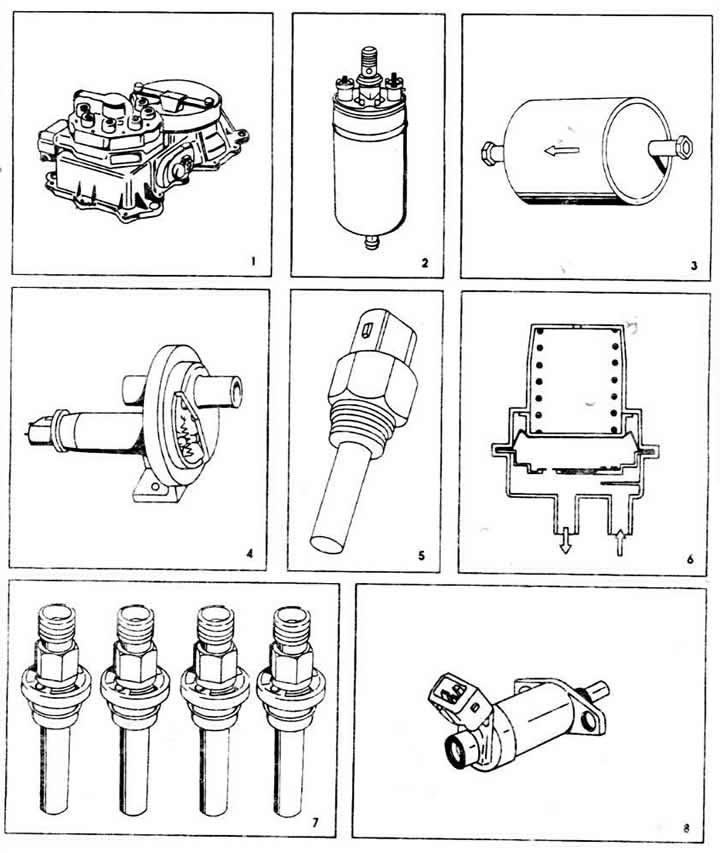
Components of the K-Jetronic fuel injection system: 1 - mixture regulator (a unit formed by a fuel dispenser and an air flow meter); 2 - fuel electric pump; 3 - fuel filter; 4 - additional air supply valve; 5 - thermal time relay; 6 - fuel storage tank; 7 - injection nozzles; 8 - starting nozzle.
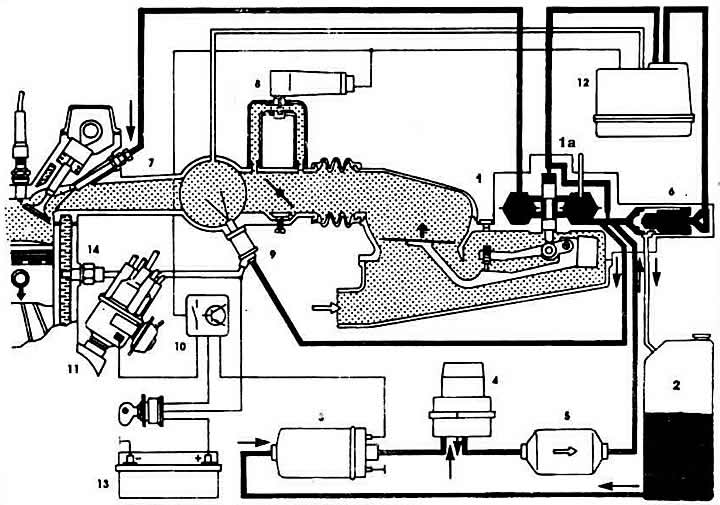
Structural diagram of the fuel injection system "K-Jetronic": 1 - mixture regulator; 1a - fuel distributor; 2 - fuel tank; 3 - fuel electric pump; 4 - fuel storage tank; 5 - fuel filter; 6 - supply pressure regulator; 7 - injection nozzle; 8 - additional air supply valve; 9 - electromagnetic starting nozzle; 10 - fuel pump relay; 11 - ignition distributor sensor; 12 - control pressure regulator; 13 - battery; 14 - thermal time relay.
The fuel pump draws fuel from the fuel tank through the filter and the accumulator delivers it to the fuel distributor.
The fuel pump is multi-stage, rotary. It is driven by a constant-excitation electric motor. Along the circumference of the eccentric rotor mounted on the electric motor shaft, there are nests for rollers. Under the action of centrifugal force, the rollers are pressed against the pump body, which ensures the pump is hermetic. Fuel sucked in through the gaps between the rollers enters the discharge line.
Despite the fact that the electric motor is immersed in fuel, the pump is explosion-proof, since a flammable mixture never forms in its housing. In all engine operating modes, the pump pumps an excess amount of fuel compared to the maximum amount of fuel required to maintain constant pressure in the fuel supply system.
If the engine does not start or starts with difficulty, idles unstably, stalls regardless of the operating mode, and does not develop full power, then the cause may be a malfunction of the fuel pump.
The amount of air sucked into the intake manifold is measured by an air flow meter.
The air flow meter is installed before the throttle valve. It is equipped with a guide device with a pressure disk fixed on a movable lever, which deflects depending on the air flow. The displacement of the pressure disk of the air flow meter is transmitted through the lever to the distributor plunger of the distributor, which determines the amount of fuel in the system.
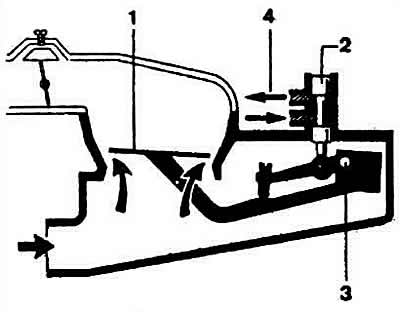
Operating principle of the air flow meter: 1 - pressure disc; 2 - distribution plunger; 3 - lever axis; 4 - to the intake valves.
The fuel quantity distributor, in addition to the distribution plunger, includes a supply pressure regulator, a differential pressure valve, a supply pipeline and four injection nozzles in accordance with the number of engine cylinders. When the pressure disk of the air flow meter rises, the distribution plunger of the fuel quantity distributor moves accordingly, opening with its control edges access of fuel to the upper chamber of the differential pressure valve, separated from the lower chamber by a diaphragm. The fuel pressure and the force of the spring acting on the upper surface of the diaphragm are greater than the pressure on the lower surface of the diaphragm. As a result, the diaphragm shifts downwards and opens the channels for supplying fuel to the nozzles. Difficult starting, inability to start the engine, as well as its unstable operation at idle indicate a possible malfunction of the nozzles.
The supply pressure regulator maintains the fuel pressure in the system at a certain level and ensures that excess fuel is supplied to the drain line.
The fuel filter is designed to clean the fuel circulating in the system. The arrow on the filter body shows the direction of fuel flow in the system.
The fuel accumulator is installed behind the fuel pump. It has a damper and accumulator chambers, which are separated by a diaphragm. In front of the diaphragm there is an additional partition with a disc valve, which ensures the supply of fuel to the system. A throttling hole for draining fuel is made in the partition.
After the fuel pump is turned on, the storage chamber is filled with fuel and the spring diaphragm is stretched to the stop. After the engine is stopped, due to the tension of the diaphragm, the fuel remains under pressure and the formation of fuel vapor is not allowed, which facilitates the start of a hot engine.
The engine is started and warmed up by an electromagnetic starting nozzle, an additional air supply valve and a control pressure regulator.
The electromagnetic starting injector is designed to inject an additional amount of fuel into the intake manifold at the moment of starting a cold engine. It works together with a thermal time relay, which closes and opens its electrical circuit depending on the engine temperature and the duration of its start.
Difficulty starting or failure to start the engine, as well as increased fuel consumption, may be caused by a faulty starting injector. If the engine does not start or idles unstably, the cause may be a faulty thermal time relay.
The additional air supply valve serves to increase the crankshaft speed during engine warm-up. When starting a cold engine, the additional air supply channel is opened by the rotary valve flap, which moves when the bimetallic spring heats up. As the engine warms up, the additional air supply channel gradually closes.
Malfunction of the additional air supply valve may be the cause of the following malfunctions:
- the engine does not start or starts with difficulty;
- the engine stalls after starting;
- the engine does not increase idle speed when warming up.
In addition, the supply of additional air is regulated by the pressure disk of the air quantity meter, the movement of which leads to a corresponding rise of the distribution plunger, which also contributes to an increase in the crankshaft speed (with the throttle valve closed).
The control pressure regulator enriches the working mixture entering the combustion chambers when the engine is warming up. On a cold engine, the bimetallic spring compresses the diaphragm spring of the other valve, opening the fuel drain channel, which leads to a decrease in the counteraction on the distribution plunger. A decrease in the control pressure with a constant air flow causes an increase in the stroke of the pressure disk. As a result, the distribution plunger is additionally lifted, increasing the amount of fuel supplied to the injectors.
As the bimetallic spring heats up, the pressure on the spring of the diaphragm valve of the control pressure regulator decreases and the drain channel slowly closes. The control pressure reaches the normal value and enrichment of the combustible mixture stops.
Operation under load and idle conditions
Fuel electric pump 1 (see diagram) takes fuel from the fuel tank and pumps it under pressure of about 5 kg/cm² into the metering distributor 2 through the fuel filter 4 and fuel accumulator 3.
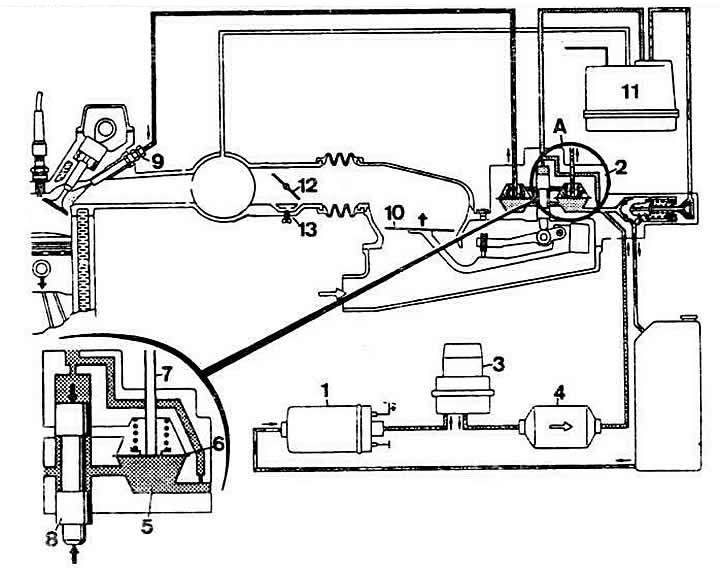
Scheme of operation of the fuel injection system "K-Jetronic" in load and idle modes: 1 - fuel pump; 2 - fuel dispenser; 3 - fuel storage tank; 4 - filter; 5 - fuel distributor chamber; 6 - differential pressure diaphragm valve; 7 - fuel supply pipe to the injector; 8 - distribution plunger; 9 - nozzle; 10 - air flow meter pressure disk; 11 - control pressure regulator.
Fuel under supply pressure fills the lower chambers 5 of the metering distributor and presses the diaphragms of the differential pressure valves 6 to the tubes 7 supplying fuel to the injectors. Fuel under pressure penetrates into the upper chambers of the metering distributor through the slots in the walls of the distribution plunger 8. The amount of fuel entering the upper chambers of the metering distributor changes depending on the vertical movement of the distribution plunger.
When the total fuel pressure in the upper chambers and the spring pressure exceed the fuel supply pressure in the lower chambers, the diaphragms of the valves 6 are lowered, opening the access of fuel through the tube to the injection nozzle 9. As soon as the pressure in the upper chambers of the metering distributor decreases, the diaphragms of the valves 6 return to the initial position. Due to the uniform periodicity of the opening and closing of the fuel supply channels to the nozzles, a constant fuel pressure is established. The displacement of the pressure disk 10 of the air flow meter is transmitted through the lever to the distribution plunger, the return of which to the initial position occurs due to the counteracting fuel pressure in the upper part of the metering distributor. The counteracting pressure is created due to the supply pressure and is regulated by the control pressure regulator 11. The bypass valve installed in the throttle valve area provides a minimum vacuum in the air flow meter when the engine is idling. The degree of opening of the valve is regulated by a needle screw.
Cold engine start
Fuel electric pump 1 (see diagram p. 60) instantly creates the working pressure of the fuel in the system. At the moment of starting a cold engine and for a certain time, the starting injector 15 injects an additional amount of fuel into the intake manifold. The duration of the starting injector operation is determined by the thermal time relay depending on the temperature of the coolant.
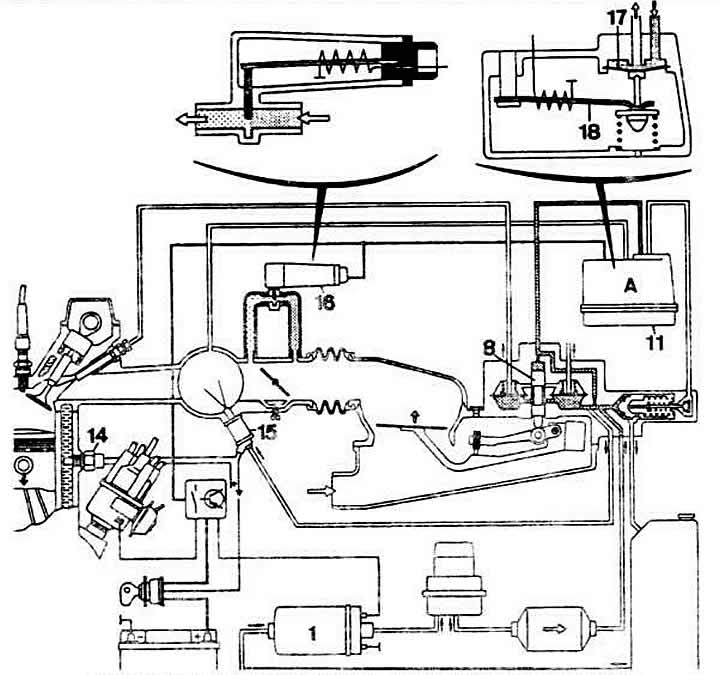
Scheme of operation of the K-Jetronic injection system when starting a cold engine: 1 - fuel pump; 8 - distributing plunger of the dispenser-distributor 11 - control pressure regulator; 14 - coolant temperature sensor; 15 - starting nozzle; 15 - additional air supply valve; 17 - diaphragm valve for regulating control pressure; 18 - bimetallic spring for controlling the control pressure adjustment valve.
The additional air supply valve 16 is installed in the air channel, which is made parallel to the throttle valve 12. The valve 16 provides an additional amount of air to the engine to increase the crankshaft speed of a cold engine at idle.
Additional enrichment of the fuel-air mixture during starting and warming up a cold engine is achieved due to the freer lifting of the distribution plunger 8 of the metering distributor due to the fact that the control pressure regulator 11 reduces the counteracting return pressure.
Until the engine is warmed up, the bimetallic spring 18 compresses the spring of the diaphragm valve 17, opening the fuel drain channel, which leads to a decrease in the counteracting pressure on the distribution plunger.
Starting a hot engine
To completely eliminate fuel evaporation after the engine has stopped, the pressure in the injection system is maintained for some time by a fuel accumulator, which temporarily interrupts the flow of fuel into the tank.