



Table of contents: Checking the fuel pressure in the… ↓ Checking the control pressure on a… ↓ Checking the control pressure on a… ↓ Checking residual pressure ↓ Checking the fuel pressure when the… ↓
To check the pressure, use a VW 1318 pressure gauge with a fitting and a tap that measures both the flow pressure and the inlet pressure.
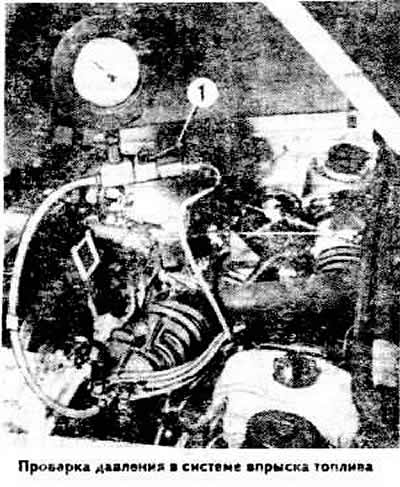
Connect the pressure gauge hoses between the dispenser-distributor and the control pressure supply pipeline coming from the control pressure regulator.
Remove air locks from the pressure gauge hoses. To do this, start the engine, set the pressure gauge valve to the position for monitoring the flow pressure and lower the pressure gauge so that it hangs freely on the hoses.
Checking the fuel pressure in the system
Check fuel pump performance and condition air filter element.
Set lever 1 (see photo) of the pressure gauge to the "open" position, placing the lever in line with the fitting.
Make sure the connector is connected to the control pressure regulator.
Start the engine and let it idle.
Measure the fuel pressure in the system using a pressure gauge, which for the YZ engine should be within 4.5-5.2 kg/cm², for the DZ engine - within 4.7-5.4 kg/cm².
If the pressure does not fit within the specified limits, replace the fuel distributor. You can also try to eliminate the causes of deviation of the fuel pressure from the required one.
The reasons for insufficient fuel pressure in the system may be:
- leaks in fuel lines and their connections;
- insufficient fuel pump performance;
- insufficient fuel supply pressure.
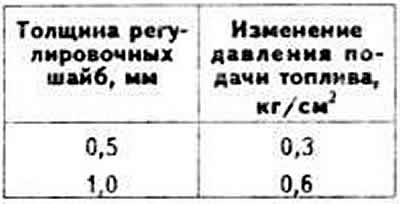
The cause of increased fuel supply pressure is a violation of the fuel pressure regulator adjustment or jamming of its plunger.
The fuel pressure in the system is regulated by selecting the thickness of the adjusting washers installed on the plunger of the fuel pressure regulator.
Checking the control pressure on a cold engine
Set valve 1 of the pressure gauge to the "closed" position, placing it perpendicular to the fitting.
On the YZ engine, disconnect the connector from the control pressure regulator; on the DZ engine, also disconnect the connector from the additional air supply valve.
Start the engine at idle speed.
Determine the control pressure using the pressure gauge depending on the ambient temperature (see table).
Control pressure on a cold engine
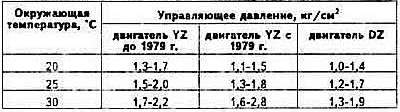
If the control pressure is not within the specified limits, replace the control pressure regulator.
Checking the control pressure on a warm engine
Warm up the engine (oil temperature 50-70°C).
Set the pressure gauge valve to the "open" position.
On a YZ engine, connect the shoe to the control pressure regulator, and on a DZ engine, also to the additional air valve.
Start the engine at idle speed. The control pressure should increase to 3.4-3.8 kg/cm² after 1.3-2.5 min on the YZ engine and 2.5-5.0 min on the DZ engine.
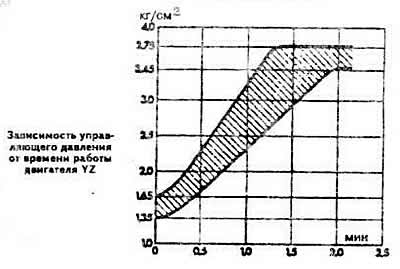
If the control pressure is not within the specified limits, replace the control pressure regulator.
Checking residual pressure
Warm up the engine (oil temperature 50-70°C).
Stop the engine.
Set the pressure gauge valve to the "open" position.
Start the engine and let it idle until the pressure on the pressure gauge reaches 3.4-3.8 kg/cm².
Turn off the ignition. After 10 minutes, the residual pressure in the system should be 1.8 kg/cm².
If the pressure drops sharply, set the pressure gauge valve to the "closed" position.
Start the engine and let it idle until the pressure gauge shows 4.5-5.2 kg/cm² on a YZ engine or 4.7- 5.4 kg/cm² on DZ engine.
Turn off the ignition. After 10 minutes, the pressure in the system should be within 1.6-1.8 kg/cm².
The control pressure regulator must be replaced if the pressure decreases when the pressure gauge valve is open, but does not decrease when the valve is closed.
Checking the fuel pressure when the engine is turned off
Warm up the engine (oil temperature 50-70°C).
Install the pressure gauge as described above.
Set the pressure gauge valve to the "closed" position.
Measure the fuel pressure in the system, which should be in in the range of 4.5-5.2 kg/cm² on the YZ engine and 4.7-5.4 kg/cm² on the DZ engine.
Turn off the ignition.
Measure the fuel pressure in the system at the moment the ignition is turned off, which should drop to 3.0 kg/cm².
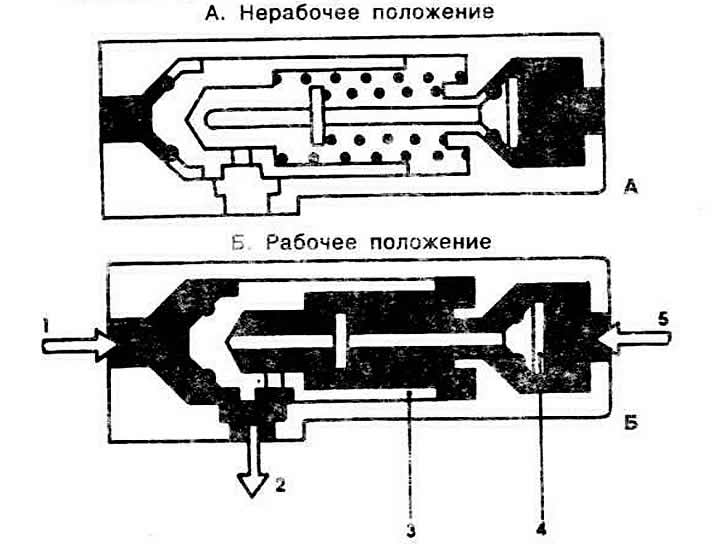
Operating principle of the supply pressure regulator 1 - fuel supply under supply pressure; 2 - fuel outlet to the fuel tank; 3 - plunger of the supply pressure regulator; 4 - isolation valve; 5 - fuel supply under control pressure.
[The article was copied from the website: AUDImanual.ru]