



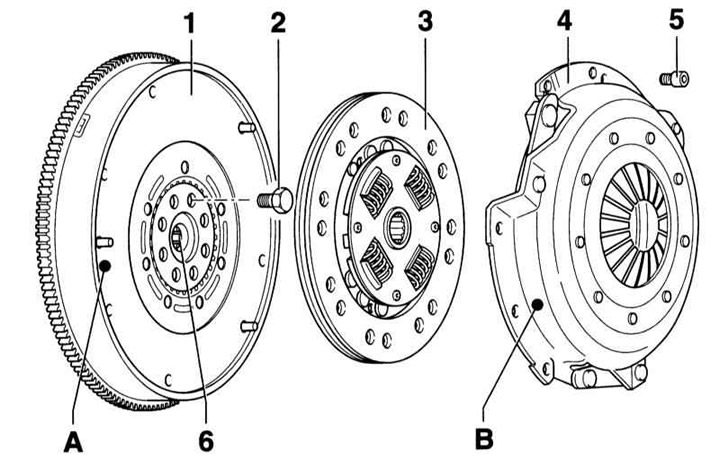
- 1 - Flywheel
The mating surface facing the friction linings must be smooth and free of oil and grease. Make sure the centering pins are securely positioned.
- 2 - Bolt for flywheel
Be sure to replace it. Attention: Clean the splines of the gearbox input shaft and, if installing a used clutch disc, the hub. Remove rust.
- without dual mass flywheel: 60 Nm + 90°.
- with dual mass flywheel and bolt length 22.5 mm: 60 Nm + 90°
- with bolt length 43 mm: 60 Nm + 180°
- 3 — Clutch slave disc
Installation position: The damping package (springs) must be facing the pressure plate. The friction linings of the driven disk must be adjacent to the flywheel, the inscription "gearbox side", if any, faces the pressure plate.
4 — Pressure plate. Observe the installation position
- 5 - Bolt 25Nm. Turn and wrap in several steps
A/B Coloured Dots. If present, the white dot (A) should be on the dual mass flywheel side and the white dot (B) should be on the pressure plate side.
The models in question are equipped with a single-disc dry clutch with a diaphragm spring.
The clutch consists of a basket with a pressure plate, a driven plate, a clutch release bearing and a hydraulic drive.
The clutch basket is bolted to the flywheel, which in turn is secured to the engine crankshaft. Between the pressure plate and the flywheel is the driven clutch disc, which is pressed against the flywheel by the pressure plate. The driven clutch disc is connected via a splined connection to the primary shaft of the gearbox.
When the clutch pedal is pressed, the clutch release bearing presses the pressure plate spring using the hydraulic drive. This relieves the pressure plate and the driven disk is no longer pressed against the flywheel. The power connection between the engine and transmission is interrupted.
The clutch of all models with manual transmission has a hydraulic drive. The working fluid is brake fluid, which comes from a common brake fluid reservoir.
Each time the clutch is engaged and disengaged, friction causes wear on the friction linings of the driven disk. The driven disk is a wearing element of the clutch. Its average service life is over 100,000 km. The wear rate depends on the load (driving with a trailer) and driving style. The clutch does not require maintenance, as it is self-adjusting.
Most engines are equipped with dual mass flywheel. This type of flywheel has a spring-damping system that allows to dampen torsional vibrations that occur during engine operation. In addition, this reduces the noise level at low speeds. The clutch disc with this type of flywheel consists of a hub, driven plate and friction linings. Damping springs are not installed.