
Repair Chevrolet Repair Toyota Repair Honda Repair AvtoVAZ Repair Mercedes-Benz Repair BMW Repair Opel
Home  |  Contacts  |  Sitemap  |    
English Русский
Български
Беларускі
Український
Српски
Hrvatski
Română
Polski
Slovenský
Magyar
AudiManual.ru


  • AUDI 80
  • AUDI 100
  • AUDI A3
  • AUDI A4
  • AUDI A6
  • AUDI A8
  • AUDI Q
  • OTHER
  • ARTICLES
B8 (2007-2015) B7 (2004-2008) B6 (2000-2006) B6 (2000-2006, petrol) B5 (1994-2001) B5 (1994-2001, petrol)

Bleeding air from the clutch hydraulic system (Audi A4 B6)

  • Home
  • Audi A4
  • B6 (2000-2006)
  • Transmission
  • Clutch and drive shafts
  • Bleeding air from the clutch hydraulic system
            0
Table of contents: Removal air using a special device ↓ Removal air without using special… ↓
Air must be removed from the clutch hydraulic system if the clutch disengages poorly when engaging any gear, the clutch pedal does not return back or returns slowly, or the hydraulic system has been opened.

Since the hydraulic clutch system operates on brake fluid, it is necessary to follow the instructions given in Section Bleeding the brake system.

Brake fluid is poisonous. Never suck it out with your mouth through a hose. Store brake fluid only in containers that cannot be accessed accidentally.

Warning: Do not allow brake fluid to come into contact with the gearbox. If this happens, wipe off the fluid immediately. Brake fluid is especially dangerous when it comes into contact with a magnesium alloy gearbox.


The operation of lifting and installing the car on stands is associated with danger! Therefore, before carrying out the operation, read the Section Jacking and towing.

1. Raise and support the vehicle on stands and remove the underbody cover, if equipped.

Removal air using a special device


At the service station, air is removed from the hydraulic system, as a rule, using a device. Such a device creates pressure (max 2.5 atm.) in the liquid tank.

1. Loosen the screws and remove the brake fluid reservoir cap. Fill the reservoir with fluid to the MAX mark.

2. Connect the air bleeder according to its manual without turning it on yet.

3. Open the ventilation valve before turning on the appliance.


4. Pull out the clutch pedal before bleeding.

5. On the clutch slave cylinder, place the hose (A) onto the ventilation nipple (arrow on the accompanying illustration), the nipple is open. Connect the ventilation hose to the hose of the brake fluid container.
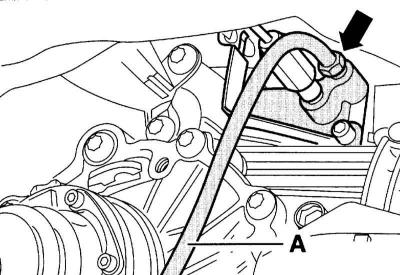
5. On the clutch slave cylinder, place the hose (A) onto the ventilation nipple (arrow on the…


6. Turn on the device and release approximately 100 cm³ of brake fluid. This is equivalent to the volume of a tea cup. At the end of the bleeding procedure, the air should not contain bubbles. Tighten the nipple with a torque of 4.5Nm.

7. Press the clutch pedal several times.

8. Fill the tank with liquid up to the MAX mark. Screw the cap onto the tank.

9. If necessary, repeat the air removal process.

10. Reinstall the lower gearbox cover if it was removed.

Removal air without using special devices


1. Check the brake fluid level in the common reservoir, if necessary, add fluid to the MAX mark.

2. Remove the dust boots from the air bleed nipple on the slave cylinder and from the front left wheel caliper.

3. Carefully open and close the air bleed valves.

4. Place a transparent hose on the caliper nipple.

5. Fill the hose with brake fluid. To do this, open the nipple on the caliper. Ask an assistant to slowly press the brake pedal and hold it in this position. Close the nipple and release the pedal. Then open the nipple again and press the pedal again. Repeat the process until the hose is filled with brake fluid. Close the hose with your finger so that the fluid does not leak out.


Caution: The fluid level in the reservoir should not fall too low, add fluid if necessary.


6. Place the free end of the hose on the clutch slave cylinder bleed nipple and open both nipples.

7. Press the brake pedal, close the nipple on the caliper and release the pedal. Repeat this process as many times as necessary to ensure that no fluid with air bubbles enters the reservoir. Keep adding fluid as you do so.

8. Close the nipples on the caliper and the clutch slave cylinder. Remove the hose and put on the dust boots.

9. Lower the car onto its wheels.

10. Fill the reservoir with brake fluid up to the MAX mark.

11. Press the brake pedal several times. This will ensure that any remaining air in the system is removed into the brake fluid reservoir.

12. Check the operation of the brake system and clutch.

Warning: During the above process, some air may remain in the hydraulic system. This is indicated by a grinding noise when engaging the gear and unclear disengagement of the clutch. In this case, immediately remove the air using a device at a service station.


(The article is a reprint of material from «audimanual.ru»)
The article was checked by auto expert Elisey Ermolaev
This article is available at russian, bulgarian, belarusian, ukrainian, serbian, croatian, romanian, polish, slovak, hungarian

Share information:
Previous articles
Audi A4 B6: Clutch and drive shafts
Next articles

Removal and installation the bearing
Removal, installation and checking the clutch
General information and clutch device
Clutch and Drive Shaft Specifications
The device of the drive shafts of the wheels
Removal and installation the drive shaft
Disassembling the drive shaft and replacing the protective cover
Quattro all-wheel drive system


Similar articles on other Audi car models:
Clutch hydraulic system — bleeding Audi 80 B3 (1986-1991, petrol)
Clutch hydraulic system — bleeding Audi 100 C3 (1982-1990, diesel)
Bleeding air from the clutch hydraulic system Audi A3 Type 8L (1996-2003)
Bleeding the hydraulic system of the clutch release drive Audi A6 C4 (1994-1997)
Bleeding the hydraulic clutch drive Audi A8 D2 (1994-2002)
Hydraulic clutch system Audi Q5 Type 8R (2008-2017)
Hydraulic clutch drive system Audi A2 (1999-2005)
Link to this page in different formats


Visitor comments

No comments yet


How much will 15 + 24 =


A4(B8, 2007-2015) 
  • General information
  • Operating instructions
  • Power unit
  • Petrol engines 1.8 l
  • Petrol engines 1.8/2.0 l
  • Petrol engines 3.0 l
  • Petrol engines 3.2 l
  • Fuel system (petrol)
  • Diesel engines 2.0 l (CA*)
  • Diesel engines 2.0 l (CJCB)
  • Diesel engines 2.7/3.0 l
  • Diesel engines 3.0 l
  • Fuel system (diesel)
  • Transmission
  • Manual gearbox 0B1
  • Manual gearbox 0B2
  • Manual gearbox 0B3
  • Manual gearbox 0B4
  • Automatic transmission 0B5
  • Automatic transmission 0B6
  • Automatic transmission 0AW
  • All-wheel drive system
  • Chassis
  • Front suspension
  • Rear suspension
  • Brake system
  • Steering system
  • Body
  • Exterior
  • Interior
  • Seats
  • Doors, locks and windows
  • Security system
  • Heating and air conditioning
  • Electrical equipment
  • Audio system
  • Power devices
  • Equipment and devices
  • Lighting and lamps
  • Electrical circuits
 
A4(B7, 2004-2008) 
  • General information
  • Introduction to manual
  • Troubleshooting
  • Operating instructions
  • Maintenance
  • Power unit
  • Petrol engines 2.0 (ALT)
  • Petrol engines 2.0 (TFSI)
  • Petrol engines 1.8 (MPI)
  • Diesel engines
  • Cooling system
  • Air conditioner
  • Fuel and exhaust system
  • Ignition system
  • Starting and charging
  • Transmission
  • Clutch
  • Manual gearbox
  • Automatic gearbox
  • Drive shafts
  • Chassis
  • Brake system
  • Front suspension
  • Rear suspension
  • Steering
  • Body
  • Exterior
  • Interior
  • Electrical equipment
  • Equipment and devices
  • Lighting and signaling
  • Windscreen wipers and washers
  • Electrical diagrams
  • Electrical diagrams (since 2007)
 
A4(B6, 2000-2006) 
  • General information
  • Vehicle Description
  • User manual
  • Maintenance
  • Power unit
  • Gasoline engine
  • Diesel engine
  • Lubrication system
  • Cooling system
  • Supply system
  • Injection system
  • Exhaust system
  • Ignition and control
  • Transmission
  • Gear box
  • Clutch and drive shafts
  • Chassis
  • Brake system
  • Car suspension
  • Steering
  • Body
  • Heating and ventilation
  • Exterior (external elements)
  • Interior (internal elements)
  • Electrical equipment
  • Power devices
  • Lighting and appliances
  • Electrical circuits
 
A4(B6, 2000-2006, petrol) 
  • General information
  • Introduction to the guide
  • Car care
  • Power unit
  • Engine repair
  • Lubrication system
  • Cooling system
  • Injection and control system
  • Ignition system
  • Power and exhaust system
  • Transmission
  • Clutch and drive shafts
  • Car gearbox
  • Chassis
  • Suspension and wheels
  • Steering
  • Brake system
  • Body
  • Interior
  • Exterior
  • Electrical equipment
  • Equipment and devices
  • Lighting and signaling
  • Power devices
  • Electrical circuits
 
A4(B5, 1994-2001) 
  • General information
  • Introduction to the guide
  • Car care
  • Maintenance (gasoline)
  • Maintenance (diesel)
  • Power unit
  • Gasoline engines
  • Diesel engines
  • Engine overhaul
  • Cooling system
  • Fuel injection (gasoline)
  • Fuel system (diesel)
  • Exhaust system
  • Ignition system
  • Transmission
  • Clutch
  • Mechanical gearbox
  • Automatic gearbox
  • Drive shafts
  • Chassis
  • Brake system
  • Car suspension
  • Steering
  • Body
  • Exterior
  • Interior
  • Doors, locks and windows
  • Heating and ventilation
  • Electrical equipment
  • Power devices
  • Equipment and devices
  • Electrical circuits
 
A4(B5, 1994-2001, petrol) 
  • General information
  • Vehicle description
  • Maintenance
  • Power unit
  • Engine repair
  • Turbocharging
  • Exhaust system
  • Cooling system
  • Ignition system
  • Fuel system
  • Motronic injection system
  • MPI and MPFI injection system
  • Transmission
  • Clutch
  • Gearbox and shafts
  • Chassis
  • Steering
  • Car suspension
  • Brake system
  • Wheels and tires
  • Body
  • Heating and ventilation
  • Body parts
  • Electrical equipment
  • Fuses and relays
  • Power devices
  • Lighting and lamps
  • Tools and devices
  • Electrical circuits
 
AudiManual.ru © 2017-2026 · Mobile version · Feedback · Sitemap: EN BG BY UA RS HR RO PL SK HU · Site search · News and articles
80 B2 · 80 B3 petrol · 80 B3 · 80 B4 · 100 C3 diesel · 100 C3 petrol · 100 C3 · 100 C4 petrol · 100 C4 · A3 Type 8L · A4 B5 petrol · A4 B5 · A4 B6 petrol · A4 B6 · A4 B7 · A4 B8 · A6 C4 · A6 C5 · A6 C5 Allroad · A8 D2 · Q5 Type 8R · Q7 Typ 4L · Audi A2 ·
This site uses cookies 🍪. Click the button to accept this fact.