



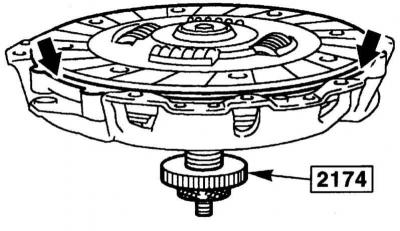
Warning: To install the clutch, you will need the AUDI-3176 centering mandrel or a standard centering tool such as the HAZET 2174.
Removal
1. Remove the gearbox, refer to Section Removal and installation of gearbox.
2. To prevent the flywheel from turning when unscrewing the mounting bolts, secure the flywheel with a screwdriver and mandrel or the AUDI-3067 tool.
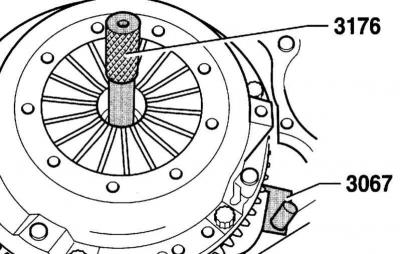
Warning: The AUDI-3067 tool is shown in the accompanying illustration in the installed position, when removing the tool, it must be turned upside down.
3. Loosen the pressure plate mounting bolts crosswise by 1 – 1.5 turns to relieve the pressure plate.
Caution: If the bolts are completely loosened immediately, the pressure springs may be damaged.
4. After loosening the bolts, unscrew them completely.
5. Remove the pressure and driven disks.
Caution: Do not drop the discs when removing them, otherwise, after installation, difficulty in disengaging the clutch and jerky operation may occur.
6. Wipe the clutch release bearing without rinsing it.
7. Wipe the flywheel.
Examination
1. Check the pressure plate for signs of overheating and grooves.
2. Check the ends of the pressure springs (arrows in the accompanying illustration). Wear up to half of their thickness is allowed.
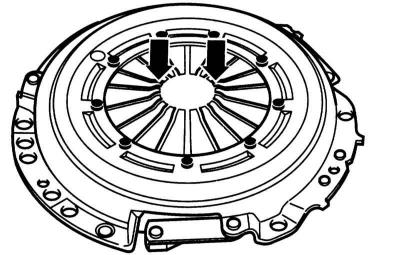
3. Check the spring connections between the pressure plate and the cover for cracks. Check the reliability of the riveted connections. If the rivets are loose, the clutch must be replaced.
4. Check the adjacent surfaces for cracks, traces of overheating and wear. Pressure plates with an inward deflection of up to 0.2 mm can be used further. The check is carried out using a ruler and a set of feeler gauges.
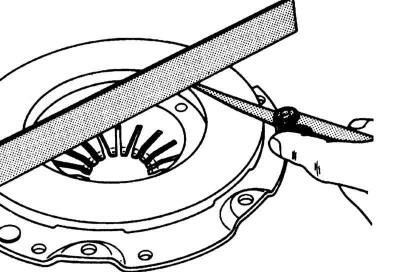
5. Check the flywheel for signs of overheating and grooves.
6. An oily disc or a disc with mechanical damage should be replaced.
7. Check the thickness of the friction linings.
8. At the service station you can check the end runout of the disk. It should not exceed 0.8 mm (at a distance of 2.5 mm from the edge).
Caution: This check is only done on an old disc that was causing difficulty disengaging the clutch. If necessary, carefully straighten the disc.
9. Check the disc with your hand in the installed position. To do this, lightly squeeze the bearing with your hand and turn it. The bearing should rotate easily.
Caution: For clutch release bearings with a plastic ring, the ring may come off when removing the transmission or the bearing itself. This is not a reason to replace the bearing.
10. Before installing the gearbox, glue the detached ring to the bearing ring with AMW 195 KD 01 glue. In this case, the 3 noses of the plastic ring (arrows in the accompanying illustration) must enter the grooves of the bearing ring.
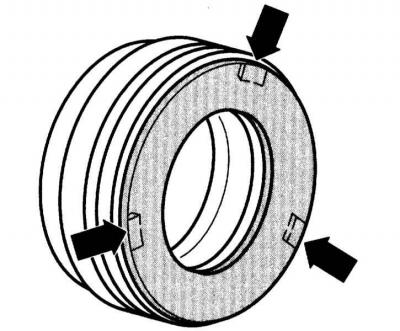
Warning: If the working surface of the plastic ring is worn more than 0.5 mm, the clutch release bearing must be replaced
11. When the car is moving, a damaged clutch release bearing will make noise when the clutch pedal is pressed. In this case, the bearing must be replaced.
Installation
Warning: Check new parts against the catalog. If used parts are installed, they must be checked beforehand.
Warning: If the old clutch disc has burned out due to overload, the pressure plate, flywheel and engine side of the gearbox must be thoroughly cleaned to eliminate the smell.
1. Before installing a new pressure plate, remove the protective anti-corrosion grease only from its working surface. Do not remove the grease from other places under any circumstances, as this may significantly reduce the service life of the clutch.
2. Check the reliability of the installation of the centering mandrel on the flywheel.
3. Clean the splines of the driven disk from rust. Lubricate the teeth of the primary shaft with a thin layer of MoS2 grease. Service stations use AUDI-G000100 grease for this. After this, move the driven disk in different directions on the primary shaft so that the hub moves easily along the shaft. Be sure to remove excess grease.
4. When installing the driven disk, make sure that the coil spring pack or the inscription "Getriebeseite" ("Gearbox side") is facing the gearbox side. The friction linings should be in contact with the flywheel. If there are color marks, make sure that the white dots of the dual mass flywheel (A) and the pressure plate (B) are opposite each other, refer to the illustration Flywheel, basket and clutch disc.
5. Center the driven disk on the pressure plate using a drift, for example, HAZET 2174 or AUDI-3176. If the driven disk is not centered, it will be impossible to insert the input shaft later.
6. Install the pressure plate onto the centering pins on the flywheel.
Caution: The pressure plate must be fully seated on the flywheel. Only then insert the mounting bolts. Never tighten the pressure plate with the bolts, otherwise the centering pins and their holes may be damaged.
7. Tighten the pressure plate mounting bolts crosswise by 1–1.5 turns. Then tighten the bolts to the torque 25 Nm. In this case, the pressure plate should not be skewed, since otherwise the centering pins and their holes may be damaged.