
Repair Chevrolet Repair Toyota Repair Honda Repair AvtoVAZ Repair Mercedes-Benz Repair BMW Repair Opel
Home  |  Contacts  |  Sitemap  |    
English Русский
Български
Беларускі
Український
Српски
Hrvatski
Română
Polski
Slovenský
Magyar
AudiManual.ru


  • AUDI 80
  • AUDI 100
  • AUDI A3
  • AUDI A4
  • AUDI A6
  • AUDI A8
  • AUDI Q
  • OTHER
  • ARTICLES
B8 (2007-2015) B7 (2004-2008) B6 (2000-2006) B6 (2000-2006, petrol) B5 (1994-2001) B5 (1994-2001, petrol)

Turbocharger — General Information and Precautions (Audi A4 B6)

  • Home
  • Audi A4
  • B6 (2000-2006)
  • Power unit
  • Exhaust system
  • Turbocharger — General Information and Precautions
            0
Turbocharger — General Information and Precautions


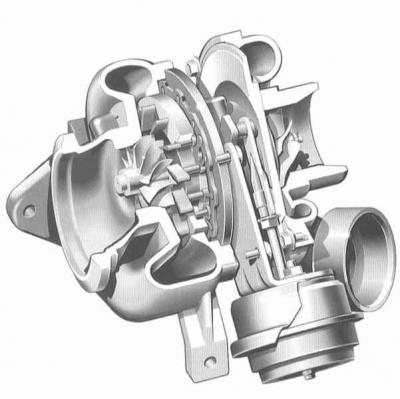
Turbocharger. Diesel engine
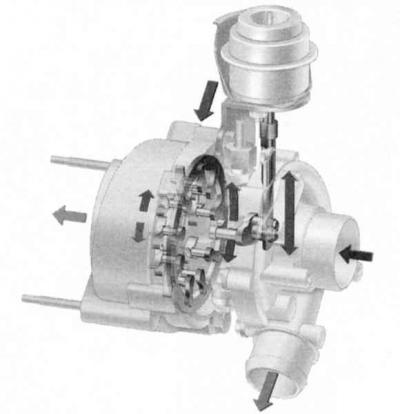
Turbocharger. Diesel engine


Turbocharger VTG

All diesel engines, as well as some petrol engines, of the AUDI A4 are equipped with a turbocharger. On the turbocharger shaft, two working wheels are located in two separate housings. The turbine wheels are driven by exhaust gases. They ensure the rotation of the turbocharger shaft and thus both turbine wheels at a speed of 300,000 rpm. The turbocharger is lubricated by the engine lubrication system.

In a gasoline engine, the turbocharger is additionally cooled by liquid.

Due to good filling of the cylinders with forced air, engine power increases up to 100%.

The turbocharger is designed to increase engine power (up to 100%) by increasing the air pressure in the intake manifold. Air does not simply enter the cylinders, but is supplied to them under pressure. Along with power, supercharging creates an increase in engine torque. The increase in power, among other things, depends on the pressure of the supercharged air, which is usually 0.4-0.8 atm. The pressure of the supercharged air is constantly monitored and regulated by the engine control unit. This eliminates the possibility of exceeding the pressure above the set value. In accordance with the increase in air supply, the high-pressure fuel pump increases the fuel supply.


The compressor turbine is driven by the exhaust gases. The gases pass through a special casing (compressor casing), are fed to the compressor turbine. The turbine rotates on a shaft, at the other end of which is a compressor wheel in a separate casing. It is this that feeds air under pressure into the pipeline.

The turbocharger with variable turbine geometry (VTG) has guide vanes whose position is controlled by the engine control unit via a solenoid valve and a vacuum actuator. This ensures optimum boost pressure across the entire speed range, resulting in higher torque and thus higher power, particularly at low speeds.

An air cooler is located between the turbocharger and the engine intake duct (intercooler), which cools the air pre-compressed by the turbocharger. This increases engine power because cold air, due to its higher density, has a higher oxygen content.

The air pressure in the pipeline is limited by a special sensor. When the maximum pressure is reached, the sensor opens the valve, thereby limiting the supply of exhaust gases to the turbine.

The compressor shaft is lubricated with engine oil, which is supplied through a specially designed hose. The shaft constantly "floats" in oil. From the compressor, the oil is discharged into the pan through the return hose.

Compared to a petrol engine, a diesel engine does not need to reduce the compression ratio due to turbocharging, which ensures that the injected fuel is fully utilised even at low revs.

The turbocharger is an integral part of the exhaust manifold and cannot be separated from it.


The turbocharger is a precision mechanism. Therefore, if a malfunction occurs, it must be completely replaced.

Precautionary measures


The rotation speed of the compressor turbines is enormous, and the operating temperature is very high. In order to avoid injury and damage to the turbocharger, please observe the following precautions.
  • Do not start the engine after removing any turbocharger component. Foreign objects getting into the turbine blades can cause them to fail. You also risk injury from objects thrown from the turbine.
  • After removing any turbocharger components or air intake hoses, cover it with a clean rag.
  • Do not give gas immediately after starting the engine, especially if it is not warmed up. Oil cannot immediately lubricate the turbine shaft.
  • Never turn off the ignition immediately after stopping the car. Do not press the accelerator pedal before stopping the engine. Immediately after turning off the ignition, oil is no longer supplied to the compressor shaft, and it will rotate for some time without lubrication.
  • Before turning off the engine, let it idle for a few minutes, during which time the turbine speed will decrease significantly.
  • Change the oil, oil filter and air cleaner regularly. Using old oil will cause deposits to form on the compressor shaft and cause it to fail. Before disconnecting the oil supply and return hoses from the compressor, thoroughly clean the surrounding surfaces. Store removed components in sealed containers.


[The original publication in its entirety is posted on the website: audimanual.ru]
The article was checked by auto expert Elisey Ermolaev
This article is available at russian, bulgarian, belarusian, ukrainian, serbian, croatian, romanian, polish, slovak, hungarian

Share information:
Previous articles
Audi A4 B6: Exhaust system
Next articles

Removal and installation of the catalytic converter and lambda…
Catalytic converter
Emission control systems
Exhaust System/Tailpipe Routing Adjustment
Intercooler — general information


Similar articles on other Audi car models:
General description and precautions Audi 80 B3 (1986-1991, petrol)
General information Audi 100 C3 (1982-1990, diesel)
Generator — General Information and Safety Precautions Audi A3 Type 8L (1996-2003)
General information and precautions Audi A6 C5 Allroad (1999-2005)
General information about the 2.8L petrol engine Audi A8 D2 (1994-2002)
General information and safety precautions: power supply system Audi Q7 Typ 4L (2005-2015, diesel)
General information about the fuel injection system Audi A2 (1999-2005)
Link to this page in different formats


Visitor comments

No comments yet


How much will 44 + 44 =


A4(B8, 2007-2015) 
  • General information
  • Operating instructions
  • Power unit
  • Petrol engines 1.8 l
  • Petrol engines 1.8/2.0 l
  • Petrol engines 3.0 l
  • Petrol engines 3.2 l
  • Fuel system (petrol)
  • Diesel engines 2.0 l (CA*)
  • Diesel engines 2.0 l (CJCB)
  • Diesel engines 2.7/3.0 l
  • Diesel engines 3.0 l
  • Fuel system (diesel)
  • Transmission
  • Manual gearbox 0B1
  • Manual gearbox 0B2
  • Manual gearbox 0B3
  • Manual gearbox 0B4
  • Automatic transmission 0B5
  • Automatic transmission 0B6
  • Automatic transmission 0AW
  • All-wheel drive system
  • Chassis
  • Front suspension
  • Rear suspension
  • Brake system
  • Steering system
  • Body
  • Exterior
  • Interior
  • Seats
  • Doors, locks and windows
  • Security system
  • Heating and air conditioning
  • Electrical equipment
  • Audio system
  • Power devices
  • Equipment and devices
  • Lighting and lamps
  • Electrical circuits
 
A4(B7, 2004-2008) 
  • General information
  • Introduction to manual
  • Troubleshooting
  • Operating instructions
  • Maintenance
  • Power unit
  • Petrol engines 2.0 (ALT)
  • Petrol engines 2.0 (TFSI)
  • Petrol engines 1.8 (MPI)
  • Diesel engines
  • Cooling system
  • Air conditioner
  • Fuel and exhaust system
  • Ignition system
  • Starting and charging
  • Transmission
  • Clutch
  • Manual gearbox
  • Automatic gearbox
  • Drive shafts
  • Chassis
  • Brake system
  • Front suspension
  • Rear suspension
  • Steering
  • Body
  • Exterior
  • Interior
  • Electrical equipment
  • Equipment and devices
  • Lighting and signaling
  • Windscreen wipers and washers
  • Electrical diagrams
  • Electrical diagrams (since 2007)
 
A4(B6, 2000-2006) 
  • General information
  • Vehicle Description
  • User manual
  • Maintenance
  • Power unit
  • Gasoline engine
  • Diesel engine
  • Lubrication system
  • Cooling system
  • Supply system
  • Injection system
  • Exhaust system
  • Ignition and control
  • Transmission
  • Gear box
  • Clutch and drive shafts
  • Chassis
  • Brake system
  • Car suspension
  • Steering
  • Body
  • Heating and ventilation
  • Exterior (external elements)
  • Interior (internal elements)
  • Electrical equipment
  • Power devices
  • Lighting and appliances
  • Electrical circuits
 
A4(B6, 2000-2006, petrol) 
  • General information
  • Introduction to the guide
  • Car care
  • Power unit
  • Engine repair
  • Lubrication system
  • Cooling system
  • Injection and control system
  • Ignition system
  • Power and exhaust system
  • Transmission
  • Clutch and drive shafts
  • Car gearbox
  • Chassis
  • Suspension and wheels
  • Steering
  • Brake system
  • Body
  • Interior
  • Exterior
  • Electrical equipment
  • Equipment and devices
  • Lighting and signaling
  • Power devices
  • Electrical circuits
 
A4(B5, 1994-2001) 
  • General information
  • Introduction to the guide
  • Car care
  • Maintenance (gasoline)
  • Maintenance (diesel)
  • Power unit
  • Gasoline engines
  • Diesel engines
  • Engine overhaul
  • Cooling system
  • Fuel injection (gasoline)
  • Fuel system (diesel)
  • Exhaust system
  • Ignition system
  • Transmission
  • Clutch
  • Mechanical gearbox
  • Automatic gearbox
  • Drive shafts
  • Chassis
  • Brake system
  • Car suspension
  • Steering
  • Body
  • Exterior
  • Interior
  • Doors, locks and windows
  • Heating and ventilation
  • Electrical equipment
  • Power devices
  • Equipment and devices
  • Electrical circuits
 
A4(B5, 1994-2001, petrol) 
  • General information
  • Vehicle description
  • Maintenance
  • Power unit
  • Engine repair
  • Turbocharging
  • Exhaust system
  • Cooling system
  • Ignition system
  • Fuel system
  • Motronic injection system
  • MPI and MPFI injection system
  • Transmission
  • Clutch
  • Gearbox and shafts
  • Chassis
  • Steering
  • Car suspension
  • Brake system
  • Wheels and tires
  • Body
  • Heating and ventilation
  • Body parts
  • Electrical equipment
  • Fuses and relays
  • Power devices
  • Lighting and lamps
  • Tools and devices
  • Electrical circuits
 
AudiManual.ru © 2017-2026 · Mobile version · Feedback · Sitemap: EN BG BY UA RS HR RO PL SK HU · Site search · News and articles
80 B2 · 80 B3 petrol · 80 B3 · 80 B4 · 100 C3 diesel · 100 C3 petrol · 100 C3 · 100 C4 petrol · 100 C4 · A3 Type 8L · A4 B5 petrol · A4 B5 · A4 B6 petrol · A4 B6 · A4 B7 · A4 B8 · A6 C4 · A6 C5 · A6 C5 Allroad · A8 D2 · Q5 Type 8R · Q7 Typ 4L · Audi A2 ·
This site uses cookies 🍪. Click the button to accept this fact.