



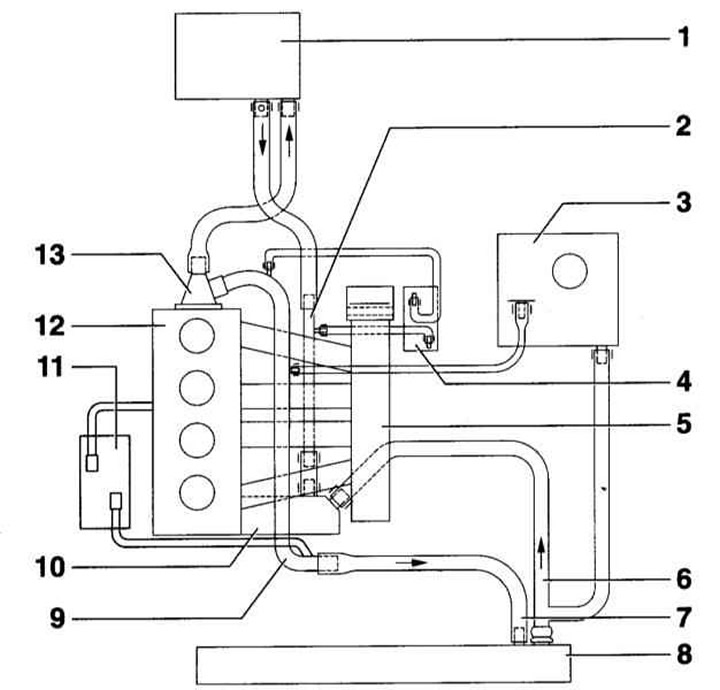
- 1 — Heater radiator
- 2 — Lower coolant pipe
- 3 - Expansion tank
- 4 - Oil cooler
- 5 — Inlet manifold
- 6 - Lower radiator hose
- 7 - Upper radiator hose
- 8 — Radiator
- 9 — Upper coolant pipe
- 10 - Water pump with thermostat
- 11 — Turbocharger
- 12 — Block and cylinder head
- 13 — Outlet fitting
Some models use a coolant temperature control system that operates according to a characteristic set in the control unit. Compared to a conventional cooling system, such a system increases the thermodynamic efficiency of the engine and thus optimizes the torque characteristic.
The cooling system, operating according to a given characteristic, consists of a coolant distributor with a thermostat, an electric heating element, and springs for mechanically locking the coolant channels.
By means of a heated thermostat, the temperature of the coolant is regulated by the engine control unit according to the characteristic built into it. At the same time, the temperature is maintained at an optimum level in terms of the engine's output power.
For example, when the engine is fully loaded, the expansion element heats up and thus the thermostat opens more. This reduces the temperature of the coolant, which leads to more intensive cooling of the combustion chambers. Cooler combustion chambers lead to earlier ignition and thus to an increase in engine torque.
The coolant is directed through the radiator by a continuously operating pump. The liquid passes through the radiator from top to bottom and is cooled by the air passing through it. An electric coolant fan is used.
Heater and ventilation
The heater consists of fans and heat exchangers located in the front and rear sections of the passenger compartment. Hot coolant passes through the heat exchangers. When the heater control handle located on the control panel is moved, the valves open and hot air begins to flow into the passenger compartment. If you turn on the heater fan, air will be forced into the passenger compartment.
The intake air passes through a filter before entering the passenger compartment (refer to Chapter Routine care and maintenance). The bulk of dust particles will settle in the filter. It is necessary to observe the frequency of filter replacement. A filter clogged with dust will limit the air supply to the cabin, which will lead to stagnation of air inside the cabin.
Distribution of air flows of the ventilation system is carried out by means of dampers. Air circulation mode is provided. The dampers are controlled by servo drives.