



1. If the tank is still full of fuel, insert the hose through the filler neck as far as possible into the tank.
2. Close the top hole of the hose tightly with your finger. The container for receiving the drained fuel should be below the bottom of the tank. Pull the hose out of the tank a little and lower the end of the hose into the container. If the hose is immersed in the fuel to a sufficient depth, the fuel will begin to flow out under pressure. Sucking fuel through the hose with your mouth is dangerous to your health.
3. If there is little fuel in the tank, this method will not help. In this case, pump out the fuel with a suitable hand pump (bellows pump with hose).
Safety precautions when working with a fuel tank
When installing and removing the fuel level sensor or fuel pump (fuel pump module) when using fuel from a partially or completely filled tank, always remember that the fuel supply line is under pressure. Therefore, before loosening the hose connections, cover the connection point with a clean cloth. Then, carefully remove the hose to relieve the pressure.
Before starting work, a hose of the exhaust gas suction device must be placed near the mounting hole on the fuel tank to suck out the gases that are emitted. If such a special device is not available, a centrifugal fan with a motor located outside the air flow can be used. The volume flow of the fan must be at least 15 m³/h.
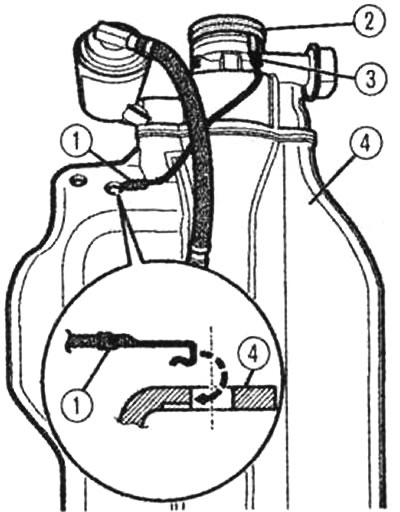
The contact tongue 1 of the connection to the body must engage with the mounting hole on the fuel tank 4, and the plug of the connector 3 must be securely fastened to the ring 2 of the filler neck.
The plastic fuel tank must be grounded, so pay attention to the installation position of the ground connection during any work. After installation, use an ohmmeter to check the electrical connection between the ring on the filler neck of the fuel tank and the bare spot on the body. The resistance of this connection should be zero.