



Due to the fact that special tools are required when checking and, above all, dismantling the fuel pump (spanner for socket nuts, etc.), these works should be carried out in a workshop. If you suspect a malfunction of the fuel pump, then the search for defects should be limited to the actions described below. Take into account that the pump supplies fuel poorly, or does not supply it at all, also if the fuel filter is clogged or the relay in the central distribution device has failed.
1. First check the fuel pump fuse (socket 28) in the fuse box on the left side of the instrument panel.
2. If you have a keen hearing, you can hear the noise of the pump. You need to listen in the rear of the car at the level of the fuel tank, the assistant should turn on the ignition at this time.
3. If you hear the noise of the pump, then the pump is probably normal. If you do not hear the noise, check the fuel supply.
4. To do this, remove the supply or return line of the petrol injection system. Caution, the lines may be under pressure. Lower the line into a suitable container.
5. Some fuel should come out of the pipeline even when the engine is not running, since there is residual pressure in the system.
6. If gasoline does not flow out, ask an assistant to operate the starter. The pump should then supply fuel.
7. If gasoline does not come out, check the power supply to the pump on the blind flange of the fuel tank.
8. To do this, unscrew the blind flange cover under the boot floor trim. First, you need to fold the rear seat forward.
9. Disconnect the four-pin connector. To do this, you need to carefully unlock it with a screwdriver.
10. To measure the voltage, connect the multimeter to the outer contacts 1 and 4 of the connector. Ask an assistant to operate the starter. While the starter is running, the multimeter should show the battery voltage.
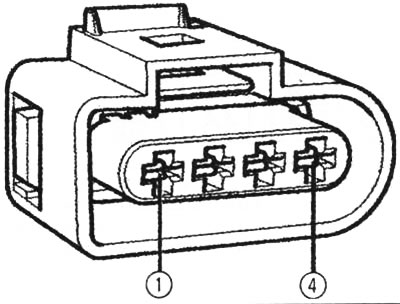
To measure voltage, connect the multimeter to the external contacts
11. If the nominal value is not achieved, this may be due to a fault in the corresponding relay, for this see chapter "Electrical equipment".
12. If the nominal value is achieved and no noise from the pump operation is heard, carefully inspect the fuel pump. To do this, remove the fuel pump module (see description of relevant work operations).
13. Check the connection and integrity of the wires between the flange and the fuel pump. If no defect is found, replace the fuel pump module.
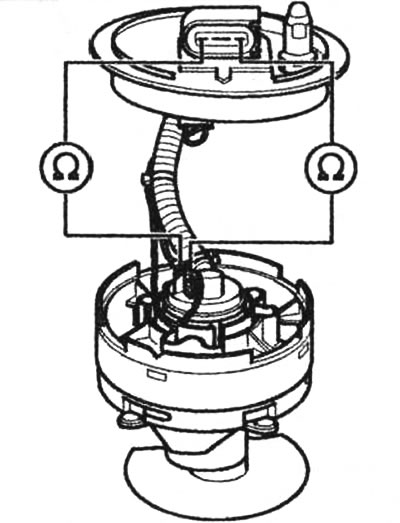
Check the integrity of the wires between the flange and the fuel pump