



Open large image in new window »
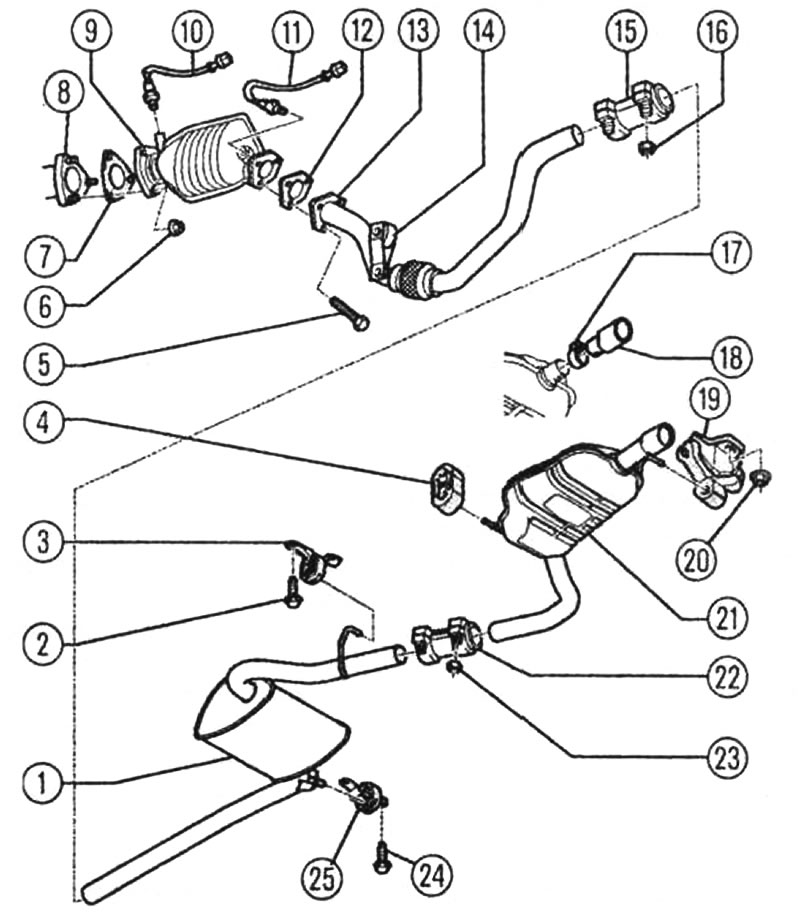
Exhaust system of a four-cylinder engine: 1 - front muffler, 2, 5, 20 and 24 - bolt 25 Nm, 3, 4, 14, 19 and 25 - suspension, 6 - nut 30 Nm, 7 and 12 - seal, 8 - exhaust manifold, 9 - catalytic converter, 10 and 11 - oxygen sensor 55 Nm, 13 - front exhaust pipe, 15 and 22 - fastening sleeve, 17 - clamp 25 Nm, 18 - muffler outlet pipe, 20 - nut 25 Nm, 21 - additional muffler (when equipped by the manufacturer, together with the front muffler it forms a single unit), 23 - nut 40 Nm.
In all cases, the manifold is followed by a catalytic converter, a front exhaust pipe, a middle muffler and an additional muffler. The system components are connected to each other using bolted connections or clamps and can be replaced individually. When assembled at the factory, the middle and additional mufflers are installed in one continuous exhaust pipe. In the event of repairs, the mufflers can be replaced individually. To do this, the connecting pipe must be cut at the designated place. After installation, both parts are connected using a fastening sleeve. In vehicles with all-wheel drive, a different exhaust system is installed. In vehicles with direct gasoline injection with stratified charge (FSI), the exhaust gases are also cleaned differently.
In all models, excessive exposure of the lower body parts to heat radiation is prevented by heat shields. After removal, seals and self-locking nuts must be replaced. If necessary, the retaining rings and rubber shock absorbers must also be replaced.
Terminology
Carbon monoxide (CO). The monoxide content is measured during exhaust toxicity testing. The prerequisite for low CO content is the precise dosage of the injected fuel quantity, ignition timing adjustment and uniform swirl of the mixture in the combustion chamber. In closed spaces, carbon monoxide is toxic; when combined with atmospheric oxygen, it forms non-toxic carbon dioxide, which plays a significant role in the greenhouse effect.
Hydrocarbons (CH). Hydrocarbons do not burn completely in cold places and in the corners of the combustion chamber. The proportion of hydrocarbons depends on the engine design (immutable parameter), however, hydrocarbon emissions also increase due to a fuel mixture that is too rich or too lean. Together with carbon oxides, hydrocarbons are responsible for the formation of smog.
Nitrogen oxides (NOx). The nitrogen oxide content of the exhaust gas increases at high combustion temperatures. This occurs, for example, in engines that are designed to emit small amounts of CO and CH (this reduces fuel consumption). At high concentrations, nitrogen oxides can irritate the respiratory system. When combined with water, they form nitric acid (sour rain).
Sulfur. The efficiency of the NO* storage catalytic converter is significantly reduced by the sulfur content of the fuel. The sulfur content of normal gasoline is 150 ppm. In the future, low-sulfur fuel will be required (less than 10 ppm).
Special control of exhaust gas toxicity. Special testing of toxic exhaust gases with a regulated catalytic converter has been mandatory since December 1993. For new vehicles, the results of the testing are valid for three years, then the testing must be carried out every two years. During the testing, the exhaust system must be in good working order, and no additional air must enter the intake system.