



When installing the fastening sleeve, make sure that the end of the bolt does not protrude beyond the lower edge of the sleeve.
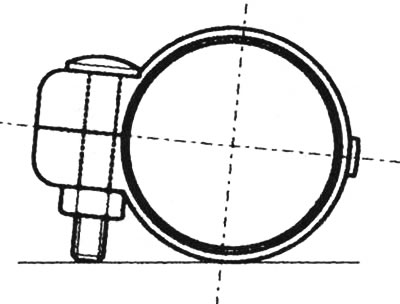
Mounting position of the clamping sleeve
Replacing the exhaust system is made easier by the markings on its parts. For example, if you are replacing the muffler outlet pipe 1, you must cut it at a right angle at the separation point using a special saw. The new pipe 3 is pushed up to mark A. The cutout in the pipe must be aligned with mark B. The clamping screw 2 is tightened to a torque of 25 Nm.
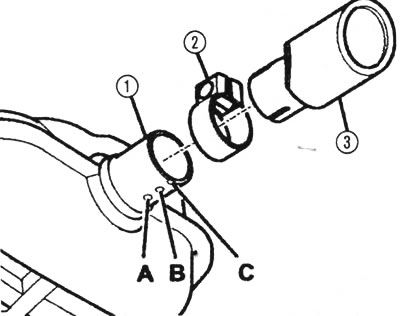
Markings make it easier to install the exhaust pipe of the muffler when replacing it
1. Place the car on trestles in such a way that it is vibration-resistant. After all, the car should not tip over when you rotate or pull the pipes with force.
2. If any bolt connection does not loosen during disassembly, strip the threads. Be sure to use new bolts and nuts when installing.
3. To be on the safe side, also replace the rubber holders.
4. If a part of the exhaust system has already been replaced, it is best to disconnect the detachable connections at the end of the pipes when they are hot. In workshops, a welding torch is used for this, but a propane gas torch can also be used. When doing this, be sure to have a fire extinguisher at hand. If you do not have a gas torch, try using rust dissolving agents.
5. The pipes are separated by means of strong rotational movements or hammer blows.
6. If this does not help, cut the pipe connection of the faulty muffler at a distance of 10 centimeters behind the place of connection. Cut the rest of the pipe lengthwise with a metal saw and break it with a powerful screwdriver.
7. If you lubricate the threads with heat-resistant copper grease during installation, the bolted connections will be easier to loosen next time. The same applies to pipe connections.
[This publication is borrowed from the resource audimanual]