
Repair Chevrolet Repair Toyota Repair Honda Repair AvtoVAZ Repair Mercedes-Benz Repair BMW Repair Opel
Home  |  Contacts  |  Sitemap  |    
English Русский
Български
Беларускі
Український
Српски
Hrvatski
Română
Polski
Slovenský
Magyar
AudiManual.ru


  • AUDI 80
  • AUDI 100
  • AUDI A3
  • AUDI A4
  • AUDI A6
  • AUDI A8
  • AUDI Q
  • OTHER
  • ARTICLES
B8 (2007-2015) B7 (2004-2008) B6 (2000-2006) B6 (2000-2006, petrol) B5 (1994-2001) B5 (1994-2001, petrol)

Neutralization of exhaust gases (Audi A4 B6)

  • Home
  • Audi A4
  • B6 (2000-2006, petrol)
  • Power unit
  • Power and exhaust system
  • Neutralization of exhaust gases
            0
Table of contents: Adjustable three-way catalytic… ↓ Operating temperature of the… ↓ Handling the catalytic converter ↓ Exhaust system for FSI engines ↓
Fuel is mainly composed of carbon and hydrogen. When burned in an engine, carbon combines with oxygen in the air to form carbon dioxide (CO₂), and when hydrogen (H₂) combines with oxygen (O₂) to form water (H₂ O). When one liter of fuel is burned, about 0.9 liters of water is produced, this water evaporates from the system under the influence of heat. In winter, after starting a cold engine, you often see white clouds of exhaust gases - this is a sign of condensation.
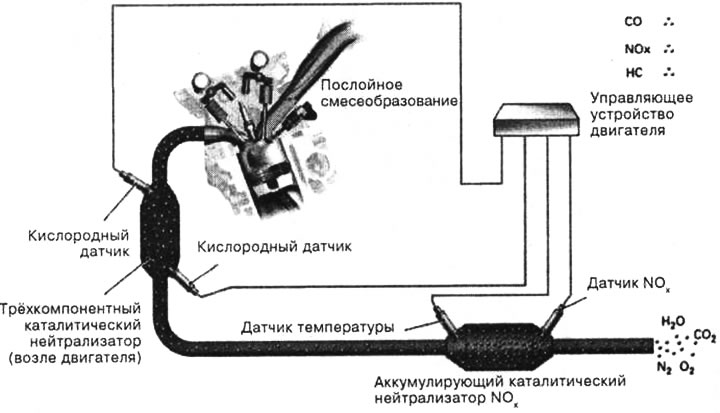
Exhaust gas aftertreatment in the FSI engine leads to further reduction of harmful emissions

Exhaust gas aftertreatment in the FSI engine leads to further reduction of harmful emissions


Adjustable three-way catalytic converter


All models sold in Germany are equipped with a regulated three-way catalytic converter. Over the course of its service life, the converter reduces the content of carbon monoxide by 85 percent, hydrocarbons by 80 percent, and nitrogen oxides by 70 percent. However, the efficiency of the converter decreases over time. The name "regulated" means that the reduction of harmful substances is regulated depending on the composition of the fuel-air mixture.
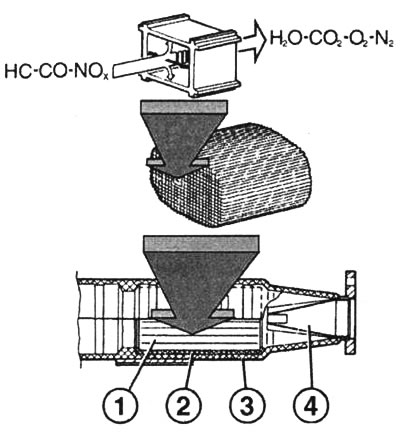


The oxidation process in the catalytic converter of exhaust gases (diagram): The catalytic…

The oxidation process in the catalytic converter of exhaust gases (diagram): The catalytic converter consists of a cellular structure of a ceramic substrate 1, the ceramic substrate is embedded in an elastic metal fabric 2, which dampens vibrations. This package is enclosed in a heat-resistant housing 3, which is made of special steel. In order for the incoming exhaust gases to pass by the cells evenly, a funnel-shaped mesh 4 is placed in front of the converter.


Operating temperature of the catalytic converter


In order for the catalytic converter and the oxygen sensor to function properly, they must be very hot (catalytic converter: up to approximately 300°C). This usually takes 20-80 seconds. However, both the converter and the sensor are very sensitive to overheating. For example, if the unburned mixture ignites in a hot converter, the temperature rises to dangerous values. If the temperature in the catalytic converter reaches 900°C, the converter ages quickly, and at temperatures above 1200°C it is destroyed. At temperatures above 1400°C, the ceramic body of the oxygen sensor melts. The exhaust system then becomes clogged, and the engine loses power.


Handling the catalytic converter


If the engine does not start due to a dead battery, do not tow or push the engine to start it, as this may introduce unburned fuel into the catalytic converter and cause long-term damage to the converter.

Misfires and interruptions in ignition indicate a malfunction of the ignition system, immediately check the system in a workshop.

When applying an anti-corrosion protective coating to the underbody, the anti-corrosion agent must not come into contact with the catalytic converter.

From time to time, with the vehicle on jack stands, check that the heat shield over the catalytic converter is not damaged.

Due to a crack in the exhaust pipe in front of the oxygen sensor, the sensor detects an increased oxygen content in the exhaust gas, as a result of which the fuel-air mixture becomes enriched and fuel consumption increases.

Exhaust system for FSI engines


In order to achieve and even exceed the stringent Euro 4 exhaust emission standard in the case of an efficient and clean direct petrol injection engine, the vehicle concept must include an expensive exhaust gas aftertreatment system. This is due to the fact that during stratified mixture formation (see Chapters "Engine management and petrol injection system") a large amount of nitrogen oxides is produced, which must be converted into harmless nitrogen on the way to the exhaust pipe.

Therefore, in the 2.0 l FSI engine, in addition to a small three-way catalytic converter, which is located directly behind the engine and therefore begins to work immediately after a cold start, there is an additional NO storage converter, and (for the first time in the world) nOx sensor. In the stratified mixture formation mode, nitrogen oxides are retained in the accumulating neutralizer by barium molecules. The sensor determines the moment when the capacity of the neutralizer is exhausted and it threatens to "overflow". This happens approximately every 60 seconds. After that, the sensor produces a pulse that goes to the central control unit of the engine. The control unit switches the engine to regeneration mode for approximately two seconds, forming a richer mixture and a higher exhaust gas temperature.

The original version of the article is posted on the website audimanual.ru
The article was checked by auto expert Alexey Ivanov
This article is available at russian, bulgarian, belarusian, ukrainian, serbian, croatian, romanian, polish, slovak, hungarian

Share information:
Previous articles
Audi A4 B6: Power and exhaust system
Next articles

Service life of the exhaust system
Exhaust system — design description
Checking the fuel pump relay
Removal the fuel pump module
Oxygen sensors — design description
Exhaust system for FSI engines
Tips for working with the exhaust system
Checking the condition of the exhaust system


Similar articles on other Audi car models:
Idle speed and CO content in exhaust gases — check Audi 80 B4 (1991-1996)
Adjustment of carbon monoxide (CO) content in exhaust gases… Audi 100 C3 (1982-1990, petrol)
Checking the condition of the exhaust system Audi A3 Type 8L (1996-2003)
Checking the exhaust system Audi A6 C5 (1997-2004)
Checking the exhaust system Audi A8 D2 (1994-2002)
Exhaust system Audi Q5 Type 8R (2008-2017)
Exhaust manifold — design description Audi A2 (1999-2005)
Link to this page in different formats


Visitor comments

No comments yet


How much will 30 + 45 =


A4(B8, 2007-2015) 
  • General information
  • Operating instructions
  • Power unit
  • Petrol engines 1.8 l
  • Petrol engines 1.8/2.0 l
  • Petrol engines 3.0 l
  • Petrol engines 3.2 l
  • Fuel system (petrol)
  • Diesel engines 2.0 l (CA*)
  • Diesel engines 2.0 l (CJCB)
  • Diesel engines 2.7/3.0 l
  • Diesel engines 3.0 l
  • Fuel system (diesel)
  • Transmission
  • Manual gearbox 0B1
  • Manual gearbox 0B2
  • Manual gearbox 0B3
  • Manual gearbox 0B4
  • Automatic transmission 0B5
  • Automatic transmission 0B6
  • Automatic transmission 0AW
  • All-wheel drive system
  • Chassis
  • Front suspension
  • Rear suspension
  • Brake system
  • Steering system
  • Body
  • Exterior
  • Interior
  • Seats
  • Doors, locks and windows
  • Security system
  • Heating and air conditioning
  • Electrical equipment
  • Audio system
  • Power devices
  • Equipment and devices
  • Lighting and lamps
  • Electrical circuits
 
A4(B7, 2004-2008) 
  • General information
  • Introduction to manual
  • Troubleshooting
  • Operating instructions
  • Maintenance
  • Power unit
  • Petrol engines 2.0 (ALT)
  • Petrol engines 2.0 (TFSI)
  • Petrol engines 1.8 (MPI)
  • Diesel engines
  • Cooling system
  • Air conditioner
  • Fuel and exhaust system
  • Ignition system
  • Starting and charging
  • Transmission
  • Clutch
  • Manual gearbox
  • Automatic gearbox
  • Drive shafts
  • Chassis
  • Brake system
  • Front suspension
  • Rear suspension
  • Steering
  • Body
  • Exterior
  • Interior
  • Electrical equipment
  • Equipment and devices
  • Lighting and signaling
  • Windscreen wipers and washers
  • Electrical diagrams
  • Electrical diagrams (since 2007)
 
A4(B6, 2000-2006) 
  • General information
  • Vehicle Description
  • User manual
  • Maintenance
  • Power unit
  • Gasoline engine
  • Diesel engine
  • Lubrication system
  • Cooling system
  • Supply system
  • Injection system
  • Exhaust system
  • Ignition and control
  • Transmission
  • Gear box
  • Clutch and drive shafts
  • Chassis
  • Brake system
  • Car suspension
  • Steering
  • Body
  • Heating and ventilation
  • Exterior (external elements)
  • Interior (internal elements)
  • Electrical equipment
  • Power devices
  • Lighting and appliances
  • Electrical circuits
 
A4(B6, 2000-2006, petrol) 
  • General information
  • Introduction to the guide
  • Car care
  • Power unit
  • Engine repair
  • Lubrication system
  • Cooling system
  • Injection and control system
  • Ignition system
  • Power and exhaust system
  • Transmission
  • Clutch and drive shafts
  • Car gearbox
  • Chassis
  • Suspension and wheels
  • Steering
  • Brake system
  • Body
  • Interior
  • Exterior
  • Electrical equipment
  • Equipment and devices
  • Lighting and signaling
  • Power devices
  • Electrical circuits
 
A4(B5, 1994-2001) 
  • General information
  • Introduction to the guide
  • Car care
  • Maintenance (gasoline)
  • Maintenance (diesel)
  • Power unit
  • Gasoline engines
  • Diesel engines
  • Engine overhaul
  • Cooling system
  • Fuel injection (gasoline)
  • Fuel system (diesel)
  • Exhaust system
  • Ignition system
  • Transmission
  • Clutch
  • Mechanical gearbox
  • Automatic gearbox
  • Drive shafts
  • Chassis
  • Brake system
  • Car suspension
  • Steering
  • Body
  • Exterior
  • Interior
  • Doors, locks and windows
  • Heating and ventilation
  • Electrical equipment
  • Power devices
  • Equipment and devices
  • Electrical circuits
 
A4(B5, 1994-2001, petrol) 
  • General information
  • Vehicle description
  • Maintenance
  • Power unit
  • Engine repair
  • Turbocharging
  • Exhaust system
  • Cooling system
  • Ignition system
  • Fuel system
  • Motronic injection system
  • MPI and MPFI injection system
  • Transmission
  • Clutch
  • Gearbox and shafts
  • Chassis
  • Steering
  • Car suspension
  • Brake system
  • Wheels and tires
  • Body
  • Heating and ventilation
  • Body parts
  • Electrical equipment
  • Fuses and relays
  • Power devices
  • Lighting and lamps
  • Tools and devices
  • Electrical circuits
 
AudiManual.ru © 2017-2026 · Mobile version · Feedback · Sitemap: EN BG BY UA RS HR RO PL SK HU · Site search · News and articles
80 B2 · 80 B3 petrol · 80 B3 · 80 B4 · 100 C3 diesel · 100 C3 petrol · 100 C3 · 100 C4 petrol · 100 C4 · A3 Type 8L · A4 B5 petrol · A4 B5 · A4 B6 petrol · A4 B6 · A4 B7 · A4 B8 · A6 C4 · A6 C5 · A6 C5 Allroad · A8 D2 · Q5 Type 8R · Q7 Typ 4L · Audi A2 ·
This site uses cookies 🍪. Click the button to accept this fact.