



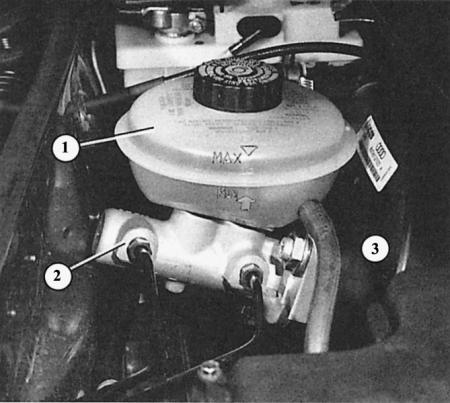
Between the engine compartment and the windshield, in the so-called moisture-trapping box, there is a reservoir with brake fluid (1), the main brake cylinder (2) and the brake booster (3). The fill level marks of the reservoir "MAX" and "MIN" are clearly visible in the photo.
This yellowish, toxic and aggressive liquid towards car paint does not corrode metal and rubber parts. It itself remains quite fluid at -40°C and, despite its fluidity, has an extremely high boiling point of approximately 260°C.
But brake fluid has a very unpleasant property: it readily absorbs water, it is "hygroscopic". Water, for example, due to atmospheric humidity, can actually penetrate into the brake fluid: through the expansion tank or through microscopic leaky areas in the brake hoses or rubber cuffs. Such water absorption leads not only to corrosion of the metal parts of the brake system, but also causes a rapid decrease in the boiling point of the brake fluid. With a water content of only 2.5%, its boiling point is only at 150°C. Near heated brakes, steam bubbles can form in the hydraulic fluid. They are compressed - the brake pedal can sink deep, sometimes the foot simply presses into the void! In this case, quickly pumping the fluid with the brake pedal sometimes helps. This effect is especially dangerous when stopping the car after a strong load on the brakes. Due to the lack of headwind, everything around the brakes heats up even more. And it takes about half an hour for the brake fluid temperature to drop to normal.
Therefore, the maintenance plan prescribes preventive replacement of brake fluid every two years. Brake fluid must meet the FMVSS 116 DOT 4 specification. All fluids with this designation can be mixed without fear.