



Engine 1.8 l
The engine together with the manual transmission is removed downwards. A crane is required to remove the engine/manual transmission unit. No way do not remove the engine/transmission assembly using a garage lift, as this may cause severe damage to the engine.
Since there are several connections to unscrew on the underside of the car, four stands are required, and a lift is needed to raise the car. The fenders in the engine bay must be protected with covers before installing the engine.
Depending on the year of manufacture of the vehicle and its equipment, electrical wires, as well as vacuum hoses and hoses of the cooling system, may have different routing. Since it is not possible to describe the routing of all possible options here, it is recommended to mark the corresponding lines before disconnecting.
Necessary special tools and auxiliary materials:
- Tap
- Clamp for spring clamps, e.g. HAZET 798-5
- Load-bearing suspension, for example, AUDI 2024 A
- MoS2 grease, for example, AUDI G 000 100
- Torque wrench 5:50 N•m
- Torque wrench 40:200 N•m
- Cable connector
Removal
Warning: Cable connectors that are removed or cut when removing the engine must be reinstalled in their original locations. To do this, mark their installation locations. To disconnect the connections, press in the stoppers and pull the plug.
1. Disconnect the negative (-) battery cable with the ignition off.
Warning: This will erase information from the electronic memory units, such as the radio code. Without the code, the radio can only be switched on by the manufacturer or an AUDI service station. Therefore, please read the instructions in the subsection Entering the radio code.
2. Remove the battery, refer to subsection Removal and installation the battery.
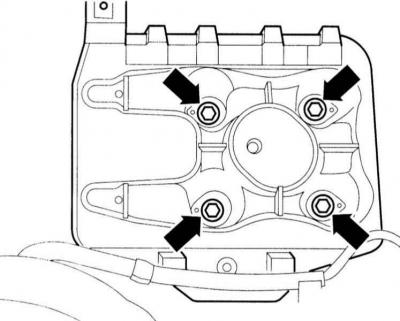
3. Loosen the mounting bolts and remove the battery holder.
4. Remove the starter, refer to the subsection Checking, removing and installing the starter traction relay.
5. Remove the air filter housing, refer to subsection Removal and installation the air filter housing.
6. Loosen the mounting bolts and remove the air duct to the air filter on the bumper.
7. Remove the lower engine compartment cover, refer to subsection Removal and installation the lower engine compartment cover.
8. Remove the right drive shaft, refer to subsection Removal and installation drive shafts.
9. Disconnect the left drive shaft from the manual transmission flange and tie it with wire to the stabilizer or bottom.
10. Drain the coolant, refer to subsection Replacing the coolant.
11. Engine 150 hp: Remove the connecting pipes between the turbocharger/charge air cooler, turbocharger/air cleaner and charge air cooler/intake manifold. To do this, remove the clamps from the hoses.
12. Loosen the V-belt tension and remove it, refer to subsections Removal and installation a ribbed V-belt and Removal and installation the V-belt.
13. Loosen the mounting bolts and remove the power steering pump from the holder, tie it to the body with wire. Do not disconnect the hoses.
Warning: Do not pinch the hoses. If the system was opened during removal, it is necessary to bleed air from it, refer to the subsection Removal and installation the power steering pump.
Cars with air conditioning:
Warning: Do not open the air conditioner cooling circuit. If coolant comes into contact with your skin, it may cause frostbite.
Warning: Loosen the air conditioner cooling system mounting clamps. Do not twist, pinch or bend the air conditioner pipes and hoses.
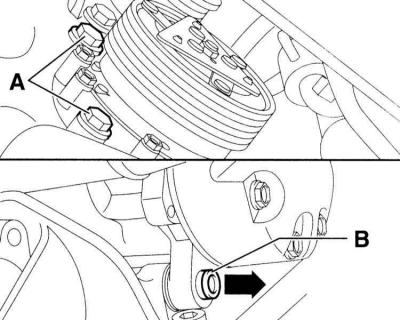
14. Loosen the compressor mounting bolts (A) and (B) and tie the compressor to the hood lock with wire so as not to stretch the hoses.
15. Remove the exhaust pipe and catalytic converter, refer to subsection Removal and installation of the exhaust system.
16. Disconnect the throttle cable, do not remove the stopper, refer to the subsection Adjusting the gas drive.
17. Remove the engine cover at the intake manifold.
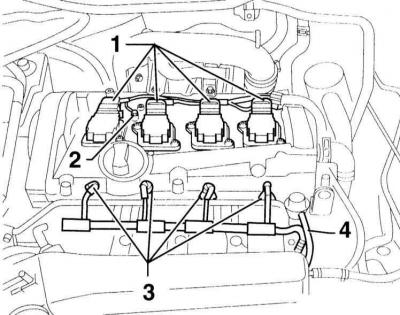
18. Disconnect the plug connections "1" of the ignition coils and "3" of the injectors. Disconnect the negative cable "2". The accompanying illustration shows a 150 hp engine.
19. Disconnect vacuum line "4" on the pressure regulator.
20. Disconnect from the engine and turbocharger (engines 150 and 180 hp) vacuum and suction hoses. If necessary, mark the hoses and connecting fittings to avoid assembly errors.
21. Disconnect all plug connections from the engine and manual transmission to the body.
Warning: The fuel system is under pressure! Before opening the hose connections, cover them with a thick cloth. Then carefully release the pressure. Wear safety glasses. Risk of injury from splashes!
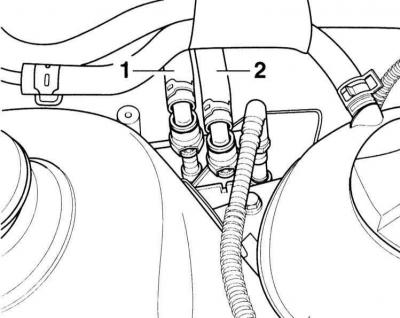
22. Disconnect the supply "1" and return "2" lines at the fuel distributor by squeezing the release buttons on the coupling. Mark the hoses with tape to facilitate subsequent reassembly.
23. Cover the fuel lines with film and rubber rings to prevent dirt from entering the system.
24. Disconnect the 2 coolant hoses to the heater heat exchanger at the front wall of the engine compartment by opening the clamps.
25. Remove all coolant hoses from the engine to the top and to the expansion tank by loosening the clamps and removing the hoses.
26. Remove the fan with the holder, refer to the subsection Removal and installation the radiator and fan.
27. Vehicles with manual transmission: Remove the shift actuators and clutch cylinder.
Warning: After removing the clutch slave cylinder, do not press the clutch pedal.
28. Cars with automatic transmission: Unscrew the mounting bolts and remove the power steering pressure pipe holder at the gearbox support. Remove the selector cable at the gearbox, refer to the subsection Adjusting the Automatic Transmission Shift Selector Cable.
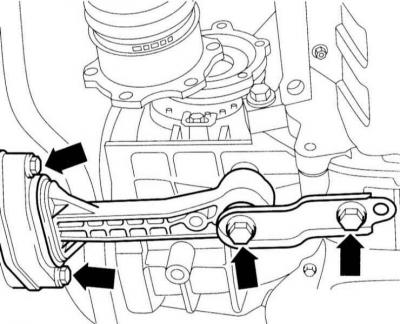
29. Loosen the mounting bolts of the pendulum support at the bottom between the body and the engine/gearbox block.
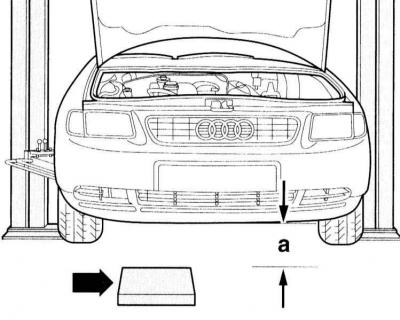
30. Raise the car. It should be at least a = 60 mm from the ground.
31. Place a wooden block (arrow) measuring 40 x 30 cm and 15 cm thick on the ground to install the engine on it in the area of the oil pan.
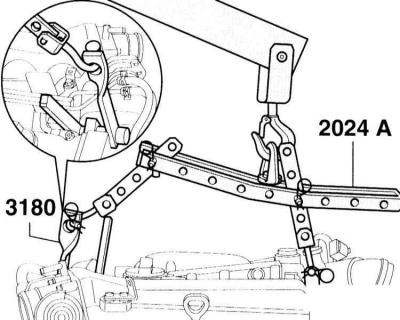
32. Connect the AUDI-2024A lifting device with the 3180 hook with eyes on the engine. Connect the vertical perforated bars with holes 1 and 5 of the cross bar. Insert the pin from the flywheel side of the engine into the second hole of the bar, from the pulley side into the third hole. The holes are counted from the hook side.
Warning: Use locking pins on hooks and locking pins. The perforated tires must be correctly aligned in length to match the center of gravity of the unit.
33. If there is no suitable lifting device available, a chain can be used to lift the unit.
34. Raise the engine/gearbox assembly with a crane to relieve the engine mounts.
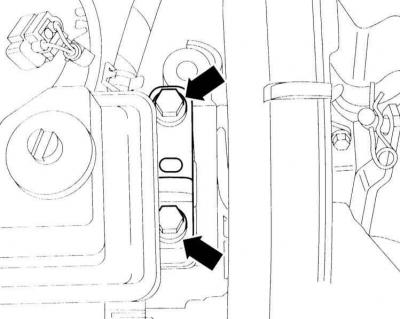
35. Unscrew the right engine/gearbox support from above.
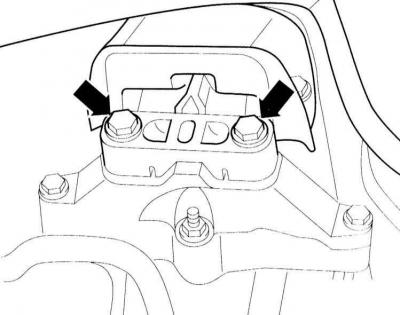
36. Unscrew the bolts securing the gearbox support on the left.
37. Check that all hoses and lines from the engine and gearbox to the chassis are disconnected.
38. Pull the engine/gearbox assembly forward as far as possible and lower it slowly onto a wooden block. Perform the operation carefully to avoid damaging the mechanisms.
Warning: Secure the unit to prevent it from tipping over.
39. If necessary, disconnect the gearbox from the engine, refer to subsection Removal and installation of manual transmission.
Installation
40. Check for pores and cracks in the rubber engine mounts and the cooling, oil and fuel hoses. Replace if necessary.
41. Only if the engine was disconnected from the gearbox: Check the clutch. Insert the engine/gearbox mounting bolts and tighten them to the specified tightening torque. When doing so, follow the instructions in subsection Removal and installation of manual transmission.
42. Replace the engine/transmission assembly and tighten by hand with new bolts.
43. Secure the pendulum arm by hand with new bolts.
44. Align the engine/gearbox unit by vigorously shaking it with your hands.
45. Tighten the engine/gearbox and swing arm mounts to the torque values given in the Specifications, first tightening all bolts with a torque wrench and then tightening the bolts further with a rigid wrench to an angle of 90° (1/4 turn).
Warning: Bolts undergo a residual elongation when tightened. Therefore, new bolts should be used after each tightening.
Warning: Before tightening, measure the thread diameter of the bolt, as this affects the tightening torque.
46. If the air conditioning compressor was removed, tighten it to a torque of 45 Nm.
47. Secure the power steering pump, refer to subsection Removal and installation the power steering pump.
48. Install the starter, refer to the subsection Removal and installation the starter.
49. Put on the V-belt and tighten it, refer to the subsections Removal and installation a ribbed V-belt and Removal and installation the V-belt.
50. Secure the air duct to the air filter at the lock holder.
51. Install the air filter housing, refer to subsection Removal and installation the air filter housing.
52. Engine 150 hp: Install the connecting pipes between the turbocharger/charge air cooler, turbocharger/air cleaner and charge air cooler/intake manifold. Secure the hoses with clamps.
53. Install the exhaust pipe/catalytic converter with new seals, refer to subsection Removal and installation of the exhaust system.
54. Install the left and right drive shafts, refer to the subsection Removal and installation drive shafts.
55. Connect the gas drive and adjust it, refer to the subsection Adjusting the gas drive.
56. Place the supply and return fuel lines onto the distribution pipe. The quick-release couplings should clearly lock into place.
57. Attach the heater hoses to and from the heat exchanger at the front wall of the engine compartment and secure them with clamps.
58. Install the radiator fan with the holder, refer to the subsection Removal and installation the radiator and fan.
59. Vehicles with manual transmission: Install the shift actuators and adjust them, refer to subsection Gear shift drive.
60. Install the clutch actuator hydraulic cylinder on the manual transmission, refer to the subsection Removal, installation and checking the clutch.
61. Vehicles with automatic transmission: Secure the power steering pressure line holder to the gearbox support. Install the selector rod on the gearbox and adjust it, see subsection Removal, installation and checking the clutch.
62. Connect the electrical wires according to the markings made during removal and secure them.
63. Secure the electrical wires to their previous mounting locations. Secure them with clamps.
64. Replace and secure the battery holder.
65. Install the battery without connecting the negative cable yet, refer to subsection Removal and installation the battery.
66. Check that electrical wires, vacuum hoses, coolant hoses and fuel hoses are connected according to their markings.
67. Check the oil level in the engine and gearbox, add oil if necessary.
68. Check for antifreeze in the coolant and top up if necessary, refer to subsections Replacing the coolant and Checking fluid levels, leak control.
69. Install the engine cover onto the intake manifold.
70. Install the lower engine compartment cover, refer to subsection Removal and installation the lower engine compartment cover.
71. Connect the battery ground (-) cable.
Warning: Activate the high-altitude automatic electric window lifter, and also set the clock and enter the radio code, refer to the subsection Entering the radio code.
72. Start and warm up the engine to operating temperature. Check the oil and coolant levels. Check all hose connections for leaks.
73. Check the headlight adjustment, refer to the subsection Headlight adjustment.
Warning: When disconnecting various electrical connections, faults are recorded in the control units, which must be deleted after installation. Since this requires an electronic tester that is connected to the vehicle's diagnostic connector. For this purpose, you must contact a service station.
(The original article is posted on the resource: AudiManual)