



Removal
Before disconnecting the battery, find out if you have a radio activation code.
Turn off the ignition and disconnect the ground wire from the battery.
Loosen the four screws and remove the engine cover (see Fig. 3.1–41).
Loosen the clamps and remove the air pipe connecting the air flow meter and the intake pipe.
Disconnect the electrical connectors of the lambda sensors.
Unscrew the nuts securing the right and left exhaust pipes.
Remove the upper gearbox-to-engine mounting bolts.
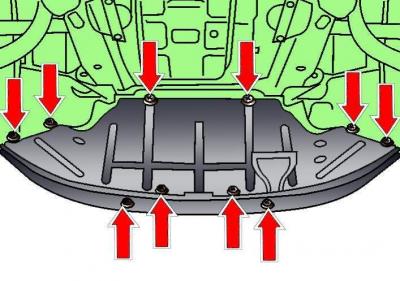
Fig. 3.1–1. Location of the engine compartment lower mudguard mounting fasteners
Release the fasteners and remove the lower engine compartment splash guard (see Fig. 3.1–1).
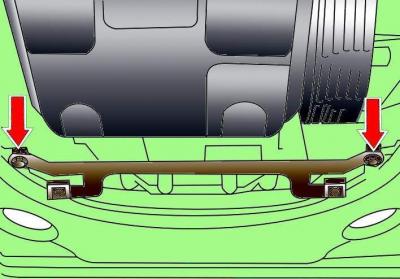
Fig. 3.1–2. Location of engine compartment lower mudguard bracket mounting bolts
Unscrew the two bolts and remove the engine compartment lower mudguard bracket (see Fig. 3.1–2)
Unscrew the bolts and remove the protective covers located above the left and right drive shafts.
Remove the bolts and disconnect the inner drive shaft joints from the gearbox. Using soft wire, suspend the inner ends of the drive shafts from the body.
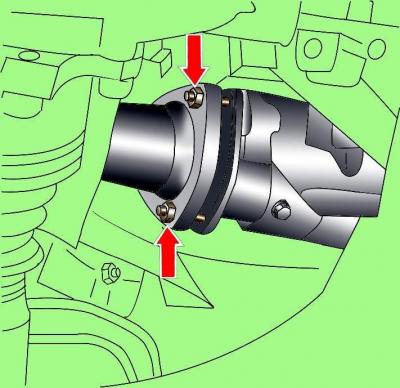
Fig. 9–1. Location of the bolts securing the exhaust inlet pipe to the catalytic converter
Unscrew the bolts securing the left and right exhaust pipes to the catalytic converter (Fig. 9–1).
Loosen the exhaust pipe connecting clamps and remove the exhaust pipes and catalytic converter.
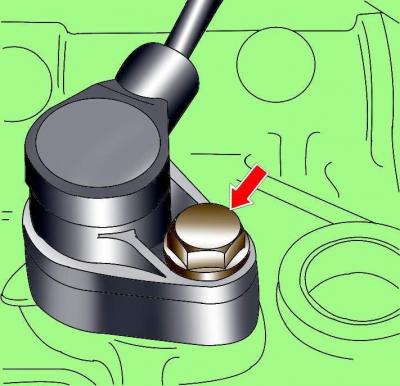
Fig. 9–2. Location of engine speed sensor mounting bolt
Remove the engine speed sensor from the front left side of the gearbox (Fig. 9–2).
Disconnect the electrical connector
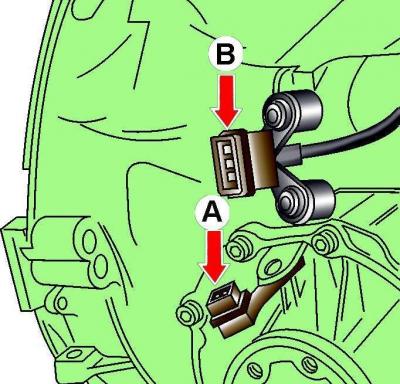
Fig. 9–3. Location of electrical connectors for the speedometer sensor (A) and reverse switch (B)
A (see Fig. 9–3) from the speedometer sensor.
Disconnect the electrical connector IN (see Fig. 9–3) from the reverse switch (multifunctional sensor).
Disconnect the remaining connectors and the ground wire from the transmission.
Unscrew the starter mounting bolts, remove it and secure it to the engine without disconnecting the wires from it.
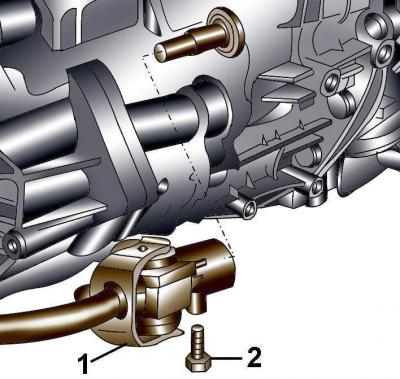
Fig. 9–4. Fastening the rod to the gear shift rod: 1 – rod; 2 – bolt
Unscrew the bolt and remove the rod from the gear shift rod (Fig. 9-4).
Remove the lower transmission-to-engine mounting bolts, except for the bolts located on the sides of the transmission flange.
Attach a special device to a stationary jack, install it under the gearbox and raise the jack so that the weight of the gearbox is supported by the jack.
If you do not have special tools for removing the gearbox, support the gearbox with a jack using a wooden block.
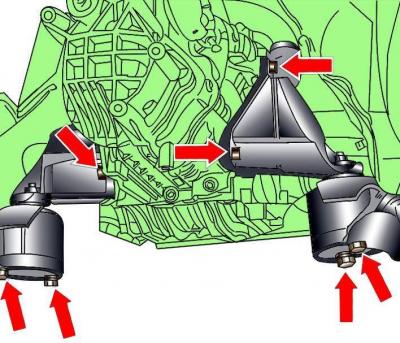
Fig. 9–5. Location of bolts for fastening the left and right gearbox supports
Unscrew the bolts securing the left and right gearbox supports (Fig. 9–5).
Remove the remaining two lower transmission-to-engine mounting bolts.
Move the gearbox away from the engine and lower it 15 cm to gain access to the clutch slave cylinder.
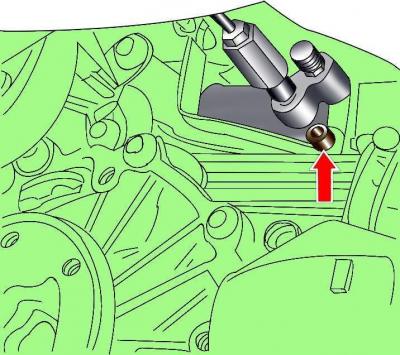
Fig. 9–6. Clutch slave cylinder mounting bolt location
Unscrew the slave cylinder and secure it to the body with soft wire (Fig. 9-6). Do not disconnect the hydraulic hose from the slave cylinder and do not press the clutch pedal.
Carefully lower the transmission and remove it from under the vehicle.
Installation
Installation is carried out in the reverse order of removal, taking into account the following.
Check the condition of the clutch.
Clean the splined part of the gearbox drive shaft and lubricate it with a thin layer of special grease G 000 100. The layer of grease must be thin and uniform, otherwise, when the clutch is operating, excess grease will be thrown onto the working surfaces of the clutch, which may disrupt its operation.
Apply a thin layer of grease to the pushrod head that mates with the clutch release lever.
Make sure the engine block is fitted with guide bushings to centre the transmission.
Raise and attach the gearbox to the engine and install the clutch slave cylinder.
Move the gearbox toward the engine so that the gearbox input shaft fits into the splines of the driven clutch disc. You may have to turn the engine crankshaft slightly to align the splines of the gearbox input shaft with the splines of the driven clutch disc. The input shaft should not hang on the clutch disc when installing the gearbox.
With the gearbox moved forward, install the clutch housing onto the cylinder block guide bushings.
Insert the gearbox mounting bolts to the engine and tighten them to 25 Nm at this stage.
Install the starter.
Tighten the gearbox-to-engine mounting bolts to the specified torque.
Connect the ground wire to the gearbox.
Screw in the gearbox support mounting bolts (see Fig. 9–5).
Remove the transmission jack.
Connect the drive shafts to the gearbox.
Install the drive shaft guards and secure them with bolts.
Install and bolt the control rod to the gearbox.
Connect the tachometer and reverse light electrical connectors to the gearbox.
Install the exhaust pipe.
Check and, if necessary, top up the oil level in the gearbox.
Connect the ground wire to the battery.
Turn on the radio and enter the code into it.
Raise the power windows all the way up. Then press all power window switches again for at least 1 second to the closed position to activate the power window control unit.
Set the time on the clock.
Before starting the engine, check the presence and level of engine oil in the engine.
Tightening torques, Nm
| Selector cable bracket to gearbox | 23 |
| Selector cable to lever | 5,6 |
| Selector cable housing to bracket | 12 |
| Torque converter to pressure plate | 85 |
| Engine torque compensator support to frame | 40 |
| Torque compensator support to engine | 42 |
| Gearbox support to lower frame | 40 |
| Drive shaft to the drive flange of the gearbox | 77 |
| Heat shield for drive shaft to gearbox | 23 |
| Generator to engine: | |
| M8 | 22 |
| M10 | 45 |
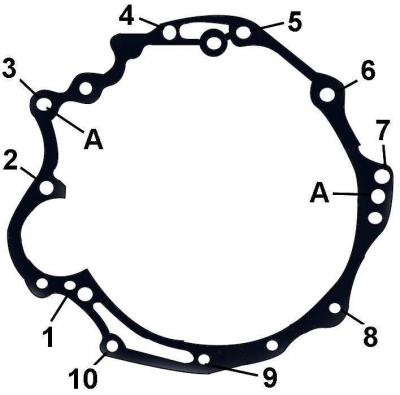
Fig. 9–7. Location and numbering of bolts for fastening the manual gearbox to the 2.8 l petrol engine: A – location of installation of the centering sleeve
| Position | Bolt | Tightening torque, Nm |
| 1 | M10x135 | 45 |
| 2 | M12x110 | 65 |
| 3, 4, 5 | M12x67 | 65 |
| 6 | M12x90 | 65 |
| 7 | M12x80 | 65 |
| 8 | M10x50 | 45 |
| 9 | M10x38 | 45 |
| 10 | M8x40 | 20 |

Fig. 9–8. Location and numbering of bolts for fastening the manual gearbox to 3.7 and 4.2 l petrol engines: A – location of installation of the centering sleeve
| Position | Bolt | Tightening torque, Nm |
| 1 | M12x75 | 65 |
| 2 | M12x110 | 65 |
| 3 | M10x45 | 45 |
| 4 | M12x90 | 65 |
[Text provided by the online resource audimanual]