



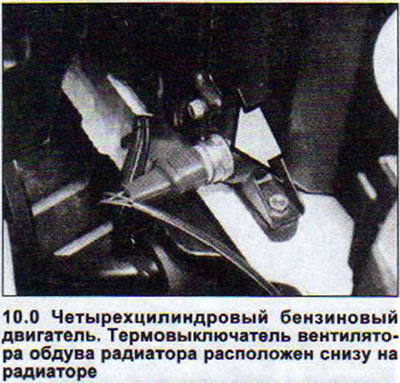
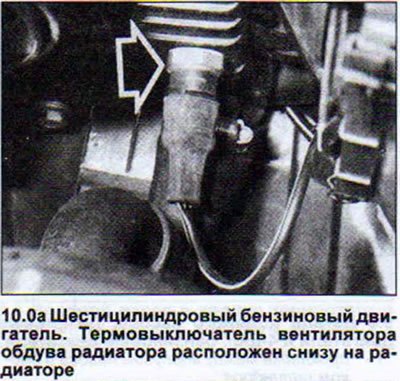
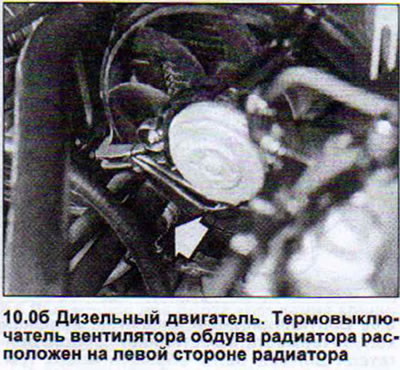
Cars with diesel engines are equipped with two two-speed electric radiator fans, which are switched on by means of a relay located on the relay block under No.2, and rotate simultaneously at the same speed (see illustration 10.0b).
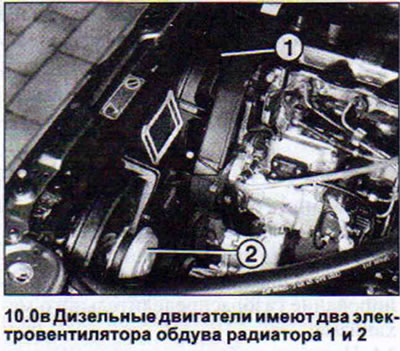
Some models with petrol engines are also equipped with two-speed fans. The thermal switch activates the second stage of fan rotation when the engine is heavily loaded and the coolant temperature is high. There is another option for turning on the fan at the second stage of rotation. This function is performed by a two-stage thermal switch, in the circuit of which a relay is included, located on the relay block under No.11.
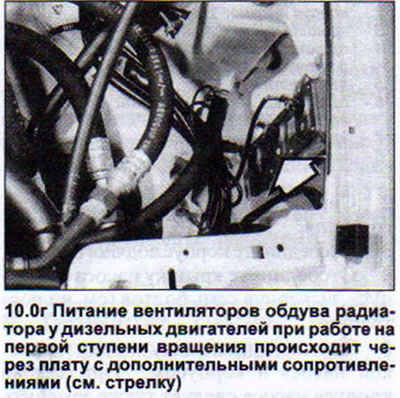
In cars with diesel engines, relay number 11 closes the fan operation contact at the first speed stage. Power supply to the fan motors at this stage is provided through additional resistors (see arrow in illustration 10.0g). The second stage is switched on via a relay located on the block under number 18.
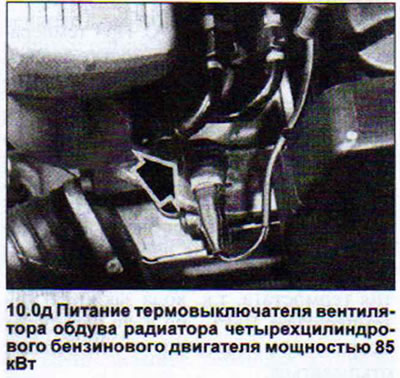
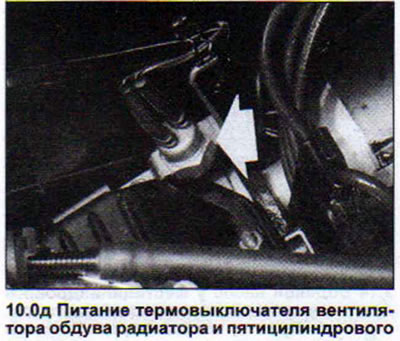
Attention! The thermal switch is supplied via terminal X. This means that when the ignition is off, the radiator fan/fans cannot turn on spontaneously. In vehicles equipped with a four-cylinder petrol engine with a power of 85 kW, as well as a five-cylinder engine, the power supply of the thermal switch of the electric fans of the radiator is carried out according to the servo circuit. This means that in the event of a thermal plug in the engine compartment, the fan turns on even after the engine is turned off (see arrows in illustrations 10.0d). Be careful!
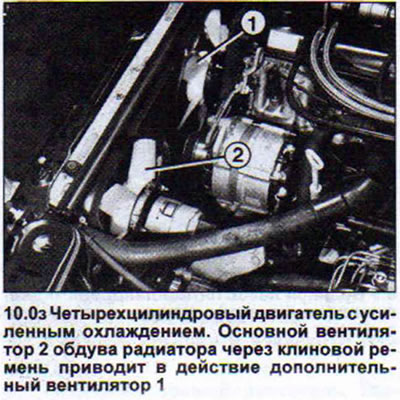
Some AUDI 80 models have special equipment. For example, cars with a four-cylinder petrol engine with a factory-fitted towing hitch or cars with enhanced cooling have an additional fan installed next to the one already mentioned. This additional fan is driven by the main fan via a V-belt (see illustration 10.0zh).
Vehicles with a five-cylinder engine do not have space to install a second radiator fan. Therefore, vehicles with this engine are equipped with a towing hitch by the manufacturer and are equipped with a more powerful radiator fan.
Cars with six-cylinder engines have one fan in the standard configuration, and two independently operating fans in the special configuration.
Both radiator fans are switched on in parallel and can operate simultaneously at both the first and second rotation speeds.
(The article was copied from the website: audimanual)