



Table of contents: Installation ↓ Examination ↓
The thermostat is a device that determines when the coolant should flow through the radiator to cool. This means that it is responsible for opening the large coolant circulation loop. The thermostat's "decisions" depend on the coolant temperature, which heats up the thermostat's container filled with special wax and the valve head attached to it. When heated, the wax turns into a liquid state and expands. As a result of the expansion, the valve head moves, opening the coolant's access to the large circulation loop. When the coolant temperature drops, the thermostat spring closes the valve and the large coolant circulation loop is closed.
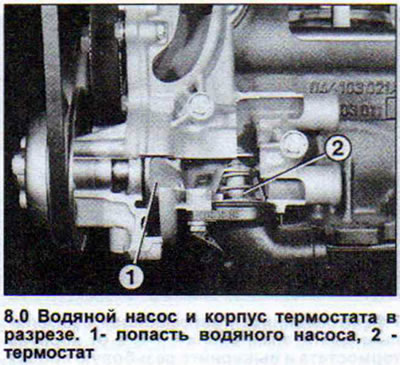
The thermostat is mounted on the bottom of the engine (see illustration 8.0). When replacing the thermostat, it is also necessary to replace the sealing ring of the thermostat housing or the water pump housing.
1. Drain all coolant.
2. Four-cylinder petrol and diesel engines. Remove the engine splash guard.
3. Disconnect the lower hose from the water pump housing.
4. Remove the two bolts securing the thermostat housing cover.
5. Remove the cover and take out the thermostat.
6. Five-cylinder engine. Remove the two bolts securing the cover to the thermostat housing (see illustration).
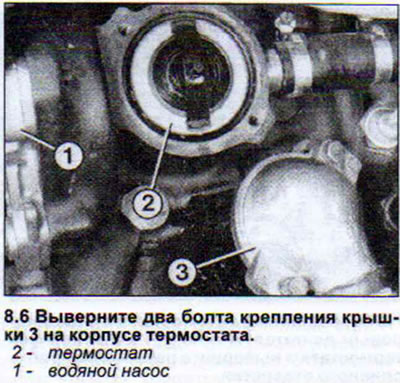
7. Move the cover to the side and remove the thermostat.
8. Six-cylinder engine. Remove the V-belt and belt tensioner.
9. Remove the toothed belt guard. Do not remove the toothed belt.
10. Disconnect the lower radiator hose from the thermostat housing.
11. Unscrew the two bolts securing the cover to the thermostat housing (see illustration).
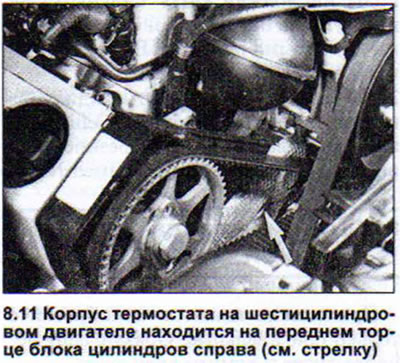
12. Carefully lift the timing belt off the thermostat housing and remove the cover.
13. Remove the thermostat from the housing.
Installation
When installing a new thermostat, its smaller diameter sealing gasket should face the engine.
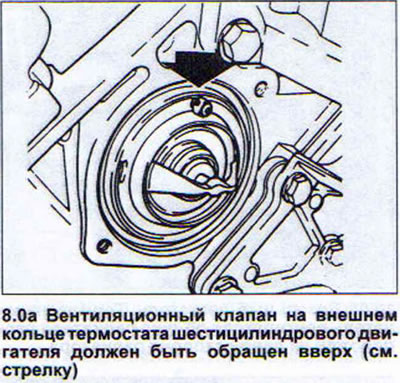
On a six-cylinder engine, the vent valve on the outer ring of the thermostat should be facing upwards (see illustration 8.0a).
14. Replace the sealing ring with a new one.
15. Tighten the bolts on the thermostat housing or on the water pump housing to a torque of 10 Nm.
Examination
The thermostat can be checked for proper operation using a thermometer. The thermostat should begin to open at a coolant temperature of approximately 87°C. At a temperature of approximately 102°C, the thermostat should be fully open. The opening stroke of the thermostat is 7-8 mm.
16. Remove the thermostat.
17. Place the thermostat in a container of water and heat the water.
18. Check to see if the thermostat starts to open when the water heats up to 87°C. It is impossible to fully open the thermostat during this test, as the water boils at 100°C, but if the thermostat is working properly, you will see it continue to open.
The original version of the article is posted on the website AUDImanual.ru