



Table of contents: Cross tie rod tip caps-check ↓ Front Suspension Ball Joint Caps -… ↓
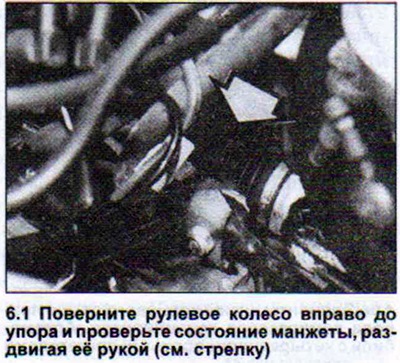
The steering gear is located at the rear of the engine compartment. Its toothed rack is covered with a protective rubber cuff, the condition of which must be checked periodically. Dust and moisture get into the steering gear through cracks in the cuff and act on it like an abrasive paste.
1. Turn the steering wheel to the right until it stops and check the condition of the cuff by moving it apart with your hand (see illustration).
2. Make sure that the cuff fastening clamps are not loose and hold the cuff securely.
3. Replace the cuff if it shows any defects.
Cross tie rod tip caps-check
The tie rod end bearings are metal spheres pressed into plastic cups. The end bearings are capped (anthers), the condition of which also needs to be checked regularly.
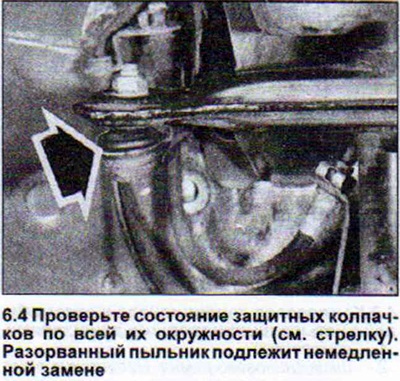
4. Check the condition of the protective caps around their entire circumference. A torn boot must be replaced immediately (see illustration).
5. Make sure there is no play in the tie rod ends. To do this, place the car on jack stands and move the tie rods from side to side, or do the same with the wheel.
Another way to check the tie rod ends.
6. Ask an assistant to turn the steering wheel of the parked car to the right and left.
7. Place your hand on the tip support. The presence or absence of play will be felt quite well.
The play of the silent blocks, which connect the steering rods to the steering mechanism, is checked in a similar manner. If the silent block is defective, the steering rod must be replaced completely.
Front Suspension Ball Joint Caps - Check
The ball joints connecting the front suspension wishbones and shock absorber struts are maintenance-free. The spherical heads of the ball joints are in plastic cups filled with long-lasting grease.
To prevent moisture and dust from entering, the ball joints are covered with protective caps (anthers). If they are damaged, dust and moisture that gets on the ball joints act as an abrasive substance, destroying the supports.
8. Turn the steering wheel all the way to one side.
9. Check the condition of the caps on the left and right sides. A damaged cap cannot be replaced separately. Replacement is performed together with the ball joint.
Steering play - check
10. Lower the driver's door window.
11. Apply the parking brake.
12. Start the engine.
13. Rotate the steering wheel through the lowered door glass opening and watch when the left front wheel begins to move in accordance with the rotation of the steering wheel. It is recommended to watch the wheel disk because the tire rubber is elastic and can dampen the displacement of the wheel.
The reasons for the appearance of play in the steering control may be:
- free play of the steering rack. This play can be adjusted;
- wear of the tie rod ends or silent blocks connecting the tie rods to the steering gear;
- defective steering column split joint joint;
- defective coupling between the steering gear and the steering column.
Hub bearing clearance - check
The front wheel hubs of front-wheel drive vehicles have double-row ball bearings. The rear hubs of these models have tapered roller bearings. The hubs of quattro all-wheel drive vehicles have double-row ball bearings at both the front and rear.
The bearings are filled with long-term grease and under normal operating conditions they last for more than 100,000 kilometers. Defective wheel hub bearings "make noise" while driving. The bearing of which hub is faulty is determined in a simple way. If the noise increases when making a right turn, then the left bearing is faulty.
14. Take hold of the wheel with your hands and try to move it perpendicular to the body. Do this with all the wheels in turn. If the hub bearings are normal, then the wheels have almost no free play. If you find free play on one of the wheels, ask an assistant to fully press the brake pedal.
15. Try to move the wheel while pressing the brake pedal. If there is no free play, then the hub bearing is faulty. If there is free play, the suspension must be checked.
16. Place the car on jack stands and turn the wheel. If the wheel moves hard or turns jerkily, the bearing is too tight. If, when turning the wheel, you hear a noise similar to the noise of millstones, the hub bearing needs to be replaced.
Please note: The rear wheel bearing on front-wheel drive models can be adjusted. The hub bearings and front and rear wheels on quattro models cannot be adjusted.
Protective CV joint covers - check
Constant velocity joints are protected from moisture and dust by rubber seals (anthers), the condition of which must be checked regularly. Damaged or cracked cuffs must be replaced immediately, because moisture and dust will destroy the CV joint.
17. Place the car on jack stands.
18. Rotate the corresponding axle shaft and inspect the protective boot at the same time. Traces of grease on the boot surface may indicate a crack.
19. Make sure the cover is securely fastened with clamps.
20. Replace the damaged cover.