
Repair Chevrolet Repair Toyota Repair Honda Repair AvtoVAZ Repair Mercedes-Benz Repair BMW Repair Opel
Home  |  Contacts  |  Sitemap  |    
English Русский
Български
Беларускі
Український
Српски
Hrvatski
Română
Polski
Slovenský
Magyar
AudiManual.ru


  • AUDI 80
  • AUDI 100
  • AUDI A3
  • AUDI A4
  • AUDI A6
  • AUDI A8
  • AUDI Q
  • OTHER
  • ARTICLES
B4 (1991-1996) B3 (1986-1991) B3 (1986-1991, petrol) B2 (1979-1986)

Electrical equipment (Audi 80 B4)

  • Home
  • Audi 80
  • B4 (1991-1996)
  • General information
  • Maintenance
  • Electrical equipment
            0
Table of contents: A car without a diagnostic unit for… ↓ Brake light switch ↓ Checking the protective coating of… ↓
Checking control devices and indicator lights.

1. Get into the car and make sure the watch is working (digital or electronic)

2. Turn on the ignition. The following indicator lights should light up:
  • charging the battery,
  • ABS (short-term),
  • airbags (goes out after about 10 seconds), and with the handbrake on
  • handbrake indicator light.

A car without a diagnostic unit for the functioning of the main systems


On the instrument panel light panel between the speedometer and tachometer, the coolant temperature indicator light and the brake system indicator light should flash, and the oil pressure indicator light should also be on.

Cars with a diagnostic unit for the functioning of the main systems On the light panel of the instrument panel between the speedometer and tachometer, when the ignition is turned on, the inscription appears "Bremslicht" (stop signal). After briefly pressing the brake pedal, the inscription "OK" (okay) should light up.

The fuel gauge and coolant temperature gauge needles move with a slight delay (only on a warm engine).

3. Turn on the direction indicators. Depending on the direction of the turn, the corresponding green indicator light should flash rhythmically.

4. Press the hazard warning switch button. The indicator lamp in the switch and both direction indicator lamps should flash.

5. Pull the headlight stalk lever toward the steering wheel. The high beam indicator light should come on.


6. Start the engine and make sure the tachometer is working.

7. Perform a test drive and ensure that the speedometer and coolant temperature gauge are working.

Brake light switch


The brake light switch on the AUDI 80 is located above the brake pedal and can only be accessed after removing the instrument panel trim on the left (see illustration 7.0).
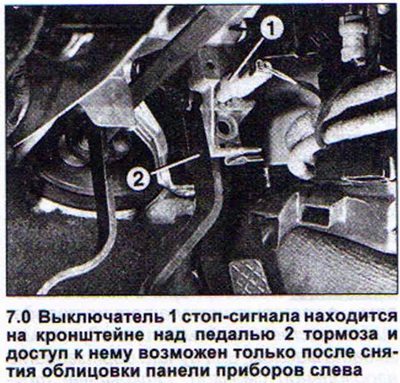
The brake light switch on the AUDI 80 is located above the brake pedal and can only be accessed…


When you press the pedal, the switch rod extends and closes the brake light contacts.

Adjusting the brake light switch

8. Remove the trim on the left under the instrument panel.

9. Press the brake pedal with your hand.

10. Move the switch along its guides to the extreme forward position.

11. Release the brake pedal and pull the switch back to the stop. After this, the switch will self-set.

If the brake light bulbs of both rear lights do not light, check the switch.

12. Disconnect the switch plug.

13. Jumper the terminals of the disconnected plug. If the brake light bulbs light up, the switch is faulty.

Checking the protective coating of the bottom


The protective coating layer on the underbody of the car should be carefully checked and, if necessary, renewed. The car owner can do this on his own if he has a device for lifting the car (overpass or lift).


14. Wash the bottom thoroughly.

15. Illuminate the entire surface of the bottom with a sufficiently powerful lamp and identify damaged areas.

16. Clean the damaged protective layer with a spatula, scraper and metal brush to bare metal. Also clean rust spots to bare metal.

17. Apply a coat of paint containing zinc powder to the cleaned surface as a primer. The protective compound can be applied to flat or large surfaces with a brush. Apply the protective compound to hard-to-reach joints and corners with a sprayer.

Attention! Bitumen-based underbody protection should be repaired only with bitumen materials. Polymer wheel arch protection should be restored only with PVC-based protection.


Note: Only certain materials may be used when repairing the underbody protective coating. Materials not intended for this purpose will corrode the standard underbody coating. In addition to products from Volkswagen and Audi, Teroson products in aerosol cans and as a brush-on paste may be used. When applying the underbody protective coating with a spray, the brakes should be covered with paper or film.


(The original source of the article can be found on the website: AUDIMANUAL.ru)
The article was checked by auto expert Timur Bazhenov
This article is available at russian, bulgarian, belarusian, ukrainian, serbian, croatian, romanian, polish, slovak, hungarian

Share information:
Previous articles
Audi 80 B4: Maintenance
Next articles

Suspension and steering
Exhaust gas system-check
V-belt/ribbed belt — checking condition and tension
Brakes, tires, wheels
Lubrication of rods, joints, hinges and locks
Jacking up a car
Towing


Similar articles on other Audi car models:
Electrical Equipment Maintenance (until August 1985) Audi 100 C3 (1982-1990)
On-board electrical equipment specifications Audi A3 Type 8L (1996-2003)
Help for orientation in the electrical equipment of the car Audi A4 B5 (1994-2001, petrol)
Description of electrical equipment and safety precautions Audi A6 C4 (1994-1997)
General information about electrical equipment Audi A8 D2 (1994-2002)
General information on on-board electrical equipment and… Audi Q7 Typ 4L (2005-2015, diesel)
Symbols used in electrical equipment diagrams Audi A2 (1999-2005)
Link to this page in different formats


Visitor comments

No comments yet


How much will 35 + 39 =


80(B4, 1991-1996) 
  • General information
  • User manual
  • Maintenance
  • Troubleshooting
  • Power unit
  • Engine
  • Cooling system
  • Heating and ventilation
  • Petrol injection
  • Diesel fuel system
  • Fuel system
  • Exhaust systems
  • Ignition system
  • Transmission
  • Clutch
  • Car gearbox
  • Chassis
  • Brake system
  • Suspension and steering wheel
  • Body
  • Body and trim
  • Electrical equipment
  • Electrical system
  • Electrical circuits
 
80(B3, 1986-1991) 
  • General information
  • Repair characteristics
  • Maintenance
  • Power unit
  • Gasoline engine
  • Diesel engine
  • Engine lubrication system
  • Fuel system (gasoline)
  • Injection system (gasoline)
  • Fuel system (diesel)
  • Ignition system
  • Cooling system
  • Heater
  • Exhaust system
  • Transmission
  • Clutch and gearbox
  • Chassis
  • Steering
  • Brake system
  • Car suspension
  • Body
  • Body elements
  • Electrical equipment
  • Power devices
  • Lighting and appliances
  • Electrical circuits
 
80(B3, 1986-1991, petrol) 
  • General information
  • User manual
  • Maintenance
  • Power unit
  • Engine 4-cylinder
  • Engine 5-cylinder
  • Cooling system
  • Fuel and exhaust systems
  • Ignition system
  • Transmission
  • Clutch
  • Mechanical transmission
  • Automatic transmission
  • Drive shafts
  • Chassis
  • Brake system
  • Suspension
  • Steering
  • Body
  • Exterior
  • Interior
  • Electrical equipment
  • Equipment and devices
  • Electrical circuits
 
80(B2, 1979-1986) 
  • General information
  • User manual
  • Power unit
  • Engine FZ
  • Engine EP, YP, YZ, DT, DS, DZ
  • Transmission
  • Clutch
  • 4 speed gearbox
  • 5 speed gearbox
  • Front wheel drive
  • Chassis
  • Front suspension
  • Rear suspension
  • Steering
  • Brake system
  • Electrical equipment
  • Equipment and devices
  • Electrical circuits
 
AudiManual.ru © 2017-2026 · Mobile version · Feedback · Sitemap: EN BG BY UA RS HR RO PL SK HU · Site search · News and articles
80 B2 · 80 B3 petrol · 80 B3 · 80 B4 · 100 C3 diesel · 100 C3 petrol · 100 C3 · 100 C4 petrol · 100 C4 · A3 Type 8L · A4 B5 petrol · A4 B5 · A4 B6 petrol · A4 B6 · A4 B7 · A4 B8 · A6 C4 · A6 C5 · A6 C5 Allroad · A8 D2 · Q5 Type 8R · Q7 Typ 4L · Audi A2 ·
This site uses cookies 🍪. Click the button to accept this fact.