The jack is designed only for lifting the car. But it does not ensure the safety of work under the car. Immediately after lifting the car with a jack, it is necessary to install reliable supports under the car raised in this way.
To prevent the car from rolling when jacked up, you can use stones or wooden blocks as wheel stops.
Hollow bricks (blocks) are an affordable and inexpensive support. But they should not have cracks and not be wet, otherwise they may fall apart. Between the support and the body, a piece of board should be laid to evenly distribute the load over the surface of the entire support. Bricks should be installed with the holes facing up and stand on a solid foundation (concrete, asphalt).
Jack stands are an ideal complement to the jack. The best way to install the jack stands is with one leg facing outward and the other two facing inward, toward the middle of the car. The stand should not have too little support surface.
A lifting ramp (overpass) is the most convenient lifting device, since it does not require a jack and guarantees safety for the vehicle and when performing work.
When using the jack that comes with the tool kit, always use a piece of wood to prevent the base of the jack from being pressed into the ground.
To lift a car whose body is rusty, a parallelogram type jack is most suitable. It can be installed a little further inward towards the center of the body.
A hydraulic plunger jack does not always provide the car wheels with lift. Therefore, when purchasing such a jack, check the height of its stroke. At the same time, a jack that is too high cannot be installed under the car.
The garage jack is the most convenient for a car enthusiast (see illustration 9.0).
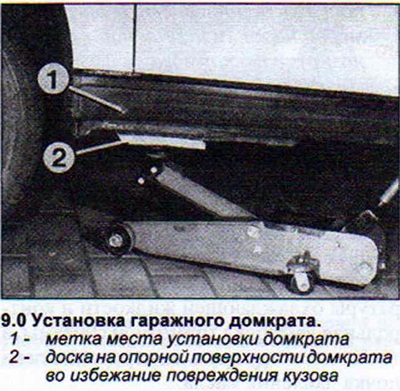
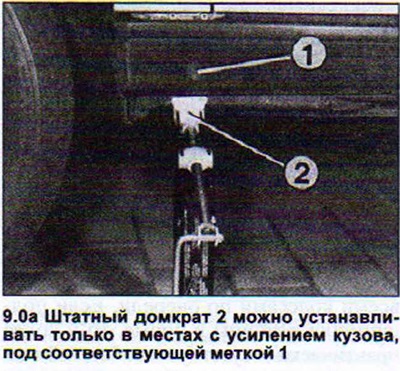
When jacking up a car, it is important to remember that the jack can be installed in places with appropriate reinforcement of the body. Such points are marked with appropriate marks (see illustration 9.0a). To avoid damage to the body, it is recommended to place a piece of board on the supporting surface of the jack (see illustration 9.0).