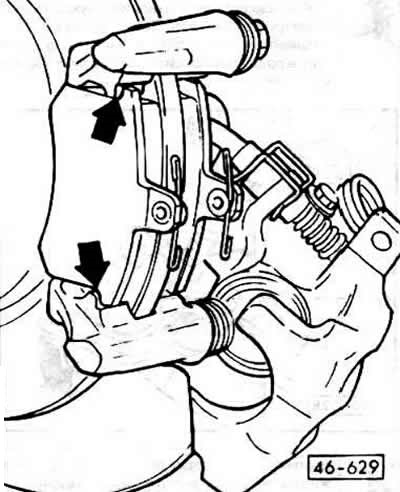
Table of contents: Removal ↓ Installation ↓
Note: From 1.88 (No. 89JA221810 or No.89JA225957) a brake caliper with a piston diameter of 38 mm is used (before 36 mm). The distinguishing feature is the mark "38" stamped on the support. It should be noted that the same design of supports must be used on one axle (piston diameter).
Removal
Loosen the rear wheel bolts, raise the rear of the vehicle, and remove the wheels.
Note: If the same pads are to be installed, they must be marked. Switching the pads from inside to outside and vice versa or from right to right or vice versa is not allowed. Switching may cause uneven braking. It is recommended to use original VW/AUDI pads. It is necessary to replace all front pads at the same time, even if only one of the pads has reached the wear limit.
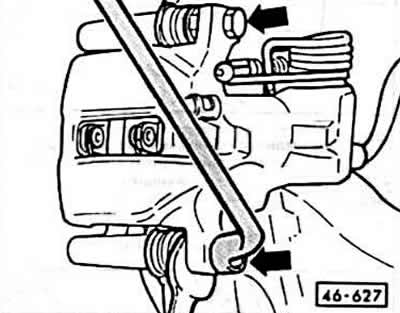
Remove the 2 caliper housing mounting bolts, holding the guide bolt from turning. Remove the piston housing and hang it on a wire. Do not disconnect the brake hose, otherwise you will have to bleed the air from the system.
Remove the brake pads.
Installation
Caution: When the pads are removed, do not press the brake pedal, otherwise the pistons will come out of the housing.
Clean the guide surfaces and the seat of the pads in the housing shaft with a suitable soft metal brush or wash with a cloth soaked in alcohol. Do not use any solvents containing mineral oils or sharp tools.
Before installing the pads, check the brake disc for grooves with your fingers. If necessary, disc brakes can be ground down (work in the workshop), if they are thick enough.
Measure the thickness of the brake discs.
Check the piston dust boot for ruptures. Replace a damaged dust boot immediately, as penetrating dirt will quickly cause the caliper to lose its tightness. This requires disassembling the caliper (work in the workshop).
Screw in the piston with a rod wrench, turning it to the right and pressing it hard.
Attention: The piston with a diameter of 38 mm must be tightened with a special key VAG 3131, if the special key is not available, insert a metal plate into both grooves of the piston and tighten the piston. The piston must not be installed with a removal key, otherwise the automatic installation system in the caliper will be destroyed.
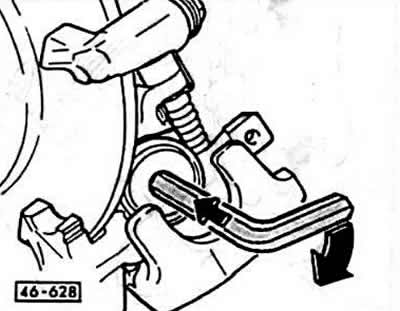
Note: When the piston is pressed, brake fluid is squeezed out of the brake cylinders into the reservoir. Monitor the fluid level in the reservoir, suck out the brake fluid if necessary.
When sucking, use a plastic bottle that is only for brake fluid. Do not use beverage bottles! Brake fluid is poisonous and should never be sucked out through a hose by mouth. Use suction devices. After replacing the pads, the brake fluid level in the reservoir should not exceed the MAX mark, since the fluid expands when heated. Leaking brake fluid flows onto the master cylinder, destroys the paint and causes corrosion.
Insert both pads into the brake housing, making sure that the lower springs are straight up and parallel to the upper edge of the brake pads.
Insert the piston housing and secure with new self-locking bolts to 35 Nm, holding the guide bolt.
Please note: Each genuine VW/AUDI "Brake Pads" repair kit contains a hex bolt for each caliper. This bolt must be used.
Perform basic adjustment of the rear brakes.
Screw on the wheel, lower the car, tighten the wheel bolts crosswise with a force of 110 Nm.
Check the brake fluid level in the expansion tank and top up to the MAX mark if necessary.