
Repair Chevrolet Repair Toyota Repair Honda Repair AvtoVAZ Repair Mercedes-Benz Repair BMW Repair Opel
Home  |  Contacts  |  Sitemap  |    
English Русский
Български
Беларускі
Український
Српски
Hrvatski
Română
Polski
Slovenský
Magyar
AudiManual.ru


  • AUDI 80
  • AUDI 100
  • AUDI A3
  • AUDI A4
  • AUDI A6
  • AUDI A8
  • AUDI Q
  • OTHER
  • ARTICLES
B4 (1991-1996) B3 (1986-1991) B3 (1986-1991, petrol) B2 (1979-1986)

Spark plugs — removal, maintenance and installation (Audi 80 B3)

  • Home
  • Audi 80
  • B3 (1986-1991, petrol)
  • Power unit
  • Ignition system
  • Spark plugs — removal, maintenance and installation
            0
1. Correct functioning of spark plugs is vital to the proper operation and performance of the engine. It is essential that the plugs installed are suitable for the engine, the correct type being specified at the beginning of this Section. If the specified type is used and the engine is in good condition, the spark plugs should not require attention between scheduled replacements. Cleaning of spark plugs is rarely necessary and should not be attempted unless special equipment is available, as the tips can easily be damaged.

2. Before removing the spark plugs, first mark the location of the high tension wires by cylinder numbers, if they are not marked

3. Pull the high-tension wire clamps off the spark plugs (photo).
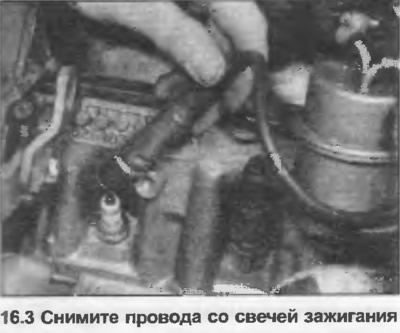
3. Pull the high-tension wire clamps off the spark plugs (photo).


4. Using a spark plug wrench, unscrew each spark plug and remove them (photo).
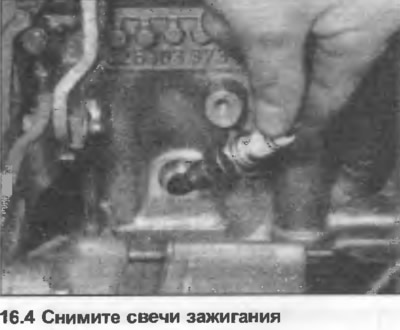
4. Using a spark plug wrench, unscrew each spark plug and remove them (photo).


5. The condition of the spark plugs can be used to judge the condition of the engine.


6. If the nose of the spark plug insulator is clean and white, without deposits, this indicates a weak mixture or too hot spark plug.

7. If the tip and nose of the insulator are covered with hard black deposits, the mixture is too rich. If the plug is black and oily, the engine is probably badly worn.

8. If the nose of the insulator is covered with a light brown deposit, the mixture is correct and the engine is in good condition.

9. The spark plug gap is important: if it is too large or too small, the spark size and efficiency will be poor. The spark plug gap should be set according to the data in Specifications at the beginning of this Section.

10. To set the gap, measure it with a feeler gauge, and then bend the outer electrode of the spark plug to the desired gap.

11. Screw in the spark plugs by hand, tighten them to the tightening torque specified in Specifications.

The original article is posted on the resource: AUDIMANUAL
The article was checked by auto expert Timur Bazhenov
This article is available at russian, bulgarian, belarusian, ukrainian, serbian, croatian, romanian, polish, slovak, hungarian

Share information:
Previous articles
Audi 80 B3: Ignition system
Next articles

Ignition timing angle (engine 7A) — adjustment
Ignition timing angle (PS and NG engines) — adjustment
Ignition timing (KV engine and 1.6/1.8 l engines) — adjustment
MPI Ignition System — Testing
Troubleshooting the ignition system


Similar articles on other Audi car models:
Toothed drive belt — removal, inspection and installation Audi 100 C3 (1982-1990, diesel)
Removal, installation and tensioning the timing belt (petrol) Audi A3 Type 8L (1996-2003)
Removal, inspection and installation of spark plugs Audi A4 B6 (2000-2006, petrol)
Spark plugs — removal and installation Audi A6 C5 Allroad (1999-2005)
Removal and installation the thermostat Audi A8 D2 (1994-2002)
Maintenance of body parts, removal/installation of some covers… Audi Q7 Typ 4L (2005-2015, diesel)
Removal and installation of wiring harness for pump-injectors… Audi A2 (1999-2005)
Link to this page in different formats


Visitor comments

No comments yet


How much will 17 + 44 =


80(B4, 1991-1996) 
  • General information
  • User manual
  • Maintenance
  • Troubleshooting
  • Power unit
  • Engine
  • Cooling system
  • Heating and ventilation
  • Petrol injection
  • Diesel fuel system
  • Fuel system
  • Exhaust systems
  • Ignition system
  • Transmission
  • Clutch
  • Car gearbox
  • Chassis
  • Brake system
  • Suspension and steering wheel
  • Body
  • Body and trim
  • Electrical equipment
  • Electrical system
  • Electrical circuits
 
80(B3, 1986-1991) 
  • General information
  • Repair characteristics
  • Maintenance
  • Power unit
  • Gasoline engine
  • Diesel engine
  • Engine lubrication system
  • Fuel system (gasoline)
  • Injection system (gasoline)
  • Fuel system (diesel)
  • Ignition system
  • Cooling system
  • Heater
  • Exhaust system
  • Transmission
  • Clutch and gearbox
  • Chassis
  • Steering
  • Brake system
  • Car suspension
  • Body
  • Body elements
  • Electrical equipment
  • Power devices
  • Lighting and appliances
  • Electrical circuits
 
80(B3, 1986-1991, petrol) 
  • General information
  • User manual
  • Maintenance
  • Power unit
  • Engine 4-cylinder
  • Engine 5-cylinder
  • Cooling system
  • Fuel and exhaust systems
  • Ignition system
  • Transmission
  • Clutch
  • Mechanical transmission
  • Automatic transmission
  • Drive shafts
  • Chassis
  • Brake system
  • Suspension
  • Steering
  • Body
  • Exterior
  • Interior
  • Electrical equipment
  • Equipment and devices
  • Electrical circuits
 
80(B2, 1979-1986) 
  • General information
  • User manual
  • Power unit
  • Engine FZ
  • Engine EP, YP, YZ, DT, DS, DZ
  • Transmission
  • Clutch
  • 4 speed gearbox
  • 5 speed gearbox
  • Front wheel drive
  • Chassis
  • Front suspension
  • Rear suspension
  • Steering
  • Brake system
  • Electrical equipment
  • Equipment and devices
  • Electrical circuits
 
AudiManual.ru © 2017-2026 · Mobile version · Feedback · Sitemap: EN BG BY UA RS HR RO PL SK HU · Site search · News and articles
80 B2 · 80 B3 petrol · 80 B3 · 80 B4 · 100 C3 diesel · 100 C3 petrol · 100 C3 · 100 C4 petrol · 100 C4 · A3 Type 8L · A4 B5 petrol · A4 B5 · A4 B6 petrol · A4 B6 · A4 B7 · A4 B8 · A6 C4 · A6 C5 · A6 C5 Allroad · A8 D2 · Q5 Type 8R · Q7 Typ 4L · Audi A2 ·
This site uses cookies 🍪. Click the button to accept this fact.