



Table of contents: The ignition is off. ↓ The ignition is off. ↓
Open the expansion tank cap. Remove the front noise insulation "1". Install the tray for service cranes "VAS 6208" under the engine. Unscrew the threaded plug of the drain hole "1" and drain the coolant.
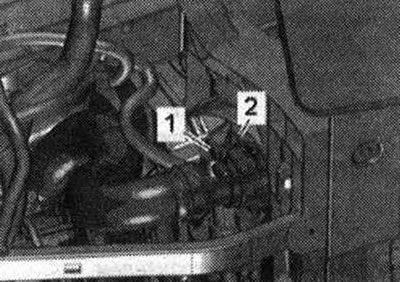
"Pos. 2" do not take into account. Remove the coolant hose from the engine oil radiator by loosening the hose clamp "arrow" and drain the remaining coolant.

The ignition is off.
Note. The cooling system is filled with a solution of coolant and antifreeze and corrosion protection for the entire year. Only use the antifreeze and corrosion protection approved for the engine. Other additives can significantly reduce the anticorrosive effect. The resulting damage can lead to coolant leakage and consequently to serious engine damage. Antifreeze and anticorrosive concentrate prevent damage due to freezing, corrosion and limescale deposits. In addition, they increase the boiling point. Therefore, an antifreeze and anticorrosive concentrate should be used in the cooling system all year round. Particularly in countries with a tropical climate, the coolant's higher boiling point ensures reliable engine operation under high load. The freezing point of the coolant should be approximately -25°C (in countries with an arctic climate, approximately -35°C). It is prohibited to reduce the content of the additive in the coolant by adding water, even in the warm season or when operating in countries with a warm climate. The content of the additive must be at least 40%. If the freezing temperature must be lowered due to climatic conditions, the proportion of anti-corrosion concentrate with antifreeze can be increased, but not more than to 60% (the freezing temperature in this case will be about -40°C). If this limit is exceeded, the freezing temperature will increase again, and, in addition, the heat capacity of the coolant will decrease. Use only clean drinking water to mix the coolant. Do not use the drained coolant in the following cases: after replacing the radiator, heater heat exchanger, cylinder head, cylinder head gasket or cylinder block. If the coolant is contaminated. Contaminated coolant cannot be used further. Secure all hose connections with hose clamps of the appropriate series. Use the refractometer "T10007" to check the additive in the cooling system.
Close the drain plug "1". Ignore "Pos. 2". Connect the coolant hose to the radiator "arrow". Pour 12 liters of coolant into the coolant tank, pre-mixed with an additive in the correct proportion: anti-corrosion concentrate (40%) and water (60%) for a freezing temperature of up to -25°C; Anti-corrosion concentrate (50%) and water (50%) for freezing temperatures down to -35°C. Screw on the adapter of the cooling system tester "V.A.G 1274/8" to the expansion tank.
The ignition is off.

Install the cooling system filling device onto the adapter "V.A.G 1274/8". Place the outlet hose "1" in a small container "2". The outlet air will capture a small amount of coolant, which must be collected. Close the valves "A" and "B" by turning them perpendicular to the flow direction. Connect the hose "3" to the compressed air. Pressure: excess pressure 6...10 bar. Open the valve "B" by turning it in the direction of the flow. A vacuum is created in the cooling system using the ejector pump; the indicator arrow should be in the green field. Open tap "A" briefly, for which turn it parallel to the flow direction so that the hose of the tank of the device for filling the cooling system is filled with coolant. Close tap "A" again. Open tap "B" for 2 minutes.
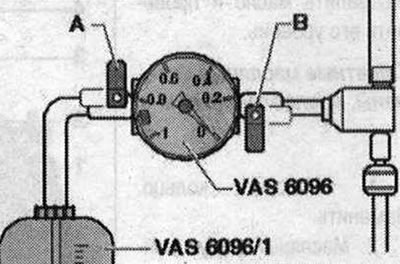
The ejector pump continues to create a vacuum in the cooling system; the indicator arrow should be in the green field. Close tap "B". The indicator arrow should remain in the green field, in which case the cooling system has sufficient vacuum for subsequent filling. If the arrow is below the green field, repeat the previous operations. If the vacuum decreases, check the cooling system for leaks. Remove the compressed air hose. Open tap "A". Due to the vacuum, the coolant coming out of the tank of the device for filling the cooling system fills the system. Remove the device for filling from the adapter "V.A.G 1274/8" on the expansion tank of the cooling system. Put the tube on "V.A.G 1274/10" on the adapter "V.A.G 1274/8".
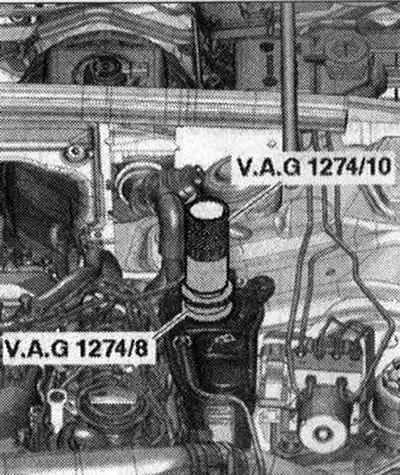
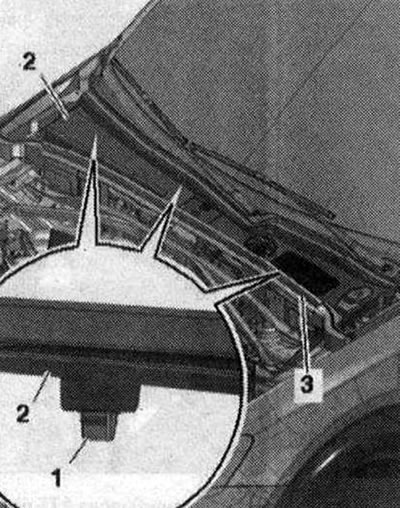
Fill with coolant until the cooling system tester tube is completely filled. If necessary, add coolant while bleeding air. Remove gasket "3". Release fastening clamps "1" from fasteners and remove water drain box cover "2".
Remove the coolant hose to the heat exchanger by disconnecting the hose clamp. As soon as coolant starts coming out of the vent "arrow", place the coolant hose on the fitting and secure it with a clamp. On a car with an independent heater, turn on the heater for about 30 seconds.

Screw in the expansion tank cap until it clicks. Start the engine. Set the temperature for all zones to "HI" and, if possible, set the lowest ventilation level (= 0). Switch off the air conditioning compressor by pressing the "AC" button. The tester LED in the button should not light. The engine should run at 2000 rpm for 3 minutes. Let the engine idle until the 2 large coolant hoses on the radiator heat up. The engine should run at 2000 rpm for 2 minutes. Switch off and let the engine cool down. Install soundproofing. Check the coolant level. When the engine is cold, the coolant temperature level should be at the MAX mark. When the engine is warm, the coolant level should be above the MAX mark.
(The original article is available on the online resource «AUDIMANUAL»)