



Caution. Risk of burns from hot steam and hot coolant. When the engine is warm, the cooling system is under excess pressure. To relieve excess pressure, place a rag around the coolant expansion tank cap and carefully open it. Secure all hose connections with hose clamps of the appropriate series. The arrows on the ends of the pipes and hoses of the cooling system must be opposite each other.
Coolant hose connection diagram
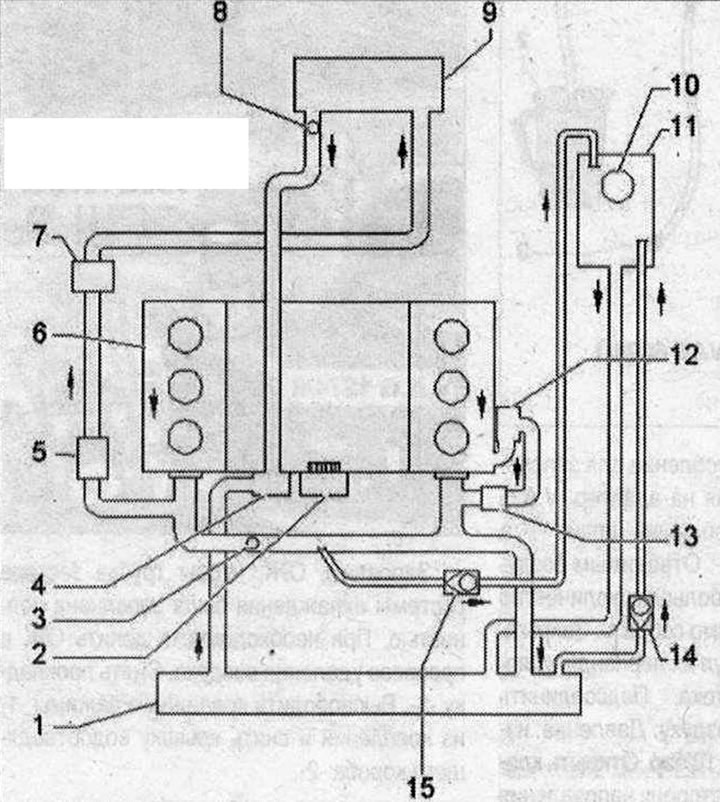
Cars without independent heater The arrows show the direction of coolant flow. 1. Radiator. After replacement, change the coolant; 2. Coolant pump; 3. Coolant temperature sensor "G62"; 4. Thermostat; 5. Coolant circulation pump "V50". Controlled by the circulation pump relay "J160"; 6. Cylinder head and cylinder block. After replacement, change the coolant; 7. Coolant shut-off valve. Controlled via the Climatronic coolant shut-off valve "N422". The Climatronic coolant shut-off valve "N422" is controlled by the used Climatronic "J255"; 8. Ventilation hole; 9. Heater heat exchanger. After replacement, change the coolant; 10. Expansion tank cap; 11. Expansion tank; 12. Oil radiator. After replacement, change the coolant; 13. Pump for the coolant bleeding system after the engine is turned off "V51" (only for vehicles for use in hot countries); 14/15. Check valve
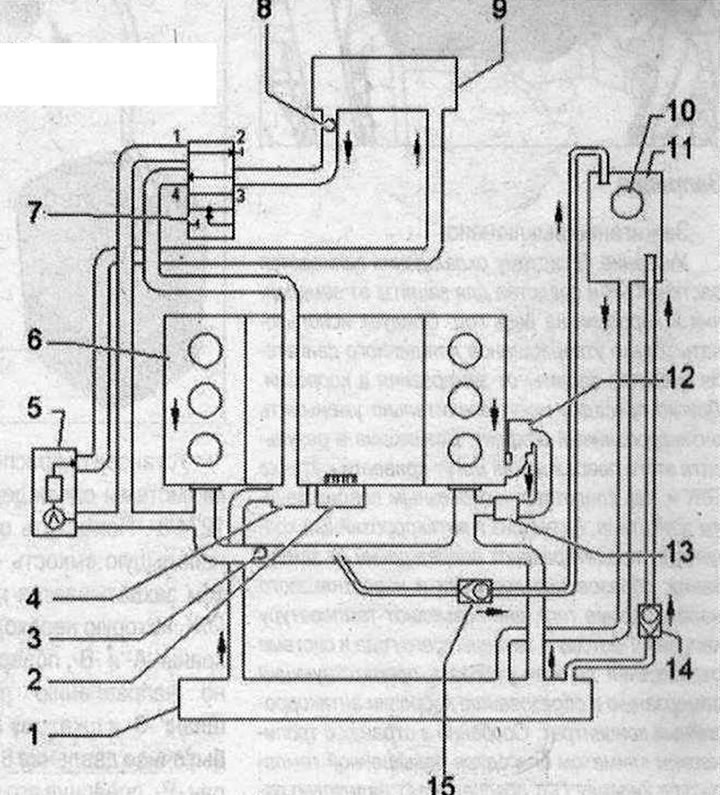
Car with independent heater 1. Radiator. After replacement, change the coolant; 2. Coolant pump; 3. Coolant temperature sensor "G62"; 4. Thermostat; 5. Autonomous heater with circulation pump "V55"; 6. Cylinder head and cylinder block. After replacement, change the coolant; 7. Coolant shut-off valve Climatronic "N422"; 8. Ventilation hole; 9. Heater heat exchanger. After replacement, change the coolant; 10. Expansion tank cap. Checking the pressure reducing valve; 11. Expansion tank; 12. Oil radiator. After replacement, change the coolant; 13. Coolant bleeding system pump. After engine shutdown "V51" (only for vehicles for use in hot countries); 14/15. Check valve