



Caution! Do not allow diesel fuel to come into contact with rubber parts, especially the cooling system hoses. Remove any fuel that comes into contact with these parts immediately. Otherwise, the rubber of these parts will become unusable over time.
1. Unscrew the plug 2 of the ventilation hole (see illustration).
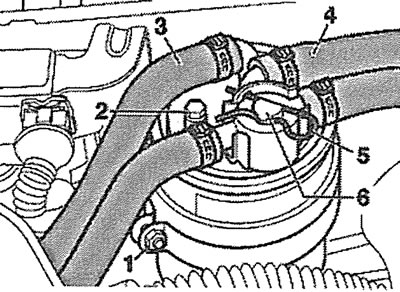
9.1. Unscrew the plug 2 of the ventilation hole:
1 - fuel filter clamp
2 - Ventilation hole plug
3 - fuel supply hose from the tank
4 - fuel hose to the high-pressure fuel pump
5 - clamp
6 - pressure reducing valve with connected hoses
2. Connect a low pressure hand pump with a condensate collection container, such as the VAG 1390, to the vent by inserting the suction hose of the pump into it (see illustration).
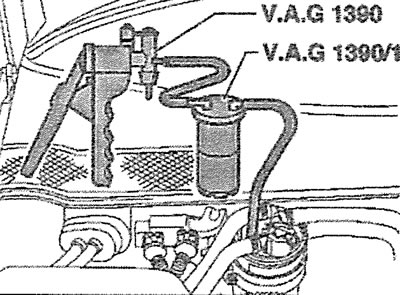
9.2 Connect a low pressure hand pump with a condensate collection container, such as VAG 1390, to the ventilation opening by inserting the suction hose of the pump into it
Attention! No liquid should enter the pump when removing condensate.
3. Drain approximately 100 cm³ of condensate from the fuel filter (almost one full cup), pumping the lever of the hand pump.
4. Disconnect the hand pump, screw the plug 2 into the filter ventilation hole (see illustration 9.1).
5. Start the engine. The fuel system will be bled automatically.
6. Inspect the fuel system for leaks, especially at the fuel filter attachment points and fuel filter connections.
Replacing the fuel filter
7. Cut the clamps securing fuel hoses 3 and 4 with side cutters and disconnect the hoses from the filter (see illustration 9.1).
8. Remove clamp 5 (see illustration 9.1).
9. Lift the pressure reducing valve 6 together with the connected hoses upwards and remove it from the filter (see illustration 9.1).
10. Unscrew the clamp bolt 1 of the filter mounting clamp and remove the filter from the holder (see illustration 9.1).
11. Fill the new fuel filter with clean diesel fuel. This will make it easier to start the engine after replacing the filter.
12. Install the filter into the clamp and tighten the clamp bolt 1 (see illustration 9.1).
13. Replace the O-ring of the pressure reducing valve 6 with a new one (see illustration 9.1), by soaking it in diesel fuel before installation.
14. Replace the pressure reducing valve and secure with clamp 5 (see illustration 9.1).
15. Place fuel hoses 3 and 4 on the pipes and secure them with clamps.
Caution! Do not mix up the inlet and outlet hoses. Follow the arrows on the hoses, which indicate the direction of fuel flow through the hose.
16. Start the engine. Air will be removed automatically.
17. Inspect the fuel system for leaks, especially at the fuel filter attachment points and fuel hose connections.