
Repair Chevrolet Repair Toyota Repair Honda Repair AvtoVAZ Repair Mercedes-Benz Repair BMW Repair Opel
Home  |  Contacts  |  Sitemap  |    
English Русский
Български
Беларускі
Український
Српски
Hrvatski
Română
Polski
Slovenský
Magyar
AudiManual.ru


  • AUDI 80
  • AUDI 100
  • AUDI A3
  • AUDI A4
  • AUDI A6
  • AUDI A8
  • AUDI Q
  • OTHER
  • ARTICLES
B8 (2007-2015) B7 (2004-2008) B6 (2000-2006) B6 (2000-2006, petrol) B5 (1994-2001) B5 (1994-2001, petrol)

Seat belts (Audi A4 B7)

  • Home
  • Audi A4
  • B7 (2004-2008)
  • General information
  • Operating instructions
  • Seat belts
            0
Table of contents: General information ↓ Rules for using 3-anchor seat belts ↓ Recommendations for pregnant women ↓

General information


Note: Information about emergency seat belt tensioners is provided in Section 12.


All people in a moving vehicle must wear seat belts, as indicated by a special K/L (see Section 15), which lights up for a few seconds when the ignition is turned on.

It is not permitted to use one seat belt to secure more than one person.

The middle rear seat is equipped with a lap belt of adjustable length. This belt should be adjusted so that it fits snugly across the hips. When not in use, the belt should be fastened.

The front seat belts, as well as the side seats of the rear seats, have a diagonal-lap design, i.e. they have three anchor points, one of which is equipped with an inertial return device with automatic locking in case of jerks. Belts of this type do not require length adjustment. The lap section of the belt should be positioned at hip level so that it covers the occupant's hip joint, as the strongest element of the human skeleton, and does not press on the stomach. The shoulder section of the belt must not be passed under the arm or placed on the occupant's neck. Make sure that the belt is not twisted.

Remember that the seat belt is most effective when the seat back is in an upright position. If the seat back is too reclined, the occupant will be more likely to slide under the belt during an impact. The height of the upper seat belt point in the front seat should be adjusted so that the belt webbing passes through the middle of the shoulder. To do this, slide the upper belt anchor in the appropriate direction (see Illustration 8.1.) and after finishing the adjustment, pull the belt to make sure it is fixed.
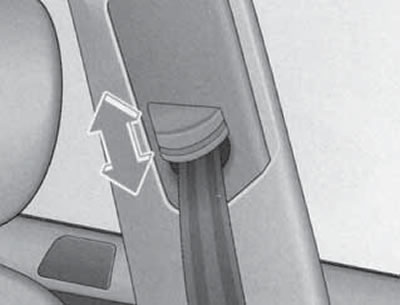


Remember that the seat belt is most effective when the seat back is in an upright position. If the…8.1. Adjusting the height of the front seat belt.


After an accident or if damaged, it is necessary to replace the seat belts, including their emergency tensioners, and child restraint systems, and check their fastenings.

Rules for using 3-anchor seat belts


Slowly pull the belt out of the return device, place it over your shoulder and click the belt buckle clip into the buckle, then pull the shoulder section of the belt up, checking that the clip is securely fixed in the buckle. Make sure that the belt webbing is not twisted - a twisted belt is dangerous in itself.

Lower the lap section of the belt as far as possible, placing it as low on the hips as possible. Pull the shoulder section of the belt to take up the slack and try to achieve a tight fit: tighten the belt as necessary. The strap should pass diagonally across the occupant's chest so that the impact load falls mainly on the strongest part of the upper torso.

The driver, having fastened his seat belt, must check that all passengers are also properly fastened. To unfasten the belt, press the red button located on the lock body. When the belt is wound up by the drum of the retractor, hold the belt by the buckle. After leaving the car, make sure that the belt is not pinched by the door.


Warning: Do not attach pads or other objects to the seat belts. Adding additional devices or changing the position of the shoulder section attachment may reduce the effectiveness of the seat belts and increase the risk of injury in a crash.


Recommendations for pregnant women


Ensuring the safety of a pregnant woman is the best way to preserve the fetus in the event of an accident, so when driving a car (as a driver or passenger) a pregnant woman must wear a seat belt, paying particular attention to the correct placement of its sections relative to her body.

When using diagonal waist belts, remember that the waist section of the belt should be positioned as low as possible on the hips and should never be on the stomach.

A pregnant woman should also take an upright position on the seat. In this case, the front seat should be moved as far away from the dashboard as possible, which will reduce the risk of injury and mutilation not only for the pregnant woman but also for the fetus in the event of an accident or deployment of the front airbag.

At each visit to your supervising physician, consult whether it is advisable for you to drive a car.

The original source of the article can be found on the website AUDIMANUAL
The article was checked by auto expert Timur Bazhenov
This article is available at russian, bulgarian, belarusian, ukrainian, serbian, croatian, romanian, polish, slovak, hungarian

Share information:
Previous articles
Audi A4 B7: Operating instructions
Next articles

Anti-theft system
Windows doors
Upper hatch
Access to the fuel tank filler neck
Transportation of children
Seat and headrest adjustment, additional seat functions
Adjustment of rear view mirrors and steering wheel, their…
Supplemental Restraint Systems (SRS)


Similar articles on other Audi car models:
Seat belts Audi 80 B3 (1986-1991, petrol)
Seat belts Audi 100 C4 (1990-1994, petrol)
Visual inspection of the seat belt and airbag unit Audi A3 Type 8L (1996-2003)
Checking the condition of seat belts Audi A6 C5 (1997-2004)
Seat belts Audi A8 D2 (1994-2002)
Seat belts Audi Q5 Type 8R (2008-2017)
Valve seat machining Audi A2 (1999-2005)
Link to this page in different formats


Visitor comments

No comments yet


How much will 27 + 16 =


A4(B8, 2007-2015) 
  • General information
  • Operating instructions
  • Power unit
  • Petrol engines 1.8 l
  • Petrol engines 1.8/2.0 l
  • Petrol engines 3.0 l
  • Petrol engines 3.2 l
  • Fuel system (petrol)
  • Diesel engines 2.0 l (CA*)
  • Diesel engines 2.0 l (CJCB)
  • Diesel engines 2.7/3.0 l
  • Diesel engines 3.0 l
  • Fuel system (diesel)
  • Transmission
  • Manual gearbox 0B1
  • Manual gearbox 0B2
  • Manual gearbox 0B3
  • Manual gearbox 0B4
  • Automatic transmission 0B5
  • Automatic transmission 0B6
  • Automatic transmission 0AW
  • All-wheel drive system
  • Chassis
  • Front suspension
  • Rear suspension
  • Brake system
  • Steering system
  • Body
  • Exterior
  • Interior
  • Seats
  • Doors, locks and windows
  • Security system
  • Heating and air conditioning
  • Electrical equipment
  • Audio system
  • Power devices
  • Equipment and devices
  • Lighting and lamps
  • Electrical circuits
 
A4(B7, 2004-2008) 
  • General information
  • Introduction to manual
  • Troubleshooting
  • Operating instructions
  • Maintenance
  • Power unit
  • Petrol engines 2.0 (ALT)
  • Petrol engines 2.0 (TFSI)
  • Petrol engines 1.8 (MPI)
  • Diesel engines
  • Cooling system
  • Air conditioner
  • Fuel and exhaust system
  • Ignition system
  • Starting and charging
  • Transmission
  • Clutch
  • Manual gearbox
  • Automatic gearbox
  • Drive shafts
  • Chassis
  • Brake system
  • Front suspension
  • Rear suspension
  • Steering
  • Body
  • Exterior
  • Interior
  • Electrical equipment
  • Equipment and devices
  • Lighting and signaling
  • Windscreen wipers and washers
  • Electrical diagrams
  • Electrical diagrams (since 2007)
 
A4(B6, 2000-2006) 
  • General information
  • Vehicle Description
  • User manual
  • Maintenance
  • Power unit
  • Gasoline engine
  • Diesel engine
  • Lubrication system
  • Cooling system
  • Supply system
  • Injection system
  • Exhaust system
  • Ignition and control
  • Transmission
  • Gear box
  • Clutch and drive shafts
  • Chassis
  • Brake system
  • Car suspension
  • Steering
  • Body
  • Heating and ventilation
  • Exterior (external elements)
  • Interior (internal elements)
  • Electrical equipment
  • Power devices
  • Lighting and appliances
  • Electrical circuits
 
A4(B6, 2000-2006, petrol) 
  • General information
  • Introduction to the guide
  • Car care
  • Power unit
  • Engine repair
  • Lubrication system
  • Cooling system
  • Injection and control system
  • Ignition system
  • Power and exhaust system
  • Transmission
  • Clutch and drive shafts
  • Car gearbox
  • Chassis
  • Suspension and wheels
  • Steering
  • Brake system
  • Body
  • Interior
  • Exterior
  • Electrical equipment
  • Equipment and devices
  • Lighting and signaling
  • Power devices
  • Electrical circuits
 
A4(B5, 1994-2001) 
  • General information
  • Introduction to the guide
  • Car care
  • Maintenance (gasoline)
  • Maintenance (diesel)
  • Power unit
  • Gasoline engines
  • Diesel engines
  • Engine overhaul
  • Cooling system
  • Fuel injection (gasoline)
  • Fuel system (diesel)
  • Exhaust system
  • Ignition system
  • Transmission
  • Clutch
  • Mechanical gearbox
  • Automatic gearbox
  • Drive shafts
  • Chassis
  • Brake system
  • Car suspension
  • Steering
  • Body
  • Exterior
  • Interior
  • Doors, locks and windows
  • Heating and ventilation
  • Electrical equipment
  • Power devices
  • Equipment and devices
  • Electrical circuits
 
A4(B5, 1994-2001, petrol) 
  • General information
  • Vehicle description
  • Maintenance
  • Power unit
  • Engine repair
  • Turbocharging
  • Exhaust system
  • Cooling system
  • Ignition system
  • Fuel system
  • Motronic injection system
  • MPI and MPFI injection system
  • Transmission
  • Clutch
  • Gearbox and shafts
  • Chassis
  • Steering
  • Car suspension
  • Brake system
  • Wheels and tires
  • Body
  • Heating and ventilation
  • Body parts
  • Electrical equipment
  • Fuses and relays
  • Power devices
  • Lighting and lamps
  • Tools and devices
  • Electrical circuits
 
AudiManual.ru © 2017-2026 · Mobile version · Feedback · Sitemap: EN BG BY UA RS HR RO PL SK HU · Site search · News and articles
80 B2 · 80 B3 petrol · 80 B3 · 80 B4 · 100 C3 diesel · 100 C3 petrol · 100 C3 · 100 C4 petrol · 100 C4 · A3 Type 8L · A4 B5 petrol · A4 B5 · A4 B6 petrol · A4 B6 · A4 B7 · A4 B8 · A6 C4 · A6 C5 · A6 C5 Allroad · A8 D2 · Q5 Type 8R · Q7 Typ 4L · Audi A2 ·
This site uses cookies 🍪. Click the button to accept this fact.