



Table of contents: General recommendations ↓ Diagonal lap inertia seat belts ↓ The order of fastening seat belts ↓ The order of unfastening the belts ↓ Belt height adjuster ↓
It is well known and proven that in the event of an accident, seat belts provide reliable protection for the driver and passengers. That is why, in most countries of the world, the mandatory use of seat belts is provided by law. Seat belts must be fastened before starting to move, including when driving within the city. This rule also applies to passengers in the back seats, including pregnant women. For them, diagonal-lap belts are best suited.
General recommendations
It is not permitted to fasten several passengers, even children, with the same seat belt.
There should be no hard or fragile objects between the belt and the body, such as glasses, pens, a bunch of keys, a smoking pipe, etc., as under certain circumstances they may cause serious injury.
Several layers of clothing, such as a coat and jacket, on the driver or passengers negatively affect the correct fit of the seat belts and thereby reduce their protective function.
Seat belts must not be twisted, pinched or touching sharp edges.
There should be no foreign objects in the fastening lock that interfere with the fastening of the belt.
Seat belts should be kept clean. If damaged, they should be replaced promptly. Ideally at a service station, with a simultaneous check of the anchor fastening.
Diagonal lap inertia seat belts
Seat belts of this type, when tensioned smoothly, provide complete freedom of body movement. They are locked during sudden braking.
Automatic locking of the belts also occurs during a sharp increase or gain in speed, when driving uphill and on sharp turns.
The order of fastening seat belts
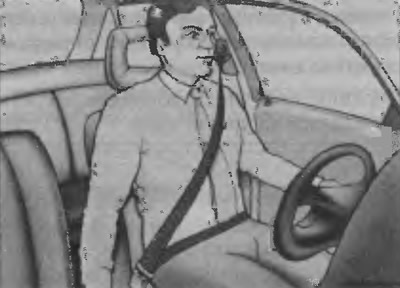
Place the belt over your chest and waist as shown in the picture, insert the fastening eye into the buckle of your seat until it clicks. Check the reliability of the fastening by lightly pulling.
The diagonal belt of the seat belt should pass through the middle of the shoulder, never across the neck, and fit snugly against the body.
In the front seats, the belt and seat height adjuster can be used to adjust the belt to the body size. The transverse belt should always fit snugly against the waist area of the body. If necessary, it can be slightly tightened.
For pregnant women, the waist belt should be as low as possible to avoid putting pressure on the abdomen. Make sure that the belts are not twisted.
When adjusting the front seat backs, do not recline them too far back, as this will weaken the protective function of the seat belts.
The order of unfastening the belts
To do this, press the orange button on the lock with your finger, the bolt will open and the fastening eye will pop out of it under the action of the spring. Holding it lightly, push the belt back - it will automatically retract. Set the head of the fastening device with the eye in a convenient position for hand grip for the next fastening.
Belt height adjuster
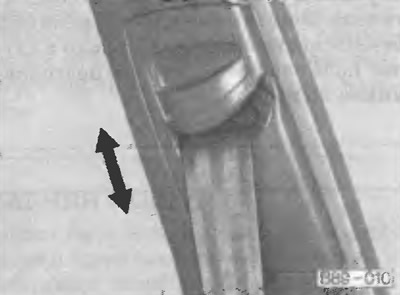
With its help the belt is optimally adjusted to the height. The height is adjusted by moving the clamp up or down, as shown in the picture, and is adjusted to the body so that the belt passes through the middle of the shoulder, and not across the neck. After selecting the appropriate height, check the reliability of the regulator clamp by lightly pulling it.
(The original article is available on the online resource audimanual.ru)