



Do not hold the child on your lap, or allow him or her to stand, kneel, or move around inside the vehicle while it is moving.
If the rear side airbags are deployed, do not allow children to hang out of the child seat toward the doors, otherwise children could be seriously injured if the airbags deploy. Turn off the rear side airbags (the procedure is performed using diagnostic equipment), if it is impossible to supervise a child in the back seat.
All passenger seats in the car are suitable for installation of universal child restraint systems for all age groups. Each group has its own system.
Children under 12 years of age and less than 150 cm in height may only be transported in the rear seat using a suitable restraint system. Otherwise, the risk of injury in an accident increases significantly. If it is not possible to use the rear seats, as an exception, a child restraint system can be installed on the front passenger seat, but the following requirements must be met:
- disable airbags on this side (see below);
- move the seat to its highest position so that the seat belt does not interfere;
- adjust the seat backrest angle to match the child seat backrest.
A deploying airbag can seriously injure a child, even if a child restraint system is used.
When attaching a child seat with a 3-point seat belt, the belt must be secured. To do this, secure the child seat according to the manufacturer's instructions, then fully extend the shoulder section of the belt and allow it to retract until it is completely flush with the child seat. When the belt is retracted, you will hear a characteristic clicking sound. After securing the belt, make sure that it does not come out again. The belt is released when it is fully retracted.
In some trim levels, the vehicle's passenger seats are compatible with the ISOFIX system for attaching child restraints. To attach a child seat using the ISOFIX system, insert it into the receiving slots (In Illustration 9.1) the fixing loops (A), and then insert the child seat levers into them until they lock. After installation, check that the child seat is securely fastened and fits snugly against the back of the standard seat.
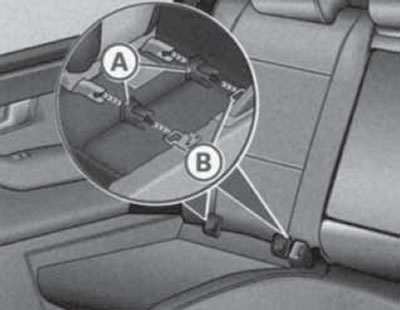 9.1. Diagram of fastening a child seat using the ISOFIX system.
Disabling and enabling airbags
If necessary, you can temporarily disable the front and side airbags of the front passenger, as well as the right rear side airbag. To do this, (in the absence of a corresponding switch) you should contact an Audi representative who has the appropriate diagnostic equipment.
On some models, a key switch is installed in the glove compartment to turn off/on the front and side airbags for the front passenger (see illustration 9.2); disabling the rear side airbags on these models is only possible using diagnostic equipment.
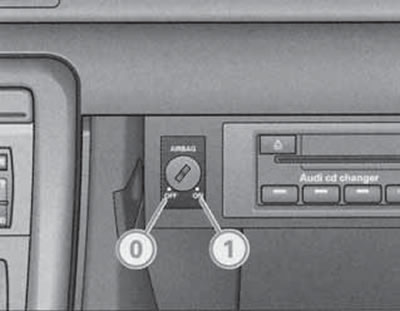 9.2. Front passenger airbag switch.
To deactivate the front passenger airbags, insert the key into the switch and turn it to the "OFF" position, - the indicator lamp "PASSENFER AIRBAG OFF" in the overhead console should light up. After the child restraint system has been removed, the airbags should be turned back on by turning the key in the key switch to the "ON" position - the K/L in the overhead console should go out.
The original version is on the portal AUDIMANUAL.RU