



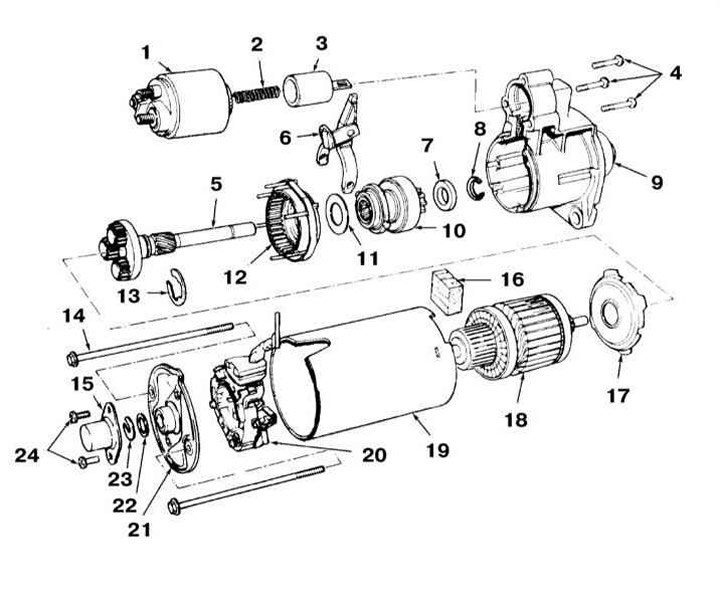
- 1 — Solenoid valve
- 2 - Return spring
- 3 - Anchor
- 4 - Screws
- 5 — Output shaft with planetary gear
- 6 - Working fork
- 7 — Thrust washer
- 8 - C-shaped latch
- 9 — Drive casing
- 10 — Overrunning clutch
- 11 — Spacer
- 12 — Toothed crown
- 13 - Spring ring lock
- 14 - Through bolt
- 15 — Back cover
- 16 - Rubber insert
- 17 — Locking plate
- 18 - Anchor
- 19 — Case with field winding
- 20 — Brush holder
- 21 — Manifold cover
- 22 — Spacer
- 23 - C-Latch
- 24 - Screws
The sole purpose of the engine starting system is to ensure that the engine rotates at a speed sufficient to start it.
The starting system consists of a starter, battery, ignition switch, relay and wiring. The retractor relay is located on the starter housing.
The starter is a DC electric motor with mixed excitation with an electromagnetic traction relay. The starter consists of a housing or stator with excitation windings, an anchor with an overrunning clutch, a cover with brush holders and a traction relay.
When the starter is turned on, current from the battery begins to flow through the winding of the starter traction relay. The relay armature is pulled in and the relay contacts are closed. At the same time, the relay armature moves the overrunning clutch with the gear through the lever. The hub of the overrunning clutch rotates on the helical splines of the starter armature shaft and also rotates the gear, which facilitates its engagement with the flywheel ring gear. Current flows through the closed contacts of the traction relay, feeding the stator and armature windings, and the starter armature begins to rotate together with the hub and overrunning clutch.
After the engine is started, the rotation speed of the pinion exceeds the rotation speed of the starter anchor. In this case, the overrunning clutch rotates freely, and the torque is not transmitted from the engine flywheel to the starter anchor shaft. After releasing the ignition key, the power supply circuit of the traction relay windings through the ignition switch is opened, the anchor of the traction relay is pressed back to its original position by the spring, the relay contacts are opened and the drive pinion disengages from the flywheel ring gear.
The starter with a solenoid relay is located parallel to the engine crankshaft and is fixed to the gearbox.
The starter is engaged only if the AT selector is in position P or N.
If the car is in the security mode, the starter will not turn.
Precautionary measures
When performing any work on the engine starting system, observe the following requirements.
- Do not keep the starter on for a long time. It may overheat and fail. Do not turn on the starter for more than 15 seconds, and wait about two minutes before turning it on again. If you crank the starter for a long time and the engine does not start, unburned fuel accumulates inside the converter. This can lead to overheating of the converter working surface after the engine starts.
- The starter is connected directly to the battery and, if handled carelessly, may catch fire or cause a short circuit.
- Always disconnect the battery ground cable before starting work.
The original article is available on the online resource: AudiManual.ru