



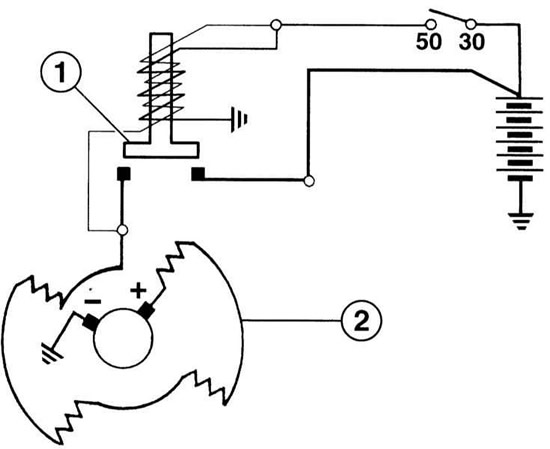
Before performing the test, make sure the battery is fully charged and the anti-theft system is not activated.
If your vehicle has an automatic transmission and the starter does not engage, make sure the selector is in position P or N.
Make sure the battery is fully charged and there is no corrosion on the battery and starter cable terminals and terminals.
If the starter turns but the engine flywheel does not, then the starter overrunning clutch may be faulty (it prevents the bendix from rotating with the engine after starting). In this case, the starter must be repaired or replaced. Another reason for this may be a strong loosening of the starter mounting bolts (the Bendix gear does not engage with the flywheel ring gear).
If when the starter is turned on, its engine does not turn over, but the solenoid relay works (clicks are heard), then either the battery is discharged, or the terminals of the starter relay are oxidized, or the starter is faulty (if the car engine is not seized).
If you cannot hear even the clicks of the starter relay when you turn on the starter, the battery is faulty, the wiring is broken, or the starter relay is faulty.
1. To check the solenoid relay for proper operation, connect the positive terminal of the starter to the small terminal of the solenoid relay. If the starter starts to turn, the solenoid relay is OK and either the ignition switch, wiring, or the automatic transmission selector sensor is faulty (if the selector is in position P or N).
2. If the starter rotates slowly after shorting the terminals, make sure the battery is charged and the cables are securely connected. If the car engine is partially seized or filled with high-viscosity oil, the starter will also rotate slowly.
3. Start the engine and warm it up to operating temperature. Turn off the engine, remove the fuel pump fuse, and disconnect the electrical connectors from the ignition coils.
4. Connect the positive lead of the voltmeter to the positive terminal of the battery and the negative lead to the negative terminal.
5. Turn on the starter and, as soon as the voltmeter readings stabilize, write them down. Do not turn on the starter for more than 15 seconds. If the starter rotation speed is normal and the voltage is more than 10.5 volts, everything is fine. If the voltage is 10.5 volts or higher, and the starter rotation speed is low, the contacts of the retractor relay are burnt, the starter or wiring is faulty. If the voltage is less than 10.5 volts and the starter rotation speed is low, the starter is faulty or the battery is discharged.
[Content source: the specified website: AUDIMANUAL]