



Table of contents: Checking for cleanliness ↓ Drying the brakes ↓ Techniques for working with a… ↓ Wash area and self-service wash… ↓ External body care products ↓ Washing of external body parts ↓ Give your car a good "soak" ↓ Ensure good visibility ↓ Cleaning headlights ↓ Caring for aluminum wheels ↓
Washing cars on the street is currently prohibited in many cities. This has its reasons: often, oil and other substances that harm the environment end up in the sewer along with the water. Another thing is washing a car in an automatic car wash. Usually, a large amount of water is used, so a fairly gentle wash is ensured. Environmental protection is ensured by oil catchers and water preparation units. Usually, automatic units allow you to choose one or another car cleaning program.
Checking for cleanliness
After the automatic car wash, it is necessary to check the cleanliness of the car. Often, the wheel housings, wheel arches and lower edges of the door channels are not treated satisfactorily by the brush. Manual work using a sponge and rag is also required for additional cleaning of the door frames and grooves. In winter, when the water containing salt, which is sprinkled on the roads, settles on the varnish coating, the inside of the wings and the lower outer parts of the body, the car should be washed in a car wash more often. Although the car will be dirty again after a while, rust will not have a chance to settle in critical places. Do not be too careless even in the case of a galvanized body!
Cleaning in an automatic car wash takes less time and is not much more expensive than doing it yourself. However, in some units the rotating brushes do not handle the varnish very carefully, and after washing, some finishing touches still have to be done.
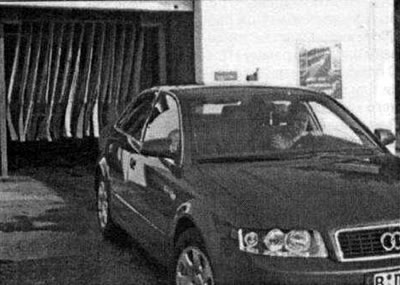
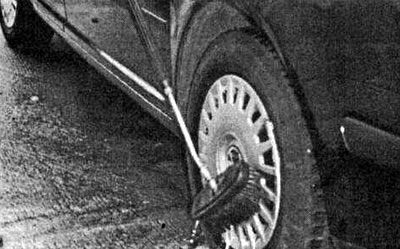
Self-service car washes have various cleaning devices. A special brush can be used to thoroughly clean wheel rims.
Drying the brakes
After each car wash, the brakes must be tested. This evaporates the moisture that gets between the brake discs and brake pads during cleaning. After driving in the rain or through melt water containing road salt, before parking the car in the garage for a few days, the brakes must be dried. To dry the brakes, it is enough to brake slightly several times over the last few hundred meters of the road. Testing the brakes eliminates the phenomenon when, due to moisture or a layer of salt on the brake discs, the brakes begin to operate with some delay.
Techniques for working with a high-pressure cleaning device
The water temperature should not exceed 60°C. Too hot water corrodes the rubber and the anti-corrosion layer protecting the underbody.
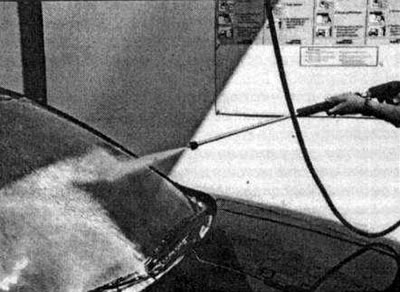
Set the pressure regulator to no more than 30 bar. The distance to the machine should be between 60 and 80 centimeters. If the distance is less and the pressure is too high, there is a risk of damaging the varnish layer.
When washing the engine, water can damage the electronic components of the engine or enter the engine through the intake tract. As a result, serious malfunctions can occur.
Never clean tires with a high-pressure cleaner, as this can damage the sidewall of the tire! Even at a relatively large distance from the cleaner to the tire and with a short exposure time, damage may occur that is not immediately apparent.
The high-pressure cleaner must be handled with care. Follow the rules that are in the self-service washing system!
Wash area and self-service wash station
If you prefer to wash your car yourself, which we recommend, since too frequent use of an automatic car wash with rotating brushes leaves traces of grinding on the paintwork, you can use a car wash platform at a petrol station. A good alternative is a self-service car wash. There you will find various auxiliary equipment from a high-pressure cleaner to a vacuum cleaner. However, before starting work, check the condition of the brushes. Perhaps your predecessor was cleaning the underbody of his car and contaminated the brushes with coarse dirt, which can cause annoying scratches on the paintwork. In addition, do not wash your car in the sun - this is harmful to the paintwork, since small drops of water act as lenses and increase the effect of dust particles and lime during drying.
To wash your car yourself, you will need the following:
- A large amount of water. If dirt is washed off with a small amount of water, then the small grains of dust and sand that penetrate the sponge act like sandpaper when cleaning the varnish coating and leave microscopic scratches in it in the form of a web.
- A hose, preferably with a plastic spray nozzle. If you don't have a water hose, you'll need at least two buckets of water.
- A brush with a hose that allows you to wash away dirt with running water. If you use a suede glove and a sponge, then the end of the hose should be held close to the surface being treated so that a large amount of water falls on it.
- The suede glove or sponge should be dipped into a bucket of water after every second or third stroke, and then wrung out to prevent dirt from getting stuck in the pores of the sponge or the pile of the glove, which could scratch the varnish.
- Wash brush with long handle, this brush is especially suitable for washing rims and wheel covers.
- Large-pore viscose sponge.
- Sponge for removing insect remains.
- A large piece of genuine leather for drying the car.
- Buckets for washing with shampoo (if necessary), and also for washing the skin for wiping glass.
External body care products
Car shampoo. Facilitates the removal of oil residues on the varnish. Wax. Has approximately the same properties as shampoo, in addition, after drying, wax protects the varnish from external influences and thus extends the time until the next polishing.
Wheel rim cleaner. Dissolves caked dust that occurs when brake pads wear out.
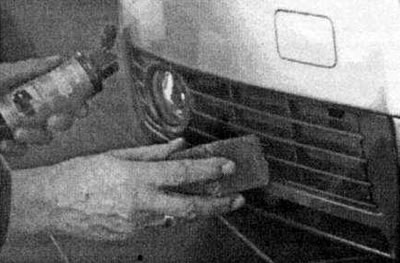
Care product for plastic products Designed specifically for faded parts. Along with components for polymer care, it contains coloring agents. Apply to the surface with a clean sponge, then rub in. After some time, wipe off excess liquid with a damp cloth.
Well-maintained plastic parts make a good impression. Scratches that occur when parking can sometimes be removed with plastic care products.
Washing of external body parts
1. Close all doors and windows. Moisture on upholstery is unpleasant.
2. If necessary, spray the underbody with a steam jet pump or hose. In winter, the underbody parts should be cleaned at every car wash. Once or twice a year, ask a workshop or gas station to lift the car on a platform and check the condition of the underbody protection.
3. Wheel rims need to be cleaned frequently because they get clogged with dust that occurs as a result of the brake pads wearing down. Light metal rims need to be cleaned regularly with water and a small amount of detergent. Aluminum rims are very sensitive to strong detergents. Clean your rims twice a month and they will last longer.
4. Another tip: in order to seal, use spray wax. Dust and dirt cannot penetrate the wax layer. Be careful that the wax does not get on the brake discs or brake pads.
Give your car a good "soak"
5. Spray the car with a hose, the water pressure should be moderate. When working in a self-service car wash with a high-pressure cleaner, select the "Rinse" program.
6. Using a brush and hose, as well as a suede glove or sponge, wash the car first from the roof to the bottom edge of the windows. Then go around the car in a circle.
7. Rub the foam in with circular movements and apply light pressure. Let the foam work for some time.
8. Rinse off the dirty liquid. In the self-service car wash, select the "Rinse" program.
9. On the final pass, clean the wheels using a brush and hose.
10. After washing, immediately clean the car with a chamois. When the water dries, a gray limescale film forms on the varnish coating.
11. Before use, dip the suede in water and then wring it out. Spread the suede on the varnish coating and, stretching it laterally, pull it towards you.
12. Rinse and wring out the suede before each pass. Hard to reach corners (for example, on the wheel housing) dry with a cotton cloth or old dry chamois. Take care of the leather upholstery! Any dirt residue can ruin it.
Ensure good visibility
13. Now move on to the outside of the windows. The approach here is the same as when cleaning the inside. Check the windshield for stone chips, scratches, and cracks.
14. Clean the rubber tongue of the windshield wiper blade with a sponge or dry chamois leather.
15. After washing, check the condition of the varnish coating, headlight glass and front bumper for any unwashed dirt. Insect remains, bird droppings, pollen and tar splashes have an aggressive effect on the varnish and must be removed immediately with a special cleaning agent.
16. Tar remover should not be used on fresh or recently refinished varnish, as the solvent it contains may corrode the varnish layers.
Cleaning headlights
Headlights need to be cleaned more often than the body. Dirt particles on the glass cause the light rays to deflect and be absorbed.
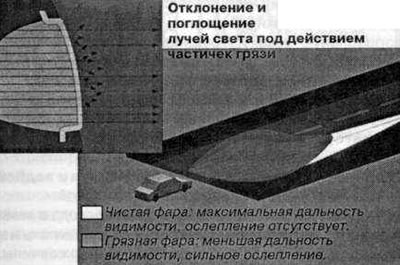
Consequences: Reduced visibility, severe blinding. After just half an hour of driving on a wet road, headlights are more than 60 percent dirty. Because of this, the illumination range is reduced by approximately 35 meters - a distance that may not be enough when braking fully in an emergency situation.
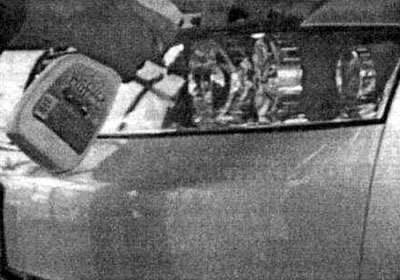
Clean headlights are important for good lighting. A headlight cleaning device does not ensure perfect cleanliness of the headlight lens. In particular, insect remains are best removed with a special agent. Spray the contaminated area (not in the sun), wait a few minutes for the product to work, then rinse it off with water. If there is still something left on the surface, place soaked newspaper on the surface and leave it overnight. The next morning you will see that the remains of the insects have stuck to the paper. To clean glass surfaces, you can use a special sponge for removing insect remains, such sponges can be purchased at gas stations.
Caring for aluminum wheels
Light metal wheels are protected from external influences by a varnish coating. However, if the rims are scratched by curbs or the sides of the wheels are exposed to gravel, even the best varnish will not help. Scratches on the wheels must be removed immediately. These scratches provide an ideal reaction surface for aggressive dust, which is the result of the abrasion of the brake pads. The gray-black products of abrasion leave small holes in the metal. Small scratches and bare spots can be corrected with a special polish.
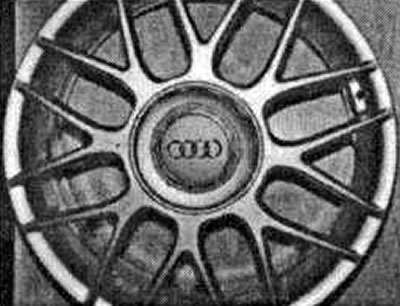
Aluminum wheels are beautiful and impressive. These wheels are protected by a layer of clear varnish, if this layer is damaged, it should be repaired as soon as possible.