



Table of contents: How is the verification carried out? ↓ Troubleshooting the vehicle control… ↓ Self-monitoring of the indicator… ↓ Additional functions on the vehicle… ↓
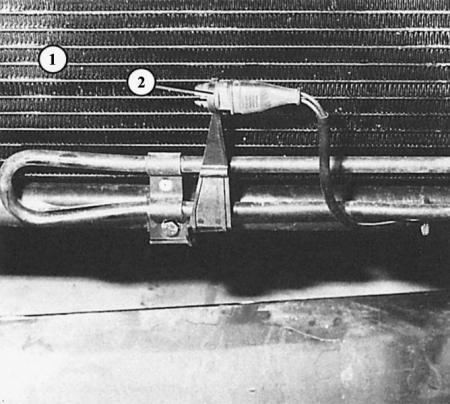
The outside temperature indicator probe (2) is located on the bracket in front of the radiator (1).
On special request, the Audi A4 can be equipped with the so-called automatic vehicle control system. This system controls eight functions and operating states after the ignition and the parking lights or brake lights are switched on. It also carries out control while driving. Thanks to this, the automatic vehicle control system replaces a certain number of traditional control lamps included in the standard equipment.
The fault indicator, the light field of which is located in the middle of the combined instrument, is divided into "hazard indication" and "warning indication" groups.
Defects that reduce the vehicle's safety level or may cause damage are considered a hazard indicator and are illuminated in red in the indicator field. Additionally, the combined instrument panel sounds three times. These are:
Brake system: brake fluid level too low.
Engine oil pressure: engine oil pressure is too low. Measurement methods are the same as traditional oil pressure monitoring (described above).
Coolant: the coolant temperature is above 120°C, or the operating temperature is not reached, or the coolant level is too low.
A yellow warning indicator appears in the light field in combination with a single sound signal. This is:
Brake lights:this symbol appears immediately after the ignition is turned on. When the brake pedal is pressed, the symbol goes out - provided that both brake lights are functioning.
Lighting:the control system cannot perform this check automatically. To check, the driver must first turn on the low beam headlights. The low beam headlights and taillights are checked at the same time. The system, due to its design, cannot show a simultaneous failure of both low beam headlight bulbs or taillights. Although this is an incredible defect.
Battery:the battery symbol lights up if the battery voltage is not within the nominal value of 10.6 to 15.6 V.
Windscreen washer system:this indicator indicates that the fluid level in the windshield washer reservoir is too low.
Fuel tank:the petrol station symbol lights up when there are 12 litres of petrol left in the fuel tank. If there are several faults in the warning indicator area, the symbols light up one after the other while the ignition is on.
"OK" indication should appear when after turning on the ignition and pressing the brake pedal the inscription goes out "Bremslicht" – "brake lights". "OK" means that all items are checked without receiving a signal about the presence of a defect. After a short time, the light symbol disappears.
How is the verification carried out?
To do its job, the vehicle's control system first receives information about the engine's operating condition. This information comes from the ignition/injection control unit (engine speed information), from terminal 50 of the starter (the engine is running) and from terminal 61 of the generator (the engine is running).
The car's lighting control positions operate in a completely different way. These "bulb control devices" operate on an electromagnetic basis and compare the current flow in the wires, for example, to the right and left low beam headlights. If there is no current at all due to a fault in one wire or a defective bulb, the control device detects the difference and sends a signal to the control unit. Of course, there is no difference even in the really rare case where both bulbs are faulty. The control device is powerless against this.
Tip: When connecting the socket for a subsequently installed trailer coupling, it is necessary to take into account that the wires to the rear lights already have a tap from the lamp tester (it is located in the "13-position relay support" in sockets 4 and 5). If the current for the socket is taken from one of the rear lights, then when the trailer lighting is switched on, there are different currents in the lamp tester, and it reports a "lamp defect".
Checking the vehicle control system on your own is only partially possible: first, all sensors are checked; if no defect is found there, then the cause of the malfunction is in the vehicle control system itself.
Troubleshooting the vehicle control system
1. The sensors are checked in the same way as for the indicator lights in a traditional instrument panel.
2. The fluid level sensor, which is installed only in the vehicle's control system, is checked as follows: if the indicator light is on despite the windshield washer fluid reservoir being filled, disconnect the wire connector on the water pump. If the indicator light now goes out, the sensor in the water pump is faulty.
3. You must have the combined front and rear lamp indicator (mounting position: "13-way relay support", sockets 4 and 5) checked by a workshop.
4. The vehicle control system is a structural element of the combined instrument equipped in this way. If defective, it must be replaced with a new instrument. Another possibility: in some cases, workshops can help.
Self-monitoring of the indicator module
1. With the ignition on and the car stationary (or moving at a speed of max. 5 km/h) press the button at the bottom left of the combination instrument.
2. All indicator symbols are polled in turn if the indicator and the system are in order.
3. The survey is not possible if there is a danger indication.
Additional functions on the vehicle control system indicator field
Speed Warning:after storing the current speed, the vehicle control system notifies you by displaying a symbol and sounding a signal if this speed is significantly exceeded. This information is stored in the memory until the ignition is turned off, unless a different speed is stored in the memory or the existing information is erased (hold down the button on the left for about 1 second.). It is possible to remember two speeds.
Radio frequency indicator: if the indicator field is not occupied by information coming from the vehicle control system, it shows the set radio frequency if the Audi radio is equipped accordingly. In addition, the indicator field informs about stereo reception or the inserted audio cassette (track). If there are radio stations with Radio Data System signals, "RDS" appears on the indicator.
Instructions to the driver:when the warning indicator flashes, you can receive instructions from the display on what to do at that moment. To do this, press the button on the bottom left next to the vehicle control system display, then a written message appears: after the signal about insufficient oil level, there should be, for example, the text "Motor abstellen, olstand prufen" – "Turn off the engine, check the oil level."