



Table of contents: General recommendations ↓ Diagonal lap seat belts with… ↓
Attention! Seat belts must be fastened before each trip, including in the city. This also applies to passengers in the back seats.
General recommendations
- The belt tape must not be twisted.
- Never use the same belt to secure two people at the same time. It is especially dangerous to place the belt over a child sitting on your lap.
- The belt strap should not press on hard or fragile objects located in the pockets (glasses, pens, bunches of keys, smoking pipes, etc.), as this may cause injury.
- Layered, loose clothing (for example, a coat over a jacket) restricts movement and reduces the effect of seat belts.
- The belt tape must not be caught or rubbed against sharp edges.
- The belt buckle must only be inserted into the buckle slot intended for the corresponding seat.
- The lock socket must not be filled with paper or debris.
- The belt tape must be kept clean, as heavy contamination may disrupt the operation of the automatic belt retraction system.
- Damaged seat belts, as well as those stretched as a result of an emergency activation, must be replaced. At the same time, the belt fastenings should also be checked.
Diagonal lap seat belts with automatic retractor
Belts with an automatic retractor provide, with smooth operation of the tensioner, complete freedom of movement. However, under heavy braking they are blocked.
The automatic system also locks the belts when the car accelerates, when driving in mountainous terrain and when turning.
In the event of a frontal collision at high speed, the front seat belts are automatically tensioned.
Fastening
Grasp the belt buckle, smoothly pull the belt strap, place it over the chest and waist, then insert the buckle into the buckle slot near the seat and secure it. Make sure the buckle is locked.
The diagonal strap of the belt should pass approximately through the middle of the shoulder, fitting snugly against the figure, but in no case encircling the neck.
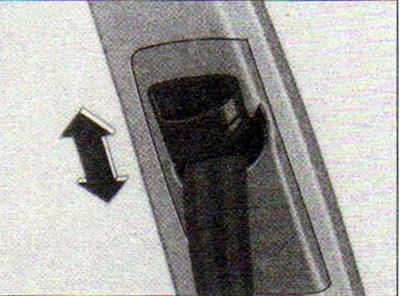
On the front seats, the fastened seat belt webbing can be adjusted to the occupant's body using the seat height adjustment or the belt's vertical adjustment.
The backrests of the front seats must not be reclined too far back, as this may result in the protective effect of the seat belts being lost.
The horizontal strap of the belt should always fit snugly against the waist. If necessary, it can be tightened slightly.
Height adjustment of seat belts
The front seat belts can be adjusted to suit the occupant's body shape by moving the buckle.
Unfastening the belts
The belt buckle is released by pressing the orange button of the lock with your finger. The buckle then pops out of the socket under the action of the spring.
To facilitate the operation of the automatic system that retracts the belt tape, the clasp should be pulled back by hand. In this case, a plastic button embedded in the belt tape helps to hold the clasp in a position convenient for gripping.
Lap seat belt
The middle rear seats are equipped with lap-type seat belts.
The belt should always fit snugly around the waist.
Manually adjustable waist belt
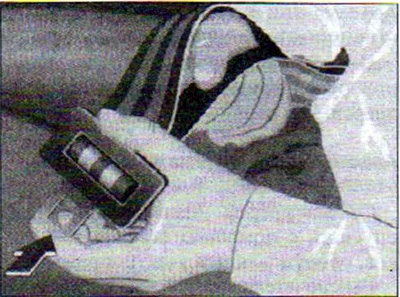
To lengthen the belt, hold the clasp at a right angle to the belt and pull it through the buckle to the desired length.
Adjusting the belt is made easier if the clasp together with the buckle is compressed in the longitudinal direction, as shown in the illustration.
To shorten the belt, simply pull on its free end.
Excessive belt length is compensated by moving the movable plastic buckle.
For safety reasons, the waist belt buckle should always be kept engaged with the buckle when not in use.
Waist belt with automatic retractor
To fasten the belt, it is pulled out with a continuous movement, and its clasp is inserted into the socket of the corresponding lock and snaps into place.
Note: The belt can only be pulled out if the tape has been completely retracted by the retractor.
To release the belt, press the orange button on the belt buckle and allow the strap to enter the retractor.
Passive safety system procon-ten
To increase the level of protection for the driver and front seat passenger wearing seat belts, the car is equipped with the procon-tcn passive safety system.
In a severe frontal collision, even seat belts cannot protect against the head hitting the steering wheel or instrument panel. For this reason, AUDI has developed a safety system that, depending on the force of the collision, moves the steering wheel away from the driver towards the engine compartment at the moment of impact. At the same time, additional tension is applied to the seat belts on the front seats. The procon-ten system uses the rearward displacement of the power unit that occurs in a frontal collision. This displacement is used to move the steering wheel away from the driver using steel cables and increase the tension of the seat belts.
[The article is a reprint of material from «AUDIMANUAL.RU»]