Table of contents: Checking functionality ↓ Adjustment ↓
Checking functionality
With the vehicle parked on its wheels, quickly press the brake pedal all the way down and release it. The regulator drive lever should move.
Adjustment
The pressure regulator adjustment must be performed on a loaded vehicle, standing on its wheels, with a full fuel tank. In this case, an assistant must take the driver's seat.
A more precise check of the performance and adjustment of the pressure regulator is performed using two high-pressure gauges with a scale of 0-160 kg/cm² with fittings and hoses.
The VW 1310 control device used for this purpose consists of two pressure gauges, each of which has a bleed screw and the readings of which can be observed from the driver's seat.
"Squeeze" the rear suspension several times.
Hang the car out.
Disconnect the hoses from the brake mechanisms of the left front and right rear wheels. Unscrew the fittings for bleeding the brake hydraulic drive from the wheel cylinders and screw in the fittings of the hoses of the control pressure gauges instead.
Bleed air from both hoses through the pressure gauge bleed screws.
Press the brake pedal several times until the pressure gauge connected to the front wheel brake mechanism shows a pressure of at least 100 kg/cm². In this case, the readings of the pressure gauge connected to the rear wheel brake mechanism should be within 50 - 63 kg/cm² on cars up to the 1985 model year, and 54.0 - 71.5 kg/cm² on cars from the 1985 model year.
Press the brake pedal several times until the pressure gauge connected to the front wheel brake mechanism shows a pressure of at least 50 kg/cm². At the same time, the readings of the pressure gauge connected to the rear wheel brake mechanism should be within 31.5 - 39.0 kg/cm² on cars up to the 1985 model year, and 32.5 - 42.5 kg/cm² on cars from the 1985 model year.
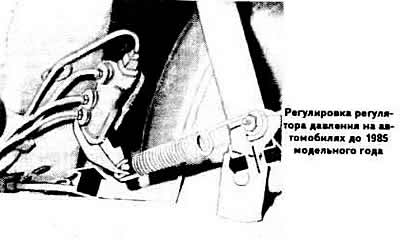
Adjust the tension of the pressure regulator spring by moving its end in the oval hole at the attachment point on the rear suspension beam, depending on the measurement results: if the pressure in the rear wheel brake mechanism is increased, loosen the spring, and vice versa.
If the measured pressure in the rear wheel brake mechanism is not within the specified limits, replace the pressure regulator.
Disconnect the control pressure gauges and remove air from the brake hydraulic system.
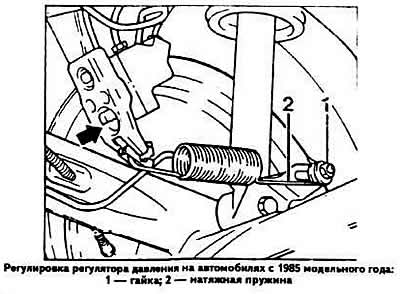
Note: On vehicles from the 1985 model year onwards, the pressure regulator can also be adjusted as follows:
- check the brake fluid level and bring it up to standard. Bleed the brake hydraulic system to remove air;
- install the car on a lift;
- raise the car so that the rear wheels are off the floor;
- move the pressure regulator drive lever all the way to the side opposite to the direction of movement;
- loosen nut 1 (see picture);
- attach tension spring 2 to the pressure regulator and plastic roller so that there is no slack;
- tighten nut 1 to 2.5 kgf·m.