



Table of contents: Removal ↓ Installation ↓
A battery is a device for storing energy in chemical form that can be used as electricity.
A battery works because two different metals, when placed in an acidic solution, generate electricity.
A battery is 100% efficient at 27°C. At -18°C, the efficiency of the same battery drops to 40%. Now, to start the engine, you need more than twice as much energy as you needed at 27°C.
Starting power (starting amperes) shows the ability of a battery to start a vehicle in very cold weather conditions. It shows the amount of amperes the battery can produce for 30 seconds at -18°C without the voltage dropping below 7.2V (minimum level required for reliable starting). The higher this figure, the greater the starting power of the battery.
The reserve capacity indicates the length of time in minutes that the battery supplies 25 amps at 27°C. This factor represents the time that the battery supplies all accessories in the vehicle at night and in bad weather conditions with a faulty alternator.
In winter conditions at -18°C and below, the battery will charge poorly due to the increase in internal resistance. During short trips in winter, the energy expended by the battery for starting is not compensated. As a result, the battery wears out, constantly discharges and eventually fails.
During the summer months, after long journeys, the engine becomes very hot and often difficult to restart. These "hot starts" sometimes require as much power as in cold weather, or more. This is especially true for high-compression, large-displacement engines and cars with air conditioning. This again highlights the importance of choosing the right battery for the car's engine.
The vehicle is equipped at the factory with a maintenance-free battery, which requires no maintenance other than keeping the case and terminals clean. To clean the terminals, disconnect them from the battery and clean them with a wire brush. Heavily oxidized terminals should be treated with a solution of bicarbonate of soda, applied with a toothbrush. Do not allow the solution to get inside the battery. Before connecting the battery clamps, lubricate the terminals with Vaseline or anti-corrosion compound.
When replacing the battery, only a modern battery model with centralized gas removal should be used.
If the design of the battery includes ventilation plugs, it is necessary to ensure that they are protected from water splashes by a plastic cover
The battery is located behind the engine compartment bulkhead, under the windshield. To access the battery, you need to remove the air grille.
Removal
Attention
- When the battery terminals are disconnected, the memory units of the control units erase the data on the recorded faults, so before disconnecting the battery terminals, it is advisable to contact a specialized workshop to recall the faults recorded in the memory. After connecting the battery terminal, it is necessary to activate and reprogram the electric windows, as well as the position of the rear-view mirrors and seats.
- Also, if the car has a radio receiver with a code, before disconnecting the terminals from the battery, check that you have the code to reactivate the receiver. Otherwise, the radio receiver can only be put into operation at a specialized station.
Turn off the ignition.
Open the hood.
Remove the air grille.
Loosen the bolt, remove the negative (-) terminal from the battery and move it to the side (Fig. 14.7).
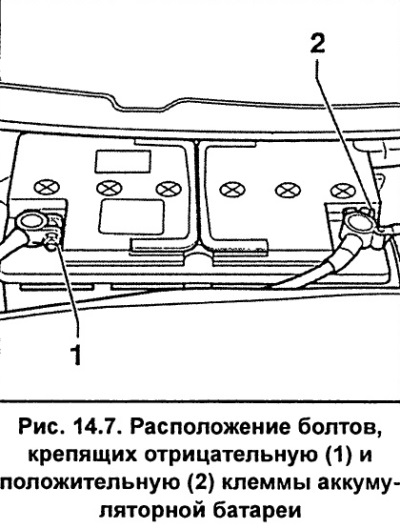
Loosen the bolt and remove the positive (+) terminal from the battery (see fig. 14.7).
At the bottom of the battery, unscrew bolt 3 (Fig. 14.8) and remove plate 2 securing battery 3.
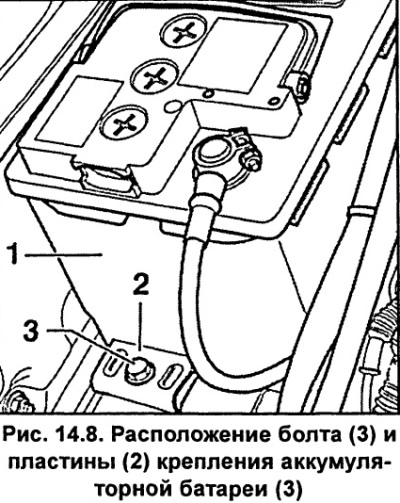
Move the battery to the side, which will release the fastening on the other side of the battery, and remove the battery.
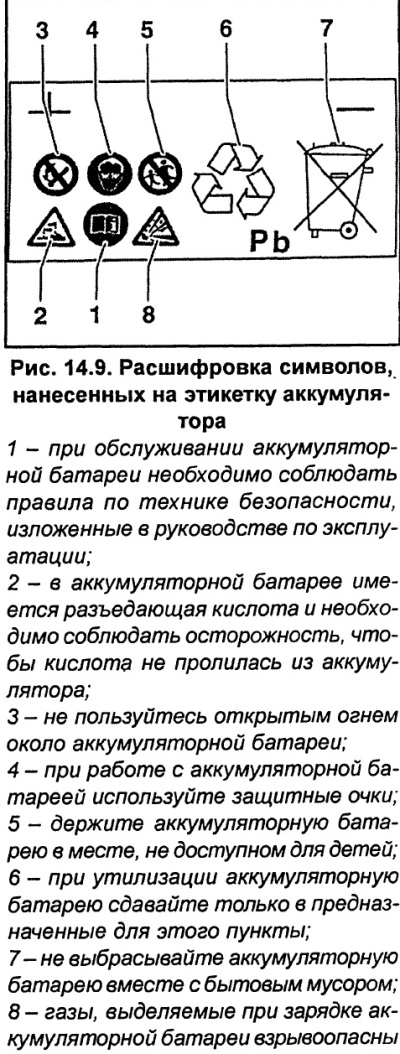
There is a sticker with warning symbols on the battery (see fig. 14.9).
Installation
Caution: When installing the battery, do not pinch the hose designed to remove gases released during battery operation. The gas outlet pipe has a valve that protects the battery from backfire.
Install the battery.
Secure the battery with plate 2 (Fig. 14.8) and screw in bolt 3, tightening it to a torque of 15 Nm. Check that the battery is securely secured by trying to move it to the left or right, otherwise the battery life may be significantly reduced.
Check that the hose designed to remove gases released during battery operation is not pinched.
Connect the positive terminal to the battery first, then the negative terminal, and secure them by tightening the mounting nuts to a torque of 6 Nm.
Attention: Before starting the engine for the first time, turn on the ignition for 10 seconds. As a result, the engine regulator is activated.
If your vehicle has a radio with a code, reprogram it.
Set the time on the clock.
Activate the power windows:
1. Press the window switch and lift the window up until it stops.
2. Press the window switch again and hold it in this position for at least one second.
Safety instructions
- When the engine is running, the battery must not be disconnected, otherwise the electronic devices of the electrical system will be damaged.
- Never short-circuit the battery terminals directly, this means the positive (+) and negative (-) terminals cannot be connected. When short-circuited, the battery becomes very hot and may burst or explode.
- Do not tilt the battery, as electrolyte may spill out of the ventilation holes. If electrolyte gets into your eyes, rinse your eyes immediately with clean water for several minutes. Then consult a doctor immediately. If electrolyte gets on your skin or clothes, neutralize the acid with alkaline soap immediately and rinse the affected area with plenty of clean water.
- The electrolyte is very aggressive. When servicing the battery, use protective gloves and glasses.
- When charging batteries, an explosive gas mixture is released.
- When working with wires and electrical devices, it is prohibited to use fire, sparking devices, open fire-hazardous lighting devices, and smoking. Sparking should be avoided when handling wires and electrical devices.
- Before carrying out any work on the vehicle's electrical system, disconnect the negative cable from the battery. When replacing incandescent bulbs, simply turn off the corresponding switches.
- To protect the battery case from ultraviolet radiation, do not store the battery in direct daylight.