



Table of contents: Removal ↓ Installation ↓
Removal
Caution! If the brake pads are to be reinstalled for further use, they must be marked before removal. Switching the pads from the right wheel to the left and vice versa or switching the outer and inner pads is not allowed. Be sure to change all brake pad linings at the same time, even if only one of them has reached the wear limit.
1. Mark the position of the rear wheels on the hub with paint. This will allow you to install the balanced wheel in its original position during assembly.
2. Loosen the wheel mounting bolts. The vehicle must be standing on its wheels when performing this operation.
3. Place the car on jack stands, unscrew the bolts and remove the rear wheels.
4. Unscrew the lower and upper caliper mounting bolts, holding the guide pins with a wrench to prevent them from turning (see illustration).
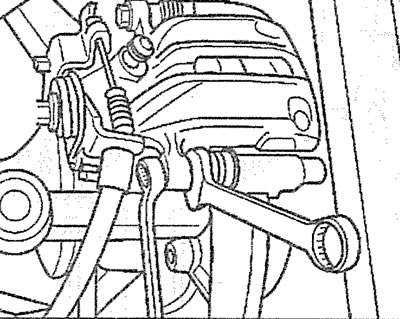
6.4. Unscrew the lower and upper caliper mounting bolts, holding the guide pins with a wrench to prevent them from turning
5. Remove the caliper and, without disconnecting the brake hose, secure it to the body. Secure the caliper to the body so as not to stretch the brake hose under the weight of the caliper.
6. Remove the brake pads from the guide.
Installation
Caution! When the brake pads are removed, do not press the brake pedal. In this case, pressing the pedal will force the piston out of the brake cylinder. If the piston does come out of the cylinder, remove the caliper and deliver it and the piston to a workshop for repair.
7. Clean (degrease) the brake pad seating and guide surfaces in the caliper with a cloth soaked in alcohol. Do not use solvents containing mineral oils or tools with sharp edges.
Caution: Use only alcohol to clean the brake mechanism.
8. Before installing the pads, check the brake disc for ribbing by running your hand over it. Brake discs with a ribbing surface should be replaced with new ones.
9. Measure the thickness of the brake disc. Replace the disc whose residual thickness has reached the minimum permissible thickness, see the relevant chapter.
10. Check the condition of the brake cylinder piston protective cap. Replace a damaged or cracked cap immediately, because dirt penetrating through a damaged cap quickly leads to caliper depressurization. In this case, the brake caliper must be removed and delivered to a workshop for overhaul.
Caution! When the piston is pressed, brake fluid is squeezed out of the wheel brake cylinder into the expansion tank. Monitor the brake fluid level in the expansion tank and remove it if necessary to prevent it from spilling out.
Attention! To extract brake fluid from the expansion tank, use a siphon or a plastic bottle that is not destroyed by the brake fluid. Do not use regular drinking water bottles! Brake fluid is poisonous and should never be sucked out by mouth through a hose. Use a siphon. And after replacing the brake pads, the brake fluid level in the tank should not exceed the maximum mark, because it expands when heated. The leaking brake fluid flows down the master cylinder, destroys its protective varnish layer and causes corrosion.
11. Screw the piston into the wheel cylinder cavity using the special device AUDI-3272 until it stops. The protrusion on the rod of the device (see arrow in illustration) should fit snugly against the caliper. Screw in the piston by turning the rod of the device to the right by the handle. If the piston enters with difficulty, then when screwing in the piston, turn the rod of the device by the flats with a wrench.
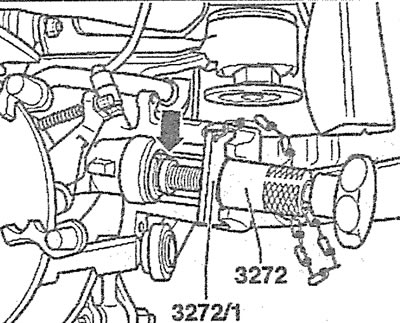
6.11. Screw the piston into the cylinder using the special tool AUDI-3272
Attention! The piston of the rear wheel brake cylinder must not be pressed in using a special pressing device or a wooden hammer handle. This will damage the parking brake mechanism. When removing and installing the brake pads or disassembling the wheel cylinder, keep in mind that the cylinder has a device for adjusting the working clearance between the brake pads and the piston. The main element of the device is a threaded regulator, along which the piston rod moves as the brake pads wear, thereby maintaining the required clearance between the brake pads and the piston. As the brake pads wear out, at a certain point the rod does not reach the cylinder piston. The clearance adjustment device prevents this situation by "lengthening" the rod as needed. For this reason, when replacing worn brake linings with new ones, the piston of the wheel cylinder cannot simply be pressed into its original position. It is pressed out using rotational movements.
If you do not have a special tool for screwing in the piston, turn a rectangular rod to the required size and insert it into the grooves on the brake cylinder piston, then screw the piston into the cylinder, pressing on it.
12. Install both new brake pads into the guide (see arrows in the illustration), removing the protective foil.
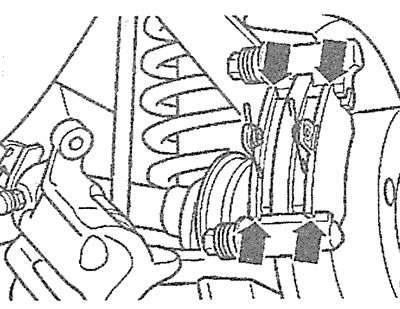
6.12 Install both new brake pads into the guide (see arrows)
13. Reinstall the caliper and secure it with new self-locking bolts to a tightening torque of 35 Nm, holding the guide pins from turning.
Please note: The repair kit includes four self-locking hex head bolts, which are designed to replace the old caliper mounting bolts.
14. Install the rear wheels in accordance with the marks made during removal.
15. Screw in the wheel mounting bolts and lower the vehicle onto its wheels.
16. Tighten the bolts crosswise to 120 Nm. Caution! Press the brake pedal all the way down several times until you feel a strong resistance to pressing. This action centers the brake pads and they self-adjust to the working position.
17. Check the brake fluid level in the expansion tank. If necessary, top up the fluid to the maximum mark.
18. Adjust the parking brake (see the relevant chapter).
Attention! Make sure that:
- brake hoses are securely connected and fixed in the holders;
- the brake fluid bleed nipples are tightened and capped;
- there is sufficient brake fluid in the expansion tank.
19. Start the engine and check the brake system for leaks. To do this, press the brake pedal with a force of 200-300 N (20-30 kg) and hold it for about 10 seconds. The pressure in the system and, accordingly, the resistance of the brake pedal, should not decrease. Check all connections for leaks.
20. Test drive and break in the new brake pads. To do this, brake several times, bringing the speed from about 80 km/h to 40 km/h and pressing the brake pedal lightly. Let the brakes cool down in between.
Attention! New brake pads must be worked in. Therefore, until the mileage of at least 200 km with new brake pads, avoid unnecessary braking until the car comes to a complete stop.