



Table of contents: General information ↓ Preparatory operations ↓
General information
Note: This chapter describes the most typical and important engine maintenance and repair procedures, excluding procedures that require special skills and tools (for example, engine overhaul), - these works should be entrusted to car service specialists. The location of the engine number depends on its type:
- on 4-cylinder SOHC gasoline engines - to the left of the connection to the transmission (see illustration 1.1a);
- on 4-cylinder 5-valve petrol engines 1.8T, 2.0 and 2.0TFSI - on the left side of the cylinder block, as well as on the sticker on the timing belt cover (see illustrations 1.1b and 1.1c);
- on petrol engines V6 3.0 l - front top on the cylinder block (to access it is necessary to remove the vacuum actuators of the intake manifold adjustment), and also on the sticker on the timing belt cover (see illustration 1.1d);
- on V6 3.2 l petrol engines - on the inside of the cylinder block on the left (see illustration 1.1e);
- on 4-cylinder TDI diesel engines - on the left side of the cylinder block, as well as on a sticker on the timing belt cover (see illustration 1.1f);
- on V6 2.5 TDI diesel engines - on the inside of the cylinder block (on the right between the head and the injection pump), and also on the sticker on the timing belt cover (see illustration 1.1g);
- on diesel engines V6 3.0 TDI - on the cylinder block at the front (see illustration 1.1h);
- on V8 petrol engines (models S4 and RS4) - on the cylinder block (see illustrations 1.H and 1.1J).

1.1a. Designation and number of 4-cylinder SOHC gasoline engines

1.1b. Designation and number of 4-cylinder 5-valve petrol engines 1.8T and 2.0 (MPI)

1.1c. Designation and number of 4-cylinder petrol engines 2.0 TFSI

1.1d. Designation and number of petrol engines 3.0 V6

1.1e. Designation and number of petrol engines 3.2 V6
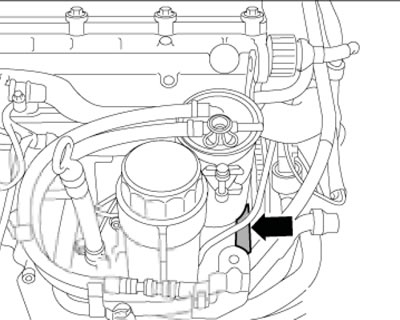
1.1f. Designation and number of 4-cylinder TDI diesel engines

1.1g. Designation and number of diesel engines V6 2.5 TDI

1.1h. Designation and number of diesel engines V6 3.0 TDI

1.1i. Designation and number of V8 4.2 petrol engines (S4 models)

1.1j. Designation and number of petrol engines V8 4.2 (rS4 models)
Due to the large number of engine variants that can be installed on the Audi A4 B6 models and the limited volume of the manual, this chapter covers in detail only some of the more popular engine models: petrol 1.8T, 2.0 MPI and 2.0 TFSI, as well as diesel 1.9 TDI-PD, 2.0 TDI-PD (SOHC and DOHC). For 1.6 l, 3.0 l and 3.2 l petrol engines and 2.7/3.0 l TDI-CR diesel engines, only illustrations are provided to explain their design. For 4.2 l petrol engines (models S4 and RS4) only Specification data are presented.
The 1.6-litre petrol engine with two valves per cylinder (code ALZ) features variable intake manifold geometry, an air mixing system and an EGR system.
The 1.8-litre petrol engine with five valves per cylinder (code BFB) features turbocharging, variable valve timing and an air mixing system.
The 2.0-litre petrol engine with five valves per cylinder (code ALT) features a variable valve timing unit and variable intake manifold geometry.
2.0L petrol engines with four valves per cylinder (codes BPG, BPJ, BUL, BWE, BWT, BYK) the distinctive features include turbocharging, direct fuel injection and a variable valve timing unit; variable geometry of the intake manifold is not used.
The 3.0L petrol engine with five valves per cylinder (code BBJ) features variable valve timing for intake and exhaust, variable intake manifold geometry and an air mixing system.
Petrol engines 3.2 l with four valves per cylinder (aUK and VKN codes) the distinctive features include direct fuel injection and a variable valve timing unit for intake and exhaust; turbocharging, variable intake manifold geometry and air mixing systems are not used.
4.2L petrol engines (S4 models) with five valves per cylinder (bVK and BHF codes) its distinctive features include a variable valve timing unit, variable geometry intake manifold and an air mixing system; turbocharging is not used.
Petrol engine 4.2 l (rS4 models) with four valves per cylinder (code BNS) features direct fuel injection, variable valve timing unit for intake and exhaust, variable geometry intake manifold and air mixing system; turbocharging is not used.
The 1.9 and 2.0 l TDI-PD diesel engines with two valves per cylinder feature a pump-nozzle injection system, turbocharging with intercooler and an EGR system. Engines with BPW and BRB codes are additionally equipped with a particulate filter.
The 2.0 l TDI-PD diesel engines with four valves per cylinder feature a pump-nozzle injection system, turbocharging with intercooler and an EGR system. Engines with the BRD and BVA codes are additionally equipped with a particulate filter; on engines with BRE and BRF codes it is possible to install a diesel particulate filter.
The 2.7 and 3.0 l TDI-CR diesel engines with four valves per cylinder feature a fuel injection system with a fuel distribution line, turbocharging with an intercooler and an EGR system as distinctive features. A particulate filter is additionally installed on the 2.7 engines; on 3.0 l engines it is possible to install a diesel particulate filter.
Preparatory operations
Before performing any engine maintenance procedures, clean the engine compartment and the outer surfaces of the power unit using a special solvent. This treatment will prevent dirt from getting inside the engine.
If necessary, depending on the nature of the work to be done, the hood can be removed to provide free access to the components to be serviced (see Chapter 11). To avoid accidental damage to the paintwork, cover the car fenders with special covers or old blankets.
Excessive engine oil consumption can be considered a signal that it is necessary to check the condition of the piston rings, valve stem seals and/or valve guides. Naturally, first of all, you should make sure that the oil loss is not associated with the development of its external leaks. Check the compression in the cylinders (see Section 2) to determine the general condition of the engine.
Loss of power, loss of RPM stability, excessive valve noise and increased fuel consumption are usually fairly common signs that an engine overhaul is needed, especially when all of these factors occur simultaneously. If performing a full range of adjustments does not help to eliminate the problems, the only way out is to perform general mechanical work to restore the engine.
Major repairs of the power unit involve restoring all its operating parameters to the level typical of a new engine. During a major repair, piston rings are replaced and cylinder mirrors are restored (turning and/or honing). Usually, the main and connecting rod bearings of the crankshaft are replaced; if necessary, its journals can be turned and restored. Valve maintenance is mandatory; their condition at the time of the need for a major overhaul of the engine almost certainly leaves much to be desired. In parallel with the general overhaul of the power unit, a restorative overhaul of the starter and generator is usually also carried out.
Note: Critical cooling system components such as hoses, drive belt and thermostat must be replaced with new ones during engine overhaul. In addition, the condition of the radiator should be carefully checked (see Chapter 1 and 3). If signs of leaks or obstruction are detected, the radiator should be replaced. Don't forget to check the condition of the oil pump. Major engine repairs do not require high professional training from the performer, but they take quite a lot of time. You should plan to stop using the car for at least two weeks, especially if you need to seek help from a mechanical workshop to perform certain repairs.
Most of the work can be done using a standard set of metalworking tools, but some of the tests to determine the suitability of individual components for further use require the use of precision measuring equipment. In doubtful situations, seek help from service station specialists.
Note: Do not forget that the decisive factor in the question of the advisability of performing a major overhaul of the engine is the condition of its cylinder block. It is often cheaper and more reliable to replace a worn engine with a reconditioned one.
In conclusion, it can be noted that all efforts to perform refurbishment of worn components will be wasted if the requirement of cleanliness during engine assembly is neglected.
(Content source: the specified website: AUDImanual.ru)