



In the case of a Tiptronic gearbox, the most important components of the automatic transmission include the torque converter, planetary gear and hydraulic and/or electronic control unit. The planetary gear forms the mechanical part of the automatic transmission, it is shifted by means of clutches and brakes without interrupting the power flow. Rotating parts are held back by a band or disc brake. The torque converter transmits torque from the engine to the gearbox, and when starting off it serves as a hydraulic clutch. In the Multitronic gearbox, which includes a variator with a disc chain (see Technical Dictionary — "The principle of operation of the variator"), the need for a torque converter is eliminated.
It is impossible to imagine an automatic transmission without extensive use of electronics today. The automatic transmission has a control unit that constantly exchanges data with the engine control unit. The latter provides data on engine speed, fuel consumption and throttle position. Other values important for regulating the automatic transmission come from the anti-lock braking system control unit (for the drive wheel traction control system), gear selector and various sensors that are located in the gearbox.
Torque converter
Between the planetary gear and the engine is a torque converter, which transmits the engine torque to the gearbox using fluid for torque converters. To do this, the engine drives a pump wheel, which is located in the torque converter. The fluid, through the so-called reactor, presses on the turbine wheel connected to the gearbox, and the turbine wheel starts to move.
There is always a certain difference between the speeds of the pump and turbine wheels. This difference is greatest when starting off, and it decreases more and more as the speed increases. Thus, there is always a certain amount of slippage. At high speeds, only about 85 percent of the engine torque is transmitted - this explains the higher fuel consumption compared to manual transmissions.
To eliminate this drawback, automatic transmissions are equipped with a clutch to lock the torque converter. This clutch has some similarities with a conventional clutch disc: when the clutch is engaged, the friction lining is pressed against the cover of the torque converter, on the other side the clutch is connected to the primary shaft of the gearbox by means of teeth with geometric closure. The gear pump for ATF fluid is driven by a torque converter.
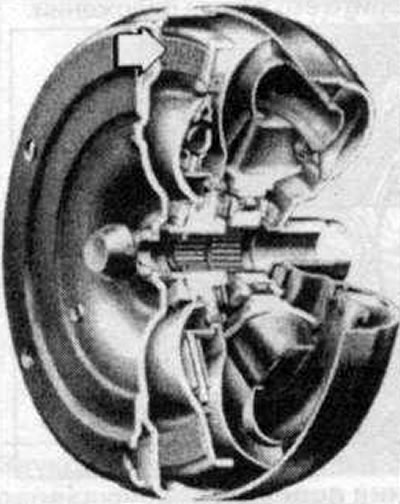
The section of the torque converter shows the blades of the pump wheel and the reactor. The arrow shows the friction lining of the clutch for locking the torque converter, which at high speeds - except in the case of cold fluid - switches to a rigid through drive to avoid slipping
Sensors
Gearbox input speed sensor. The control unit uses this signal to regulate the gear shifting process as smoothly as possible. If this sensor fails, the gearbox operates in accordance with the emergency program.
Gearbox shaft speed sensor. This sensor provides information about the speed of movement. It determines which gear is engaged, as well as the pressure in the control system when shifting gears. If the sensor fails, the emergency mode starts to operate.
Accelerator pedal limit position sensor. If the driver presses the accelerator pedal all the way down, the gearbox shifts down one or two gears, and then down another gear. If the driver holds the pedal to the floor for a long time, the air conditioner turns off, this is done to increase the available engine power. If this sensor fails, the control unit receives the corresponding data from the throttle position sensor.
Brake light switch. If the brake pedal is pressed while parked, the control unit disengages the selector lock. If the pedal is pressed while driving, the computer assumes that the vehicle is moving downhill and downshifts.
Transmission oil temperature sensor. If the oil temperature rises above 120'C, the torque converter lock-up is triggered earlier.
Signal from the anti-lock braking and traction control system control unit. If traction control is activated, the automatic transmission shifts less frequently and the shift points are shifted.
Signals from the engine control unit engine speed, fuel consumption and throttle position. All this information is used to calculate the optimal shift point. If the connection is interrupted, the gearbox starts to operate in emergency mode.
Emergency program
In the event of failure of the most important sensors, the control unit switches to the emergency program. The emergency mode is used to ensure the safety of the vehicle in the event of a malfunction without significantly reducing its driving performance, and to protect the gearbox from damage. The car can be used, but in this case it is necessary to contact a workshop as soon as possible. In emergency mode, the power is removed from all electromagnetic valves of the gearbox, with the help of springs the valves are returned to their original position. Forward movement is possible only in fourth gear. Reverse gear continues to function, but the clutch for locking the torque converter does not engage. In such a situation, it is necessary to monitor the gear indicator on the speedometer: if all segments are lit, the control unit is still active. If all segments are not lit, the control unit is not functioning. In this case, the selector lock is not activated.